


- Home
- A-Z Catalogue
- Products
- Valves
- Cetop
- Manual Directional Valves
- Proportional Valves
- Poppet Valves
- High-Speed Linear Servo Valves
- All High-Speed Linear Servo Valves
- Cetop 10 (NG32) Two Stage Type High Speed Linear Servo Valves – LSVHG-10
- Cetop 10 (NG32) Two Stage Type High Speed Linear Servo Valves – LSVHG-10 (With Fail-Safe)
- Cetop 8 (NG25) Two Stage Type High Speed Linear Servo Valves – LSVHG-06
- Cetop 8 (NG25) Two Stage Type High Speed Linear Servo Valves – LSVHG-06 (With Fail-Safe)
- Cetop 7 (NG16) Two Stage Type High Speed Linear Servo Valves – LSVHG-04
- Cetop 7 (NG16) Two Stage Type High Speed Linear Servo Valves – LSVHG-04 (With Fail-Safe)
- Cetop 5 (NG10) Direct Type High Speed Linear Servo Valves – LSVG-03
- Cetop 5 (NG10) OBE Type Direct Operated Linear Servo Valves – LSVG-03-EH
- Cetop 3 (NG6) OBE Type Direct Operated Linear Servo Valves – LSVG-01-EH
- Pumps
- Pressure control
- Flow Control Valves
- Pressure Control Valves
- All Pressure Control Valves
- Brake Valves
- Direct Relief Valve
- Low Noise Solenoid Controlled Relief Valves
- Low Noise Pilot Operated Relief Valves
- Pilot Operated Relief Valves
- Pressure reducing and relieving valves
- Pressure reducing and check valves
- Pressure control valves
- Remote Control Relief Valves
- Solenoid Controlled Relief Valves – BSG
- Solenoid Controlled Relief Valves – BST
- Unloading relief valves
- Check valves
- Environmental
- Valves
- Hydraulic Systems
- Power pack
- About Us
- Contact
- Blog

How to Choose the Right Anchor Drill Rig for Your Project
Choosing an Anchor Drill Rig is a ground decision before it is a purchasing decision. The right machine must match the anchor design, drilling method, access limits, and expected geology. A rig that looks powerful in a brochure may struggle on a narrow hillside track or in fractured rock. Small details matter: mast clearance beneath overhead lines, space to handle drill rods, and room for a support vehicle can shape the whole operation.
For this guide, drilling specialist Daniel Mercer offers this practical reminder: “Match the rig to the ground, the anchor, and the site—not just the depth on the plan.” This is an editorially composed field maxim, not a verified published quotation. Treat it as a prompt to check assumptions with qualified equipment suppliers and geotechnical professionals. Their experience can help connect design requirements with real site conditions.
The sections ahead compare rig types, drilling methods, power, mobility, and support needs. They also consider budget, maintenance, operator familiarity, and safety features. These factors rarely point to one perfect machine. A compact rig may reach a restricted slope, yet work more slowly in hard strata. A larger rig may drill efficiently but need access the site cannot provide. That trade-off deserves a hard look. Project data can also be incomplete, and early estimates may miss changing ground conditions. Use the selection process to identify uncertainties, ask specific questions, and confirm that the chosen Anchor Drill Rig suits the work—not merely the specification sheet.
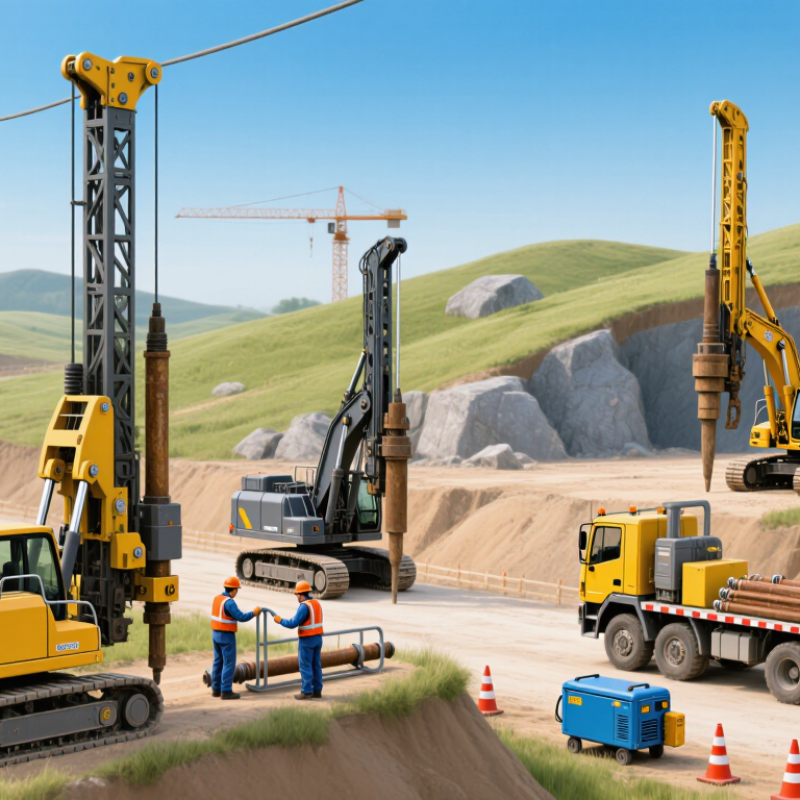
Table of Contents [Hide]
Understand Anchor Drill Rig Types and Their Applications
How to Choose the Right Anchor Drill Rig for Your Project
Understand Anchor Drill Rig Types and Their Applications
Anchor drill rigs are selected by ground conditions, hole depth, access, and required accuracy. Rotary-percussive top-hammer rigs suit many shallow-to-medium holes in fractured rock. Down-the-hole hammer rigs can maintain useful penetration in harder rock and deeper holes. Rotary rigs with casing systems are often better in loose soil, where borehole walls may collapse. The right method matters. A crawler rig may reach a steep slope, while a compact rig can fit beside a basement wall. Neither choice is automatically best.
The Federal Highway Administration’s Ground Anchors and Anchored Systems manual (GEC No. 4, 1999) describes proof testing at up to 1.33 times the design load for many anchors. This is a useful reminder: the rig must produce a borehole that supports reliable installation and testing, not just fast drilling. Check the planned anchor length, casing needs, water conditions, and working clearance before comparing rigs. A tidy specification sheet can still mislead.
Tips: Ask the contractor how the rig handles your actual soil or rock profile. Confirm rod and casing availability, mast reach, and setup space. If conditions vary sharply across the site, allow for a test hole; the first assumption may be wrong.





