


- Home
- A-Z Catalogue
- Products
- Valves
- Cetop
- Manual Directional Valves
- Proportional Valves
- Poppet Valves
- High-Speed Linear Servo Valves
- All High-Speed Linear Servo Valves
- Cetop 10 (NG32) Two Stage Type High Speed Linear Servo Valves – LSVHG-10
- Cetop 10 (NG32) Two Stage Type High Speed Linear Servo Valves – LSVHG-10 (With Fail-Safe)
- Cetop 8 (NG25) Two Stage Type High Speed Linear Servo Valves – LSVHG-06
- Cetop 8 (NG25) Two Stage Type High Speed Linear Servo Valves – LSVHG-06 (With Fail-Safe)
- Cetop 7 (NG16) Two Stage Type High Speed Linear Servo Valves – LSVHG-04
- Cetop 7 (NG16) Two Stage Type High Speed Linear Servo Valves – LSVHG-04 (With Fail-Safe)
- Cetop 5 (NG10) Direct Type High Speed Linear Servo Valves – LSVG-03
- Cetop 5 (NG10) OBE Type Direct Operated Linear Servo Valves – LSVG-03-EH
- Cetop 3 (NG6) OBE Type Direct Operated Linear Servo Valves – LSVG-01-EH
- Pumps
- Pressure control
- Flow Control Valves
- Pressure Control Valves
- All Pressure Control Valves
- Brake Valves
- Direct Relief Valve
- Low Noise Solenoid Controlled Relief Valves
- Low Noise Pilot Operated Relief Valves
- Pilot Operated Relief Valves
- Pressure reducing and relieving valves
- Pressure reducing and check valves
- Pressure control valves
- Remote Control Relief Valves
- Solenoid Controlled Relief Valves – BSG
- Solenoid Controlled Relief Valves – BST
- Unloading relief valves
- Check valves
- Environmental
- Valves
- Hydraulic Systems
- Power pack
- About Us
- Contact
- Blog

How to Choose the Best Well Drilling Equipment?
Choosing the best Well Drilling Equipment begins with the ground, not the catalog. Rock hardness, clay content, water depth, borehole diameter, and access conditions shape every decision. A compact rotary rig may suit a residential site. A heavy-duty mud rotary system may perform better in unstable sand. Air drilling can work efficiently in hard, dry formations, but it may struggle with fractured ground and water inflow.
Well-drilling educator Robert L. Bowen expressed a practical principle: “The driller must adapt the method to the formation, not force the formation to fit the method.” That idea remains valuable today. Equipment should match the geology, project scale, crew skills, maintenance capacity, and local environmental requirements. Specifications alone do not guarantee success.
Experienced contractors inspect the mast, compressor output, pump pressure, drill rods, and safety controls before mobilization. They also check transport routes and working space. A machine that looks powerful on paper may become a poor choice beside a narrow rural road. Small details matter.
The “best” option is rarely the most expensive one. It is the system that delivers stable progress, clean samples, controlled energy use, and dependable service. Yet even careful planning has limits. Subsurface conditions can change within a few meters. A promising survey may still miss a difficult layer.
This guide examines the main equipment types, selection criteria, operating costs, and common mistakes. It encourages practical judgment, verified data, and advice from qualified drilling professionals.
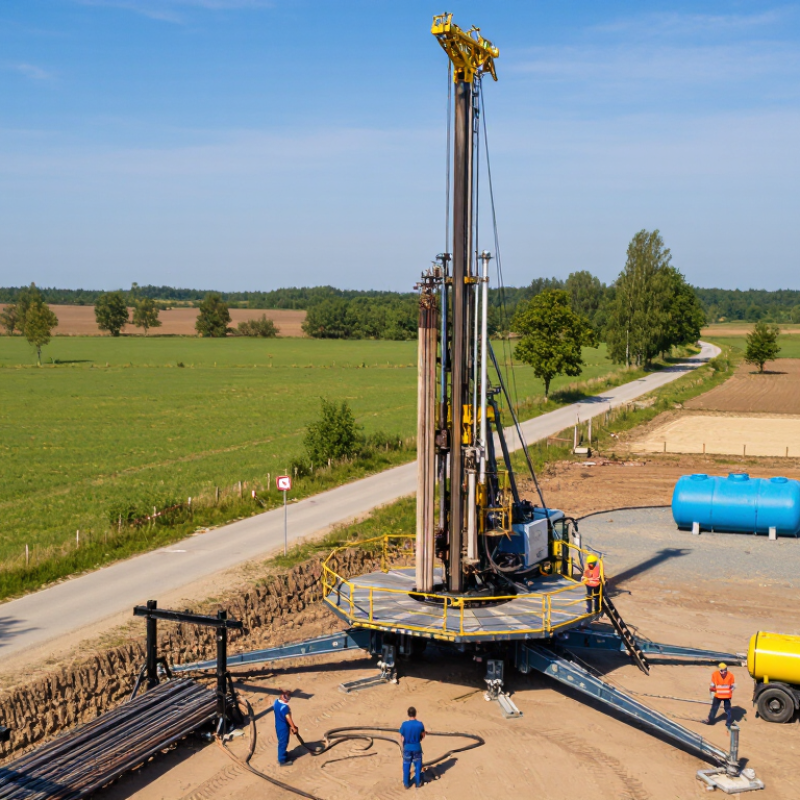
Table of Contents [Hide]
Define Well Drilling Requirements and Site Conditions
How to Choose the Best Well Drilling Equipment?
Defining well drilling requirements should come before comparing equipment. Identify the planned depth, borehole diameter, casing size, and expected water yield. Soil and rock conditions matter just as much. Loose sand may require continuous casing support, while hard rock demands suitable rotary or percussion capability. Ask for a site investigation report when available. Do not rely only on nearby wells.
Check access conditions carefully. Measure the road width, turning space, overhead clearance, and working platform strength. A powerful rig is useless if it cannot reach the location safely. Note nearby buildings, buried utilities, drainage paths, and seasonal flooding risks. Groundwater protection rules may also affect drilling methods and temporary storage.
Equipment selection should match the full drilling plan, not one impressive specification. Review torque, pullback force, pump capacity, mast height, and air requirements. Confirm that tools and replacement parts are available locally. Experienced contractors also inspect noise, dust, fuel use, and operator visibility. Small details affect daily productivity.
I once saw a project choose equipment from depth ratings alone. The machine reached the target depth, but soft ground caused repeated wall collapse. The original plan looked reasonable. It was not complete. Site data can be uncertain, especially before drilling begins. Leave room for changing tools, casing methods, and drilling fluids. A careful plan still needs practical judgment at the rig.





