


- Home
- A-Z Catalogue
- Products
- Valves
- Cetop
- Manual Directional Valves
- Proportional Valves
- Poppet Valves
- High-Speed Linear Servo Valves
- All High-Speed Linear Servo Valves
- Cetop 10 (NG32) Two Stage Type High Speed Linear Servo Valves – LSVHG-10
- Cetop 10 (NG32) Two Stage Type High Speed Linear Servo Valves – LSVHG-10 (With Fail-Safe)
- Cetop 8 (NG25) Two Stage Type High Speed Linear Servo Valves – LSVHG-06
- Cetop 8 (NG25) Two Stage Type High Speed Linear Servo Valves – LSVHG-06 (With Fail-Safe)
- Cetop 7 (NG16) Two Stage Type High Speed Linear Servo Valves – LSVHG-04
- Cetop 7 (NG16) Two Stage Type High Speed Linear Servo Valves – LSVHG-04 (With Fail-Safe)
- Cetop 5 (NG10) Direct Type High Speed Linear Servo Valves – LSVG-03
- Cetop 5 (NG10) OBE Type Direct Operated Linear Servo Valves – LSVG-03-EH
- Cetop 3 (NG6) OBE Type Direct Operated Linear Servo Valves – LSVG-01-EH
- Pumps
- Pressure control
- Flow Control Valves
- Pressure Control Valves
- All Pressure Control Valves
- Brake Valves
- Direct Relief Valve
- Low Noise Solenoid Controlled Relief Valves
- Low Noise Pilot Operated Relief Valves
- Pilot Operated Relief Valves
- Pressure reducing and relieving valves
- Pressure reducing and check valves
- Pressure control valves
- Remote Control Relief Valves
- Solenoid Controlled Relief Valves – BSG
- Solenoid Controlled Relief Valves – BST
- Unloading relief valves
- Check valves
- Environmental
- Valves
- Hydraulic Systems
- Power pack
- About Us
- Contact
- Blog

How to Choose the Best UAV Camera Gimbal?
Choosing the right Uav Camera Gimbal is not simply a matter of buying the highest-resolution payload. Stability, sensor weight, aircraft compatibility, weather resistance, and operating objectives must work together. A gimbal that performs smoothly during a calm test flight may struggle beside buildings, over water, or under sudden wind. That sounds simple. It is not.
Industry data shows why this decision deserves careful attention. Grand View Research reported strong growth in the global unmanned aerial vehicle market, supported by inspection, mapping, public safety, and media applications. Drone Industry Insights also identifies commercial services as a major force behind professional drone adoption. These reports do not prove that every expensive gimbal is better. They show a wider shift toward reliable, repeatable aerial data. Therefore, buyers should evaluate usable results, not impressive specifications alone.
This guide examines the practical factors behind a dependable Uav Camera Gimbal. It considers three-axis stabilization, payload balance, vibration control, optical zoom, thermal imaging, transmission latency, and software integration. For example, a bridge inspector may need sharp details from a stationary hover, while a filmmaker may prioritize smooth movement and accurate horizon control. Experience in the field often reveals uncomfortable truths: heavier cameras reduce flight time, and advanced sensors can increase setup complexity. A low-cost model may be enough for occasional documentation, but it can become a false economy when footage must support engineering decisions. The best choice depends on the mission, aircraft, environment, and operator skill. Even this framework has limits, because specifications rarely predict performance in every real-world condition.
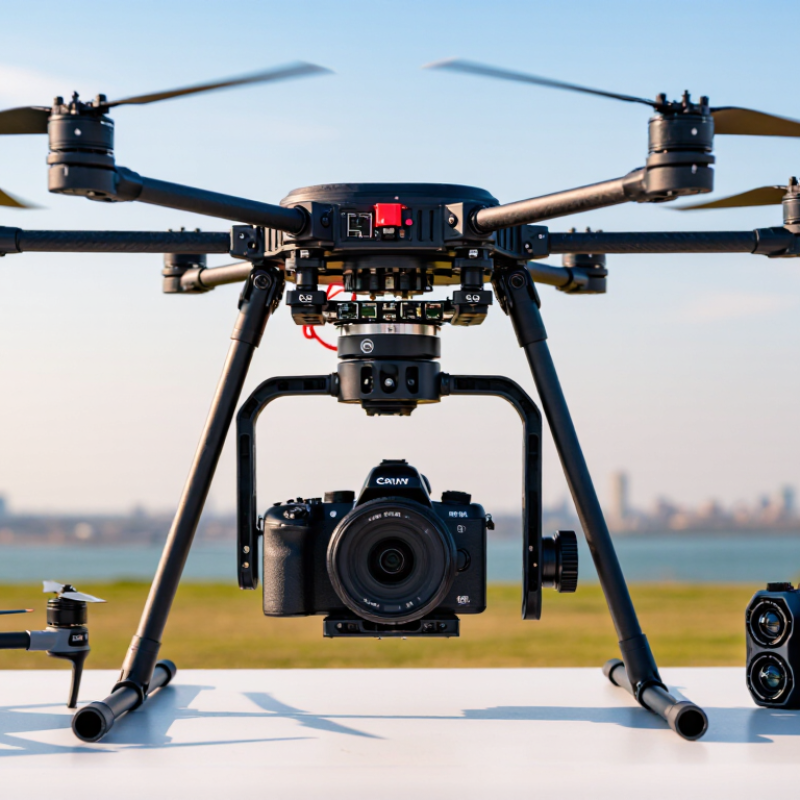
Table of Contents [Hide]
Define UAV Camera Gimbal Types and Core Stabilization Functions
How to Choose the Best UAV Camera Gimbal?
A UAV camera gimbal is more than a rotating camera mount. It controls vibration, motion, and viewing direction during flight. The main types are fixed mounts, two-axis gimbals, and three-axis gimbals. Fixed mounts suit stable, forward-facing surveys. Two-axis systems correct pitch and roll. Three-axis models also control yaw, keeping footage steady during turns. Start with the mission.
The Drone Industry Insights 2024 report identifies inspection, mapping, and surveying as major commercial UAV applications. These tasks demand different stabilization levels. Mapping often needs precise nadir alignment, while inspection requires smooth side movement. The FAA’s 2024–2028 forecast indicates that the U.S. commercial small-UAS fleet may approach one million aircraft by 2028. That growth increases demand for reliable imaging systems, not merely higher resolution.
Core functions include inertial measurement, brushless motor control, vibration isolation, horizon correction, and remote angle adjustment. A strong IMU reacts quickly, but excessive correction can create small jitters. I have found that payload balance matters as much as motor strength. Check camera weight, lens position, operating temperature, response latency, and power consumption. Keep it practical. A lighter two-axis gimbal may outperform a heavier three-axis unit on a compact aircraft. Weather sealing and emergency lock modes also deserve attention, although manufacturers sometimes describe them too broadly. Test real footage in wind. Laboratory smoothness is not always field stability.
How to Choose the Best UAV Camera Gimbal? - Define UAV Camera Gimbal Types and Core Stabilization Functions
| Gimbal Type | Typical Axis Configuration | Primary Stabilization Function | Typical UAV Application | Main Advantages | Main Limitations | Recommended Selection Criteria |
|---|---|---|---|---|---|---|
| 2-Axis Gimbal | Pitch and roll | Compensates for forward/backward and side-to-side aircraft movement. | Basic aerial photography, mapping, inspection, and lightweight UAVs. | Lower weight, reduced power consumption, and simpler integration. | Yaw movement is not actively stabilized, so heading changes may appear in footage. | Choose when payload weight, endurance, and cost are more important than maximum image smoothness. |
| 3-Axis Gimbal | Pitch, roll, and yaw | Stabilizes tilt, lateral movement, and rotational heading changes. | Professional imaging, surveying, public safety, cinematic capture, and detailed inspection. | Provides the most complete mechanical stabilization and smoother footage during turns. | Higher mass, power demand, mechanical complexity, and purchase cost. | Choose when stable imagery, precise pointing, and high-quality video are essential. |
| Fixed-Mount Camera | No active stabilization axis | Relies on aircraft control, electronic stabilization, or post-processing. | Entry-level imaging, low-cost monitoring, and applications with limited motion. | Very low weight, low power consumption, and minimal maintenance. | More sensitive to vibration, wind, aircraft attitude changes, and rapid maneuvers. | Choose only when image stability is not mission-critical or the UAV has strong electronic stabilization. |
| Single-Sensor Gimbal | Usually 2-axis or 3-axis | Stabilizes one optical or thermal imaging sensor. | Photography, visual inspection, agriculture, construction, and infrastructure surveys. | Compact design, simpler calibration, and efficient payload integration. | Cannot provide simultaneous data from multiple sensing modalities. | Match the gimbal to the sensor's mass, center of gravity, lens size, and connector requirements. |
| Multi-Sensor Gimbal | Usually 3-axis | Stabilizes multiple aligned sensors, such as visible-light, thermal, or low-light cameras. | Search and rescue, firefighting support, security observation, and complex inspection. | Combines complementary data and reduces the need for separate flights. | Greater payload mass, higher power demand, more complex alignment, and increased cost. | Confirm UAV payload capacity, available power, data bandwidth, and sensor alignment accuracy. |
| Hybrid Mechanical-Electronic Gimbal | Mechanical axes with electronic image stabilization | Uses motors and inertial stabilization together with digital correction of residual vibration. | High-quality video, inspection in turbulent air, and demanding mobile imaging. | Can improve smoothness and reduce small high-frequency disturbances. | Digital correction can crop the image and may reduce the effective field of view. | Check crop factor, processing latency, stabilization modes, and compatibility with the recording resolution. |
Core UAV Camera Gimbal Stabilization Functions
| Function | What It Does | Why It Matters | What to Check Before Purchase |
|---|---|---|---|
| Inertial Measurement | Uses gyroscopes and accelerometers to detect angular movement and acceleration. | Provides the motion data required for rapid stabilization corrections. | Sensor update rate, calibration process, and resistance to vibration or magnetic interference. |
| Brushless Motor Control | Adjusts motor torque to counter unwanted camera movement around each supported axis. | Determines stabilization response, smoothness, and holding strength. | Motor payload rating, operating temperature, noise, response speed, and overload protection. |
| Horizon Control | Maintains a level image horizon while the UAV rolls or changes direction. | Improves visual quality and measurement consistency. | Horizon accuracy, drift correction, and available calibration or trim settings. |
| Remote Tilt Control | Allows the operator or flight controller to change the camera's vertical viewing angle. | Supports ground observation, target tracking, mapping, and inspection from different angles. | Control range, command latency, movement speed, and compatibility with the UAV control system. |
| Yaw and Heading Modes | Provides follow, lock, or coordinated heading behavior during aircraft movement. | Helps maintain a predictable viewing direction and smooth panning. | Available operating modes, maximum rotation speed, heading reference, and control priority. |
| Vibration Isolation | Uses dampers or isolation mounts to reduce high-frequency vibration transferred from motors and propellers. | Reduces rolling-shutter artifacts, image shake, and sensor measurement errors. | Isolation material, resonance range, mounting method, and ease of damper replacement. |
| Auto Calibration | Automatically establishes neutral position, motor balance, and sensor reference values. | Shortens setup time and helps maintain consistent performance after installation. | Calibration procedure, software access, stored profiles, and balancing requirements. |
| Payload and Center-of-Gravity Adjustment | Supports correct mechanical balance for cameras and sensor assemblies. | Reduces motor strain, power consumption, and stabilization error. | Maximum payload, mounting pattern, adjustable plates, lens clearance, and balance range. |
Practical Selection Checklist





