


- Home
- A-Z Catalogue
- Products
- Valves
- Cetop
- Manual Directional Valves
- Proportional Valves
- Poppet Valves
- High-Speed Linear Servo Valves
- All High-Speed Linear Servo Valves
- Cetop 10 (NG32) Two Stage Type High Speed Linear Servo Valves – LSVHG-10
- Cetop 10 (NG32) Two Stage Type High Speed Linear Servo Valves – LSVHG-10 (With Fail-Safe)
- Cetop 8 (NG25) Two Stage Type High Speed Linear Servo Valves – LSVHG-06
- Cetop 8 (NG25) Two Stage Type High Speed Linear Servo Valves – LSVHG-06 (With Fail-Safe)
- Cetop 7 (NG16) Two Stage Type High Speed Linear Servo Valves – LSVHG-04
- Cetop 7 (NG16) Two Stage Type High Speed Linear Servo Valves – LSVHG-04 (With Fail-Safe)
- Cetop 5 (NG10) Direct Type High Speed Linear Servo Valves – LSVG-03
- Cetop 5 (NG10) OBE Type Direct Operated Linear Servo Valves – LSVG-03-EH
- Cetop 3 (NG6) OBE Type Direct Operated Linear Servo Valves – LSVG-01-EH
- Pumps
- Pressure control
- Flow Control Valves
- Pressure Control Valves
- All Pressure Control Valves
- Brake Valves
- Direct Relief Valve
- Low Noise Solenoid Controlled Relief Valves
- Low Noise Pilot Operated Relief Valves
- Pilot Operated Relief Valves
- Pressure reducing and relieving valves
- Pressure reducing and check valves
- Pressure control valves
- Remote Control Relief Valves
- Solenoid Controlled Relief Valves – BSG
- Solenoid Controlled Relief Valves – BST
- Unloading relief valves
- Check valves
- Environmental
- Valves
- Hydraulic Systems
- Power pack
- About Us
- Contact
- Blog

How to Choose the Best T Beam Welding Line?
Choosing a T beam welding line is not just a matter of comparing prices or advertised speed. The right system must match your beam dimensions, plate thicknesses, production volume, and required weld quality. A line built for long, repetitive runs may not suit a shop handling frequent custom orders. Fit matters.
Start by measuring the beams you actually produce, including their length, flange width, and web thickness. Then examine how the line handles positioning, tack welding, and continuous welding. Ask how quickly operators can change settings between jobs. Check the space required for loading and unloading, too. A machine may fit the floor plan on paper but leave little room for safe material handling. Small details count.
A T beam welding line should also be judged by its controls, inspection process, maintenance needs, and access to technical support. Request a production trial using representative workpieces, not an ideal sample selected for a demonstration. Watch the joint alignment and finished weld closely. Ask what happens when parts vary slightly. Real parts are rarely perfect.
A hypothetical welding-automation specialist, Elena Brooks, captures the decision this way: “A good line fits the beam, the weld, and the workday—not just the brochure.” Treat that as a practical principle, not a substitute for independent testing. This guide explores the key selection criteria, common trade-offs, and questions worth asking suppliers. Some choices will remain uncertain until you test them in your own shop. That is worth admitting.
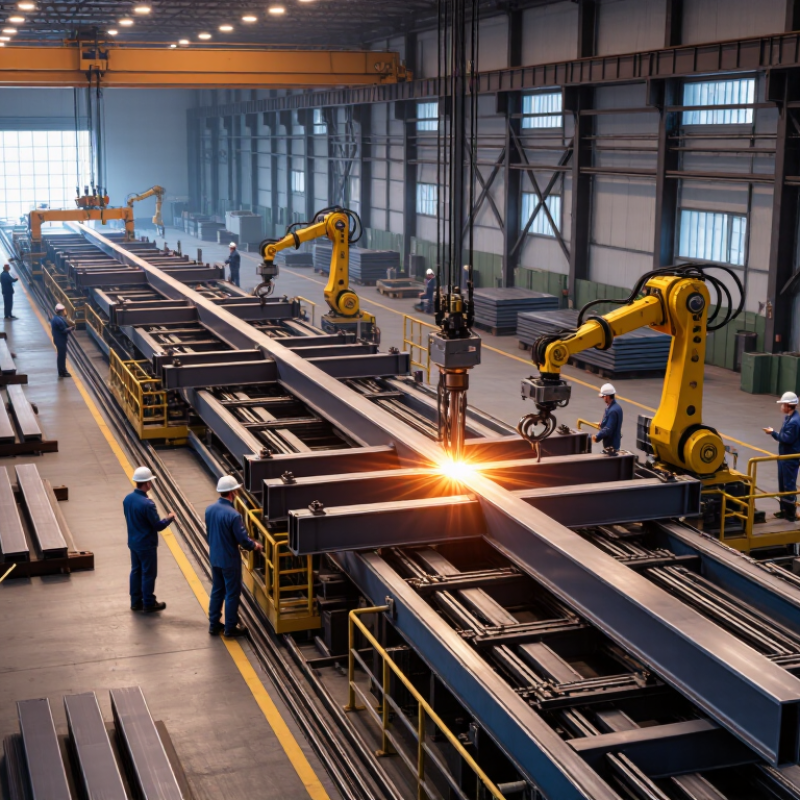
Table of Contents [Hide]
Understanding the Structure and Purpose of a T-Beam Welding Line
A T-beam welding line brings several tasks into one coordinated process. Its core components typically include web and flange positioning units, clamps, welding heads, conveyors, and straightening equipment. The web stands between two flanges, forming the familiar T-shaped cross-section. Accurate alignment matters: even a small gap or tilt can affect the finished beam. The line holds the pieces in place, welds their joints, and moves the assembly through each stage. That matters. A steady sequence can reduce repeated manual handling and help produce more consistent welds.
The line’s purpose is not just speed. It must keep the web centered, maintain suitable contact between parts, and manage heat that may cause distortion. Some systems use automated feeding and welding; others require operators to set positions or inspect the work between stages. A useful choice depends on beam dimensions, expected production volume, available floor space, and how much adjustment different jobs require. More automation is not always better. A line that handles one size very well may be awkward when dimensions change. Check how adjustments are made, how accessible the welding area is, and whether straightening can address the distortion your process actually encounters.
Tips: Ask for a demonstration using a beam close to your typical size. Watch the fit-up before welding, not only the finished seam. Confirm what measurements and maintenance checks operators must perform. Specifications help, but real setup time can be easy to overlook.





