


- Home
- A-Z Catalogue
- Products
- Valves
- Cetop
- Manual Directional Valves
- Proportional Valves
- Poppet Valves
- High-Speed Linear Servo Valves
- All High-Speed Linear Servo Valves
- Cetop 10 (NG32) Two Stage Type High Speed Linear Servo Valves – LSVHG-10
- Cetop 10 (NG32) Two Stage Type High Speed Linear Servo Valves – LSVHG-10 (With Fail-Safe)
- Cetop 8 (NG25) Two Stage Type High Speed Linear Servo Valves – LSVHG-06
- Cetop 8 (NG25) Two Stage Type High Speed Linear Servo Valves – LSVHG-06 (With Fail-Safe)
- Cetop 7 (NG16) Two Stage Type High Speed Linear Servo Valves – LSVHG-04
- Cetop 7 (NG16) Two Stage Type High Speed Linear Servo Valves – LSVHG-04 (With Fail-Safe)
- Cetop 5 (NG10) Direct Type High Speed Linear Servo Valves – LSVG-03
- Cetop 5 (NG10) OBE Type Direct Operated Linear Servo Valves – LSVG-03-EH
- Cetop 3 (NG6) OBE Type Direct Operated Linear Servo Valves – LSVG-01-EH
- Pumps
- Pressure control
- Flow Control Valves
- Pressure Control Valves
- All Pressure Control Valves
- Brake Valves
- Direct Relief Valve
- Low Noise Solenoid Controlled Relief Valves
- Low Noise Pilot Operated Relief Valves
- Pilot Operated Relief Valves
- Pressure reducing and relieving valves
- Pressure reducing and check valves
- Pressure control valves
- Remote Control Relief Valves
- Solenoid Controlled Relief Valves – BSG
- Solenoid Controlled Relief Valves – BST
- Unloading relief valves
- Check valves
- Environmental
- Valves
- Hydraulic Systems
- Power pack
- About Us
- Contact
- Blog

How to Choose the Best Metal Detector for Biscuits?
Choosing the right Metal Detector for Biscuits requires more than comparing prices, detection ranges, or attractive equipment photos. Biscuit production creates practical challenges. Products may be dry, warm, salty, or coated with chocolate. Each condition can influence signal stability and inspection accuracy.
Dr. Martin Keller, a food-inspection engineer with experience in baked-goods production, explains: “The best detector is not the most sensitive on paper; it is the one that performs reliably during real production.” This principle deserves attention. A machine that performs perfectly during a showroom demonstration may struggle beside a hot oven or vibrating conveyor.
Look closely at the product’s size, packaging, moisture level, and production speed. Test the detector using certified ferrous, non-ferrous, and stainless-steel test pieces. These checks should happen at the actual line speed. They should also reflect the largest biscuit format and the most challenging packaging.
Consider aperture size carefully. A smaller opening can improve performance, but it may restrict future production changes. Reject systems also matter. A clean, controlled air blast can remove a contaminated product without disturbing nearby biscuits. Poorly adjusted rejection can create waste, confusion, and uncomfortable questions during audits.
HACCP records, automatic test routines, stainless-steel construction, and easy belt cleaning support dependable operation. Yet no machine removes every production risk. I have seen specifications look impressive while maintenance access was inconvenient. That detail is easy to miss.
The best Metal Detector for Biscuits fits the product, line, cleaning routine, and quality culture. Choose based on verified trials, not promises alone. Production reality is often less tidy.
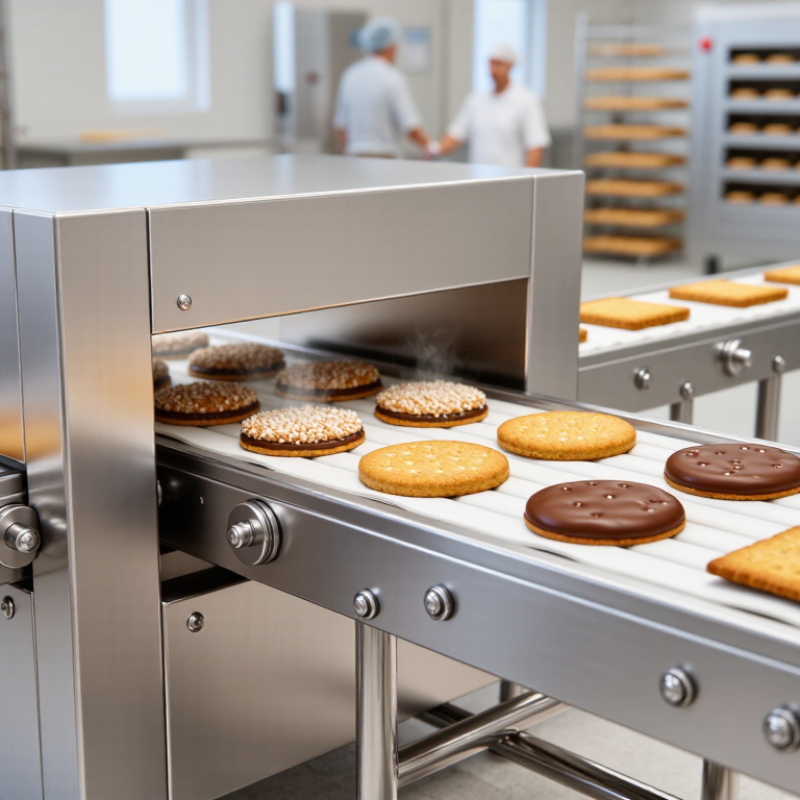
Table of Contents [Hide]
Understanding Metal Detection Needs in Biscuit Production
How to Choose the Best Metal Detector for Biscuits?
Understanding metal detection needs in biscuit production begins with the product itself.
Biscuits may contain flour dust, sugar, chocolate, fillings, or moisture. These ingredients can create a strong product effect and reduce detection stability.
The World Health Organization estimates that contaminated food causes 600 million illnesses and 420,000 deaths annually.
Metal detection is not the whole safety system, but it supports practical foreign-material control.
A suitable detector should identify ferrous, non-ferrous, and stainless-steel particles under real production conditions.
Test samples should match the line’s speed, biscuit size, packaging, and temperature.
Codex CXC 1-1969 recommends validated hazard controls, documented checks, and corrective actions.
Operators should test the system at scheduled intervals, including startup and product changeovers.
A detector alarm means little if rejected biscuits can return unnoticed.
Choose the aperture carefully.
A large opening may reduce sensitivity. A narrow opening may restrict future production.
The reject device also needs attention, especially when biscuits are fragile or stacked closely.
BRCGS Food Safety Issue 9 expects controlled inspection equipment and clear records.
That sounds simple, yet records are often incomplete during busy shifts.
This is where a careful review matters.
A detector selected only from a brochure may perform poorly beside a warm oven, vibrating conveyor, or uneven biscuit flow.





