


- Home
- A-Z Catalogue
- Products
- Valves
- Cetop
- Manual Directional Valves
- Proportional Valves
- Poppet Valves
- High-Speed Linear Servo Valves
- All High-Speed Linear Servo Valves
- Cetop 10 (NG32) Two Stage Type High Speed Linear Servo Valves – LSVHG-10
- Cetop 10 (NG32) Two Stage Type High Speed Linear Servo Valves – LSVHG-10 (With Fail-Safe)
- Cetop 8 (NG25) Two Stage Type High Speed Linear Servo Valves – LSVHG-06
- Cetop 8 (NG25) Two Stage Type High Speed Linear Servo Valves – LSVHG-06 (With Fail-Safe)
- Cetop 7 (NG16) Two Stage Type High Speed Linear Servo Valves – LSVHG-04
- Cetop 7 (NG16) Two Stage Type High Speed Linear Servo Valves – LSVHG-04 (With Fail-Safe)
- Cetop 5 (NG10) Direct Type High Speed Linear Servo Valves – LSVG-03
- Cetop 5 (NG10) OBE Type Direct Operated Linear Servo Valves – LSVG-03-EH
- Cetop 3 (NG6) OBE Type Direct Operated Linear Servo Valves – LSVG-01-EH
- Pumps
- Pressure control
- Flow Control Valves
- Pressure Control Valves
- All Pressure Control Valves
- Brake Valves
- Direct Relief Valve
- Low Noise Solenoid Controlled Relief Valves
- Low Noise Pilot Operated Relief Valves
- Pilot Operated Relief Valves
- Pressure reducing and relieving valves
- Pressure reducing and check valves
- Pressure control valves
- Remote Control Relief Valves
- Solenoid Controlled Relief Valves – BSG
- Solenoid Controlled Relief Valves – BST
- Unloading relief valves
- Check valves
- Environmental
- Valves
- Hydraulic Systems
- Power pack
- About Us
- Contact
- Blog

How to Choose the Best Infrared Thermometer in 2026?
Choosing the best Infrared Thermometer in 2026 requires more than comparing prices, screen sizes, or advertised accuracy. The real question is simple: can the device produce dependable readings in your actual environment?
Professional guidance from the U.S. National Institute of Standards and Technology highlights the importance of emissivity, calibration, measurement distance, and reflected radiation. These factors can change a reading within seconds. The U.S. Food and Drug Administration also warns that ambient temperature, sweat, cosmetics, and incorrect positioning may affect non-contact temperature measurements. Meanwhile, Grand View Research’s 2024 market analysis reports continued growth in infrared sensing, driven by healthcare, manufacturing, building inspection, and home monitoring. Growth creates more choices. It also creates more confusion.
John Snell, a recognized infrared thermography specialist and educator, has said, “An infrared camera does not measure temperature; it measures infrared radiation.” That principle applies to every Infrared Thermometer. A shiny metal pipe, a warm forehead, and a painted wall do not behave alike. Their surfaces emit and reflect energy differently.
Small details matter.
This guide will examine accuracy claims, emissivity settings, response time, distance-to-spot ratios, calibration records, and user safety. It will also compare practical performance, not just laboratory specifications. Some product labels appear impressively precise. They may not remain precise near an open window, under bright sunlight, or after repeated use. That is an uncomfortable limitation. Still, honest selection begins there: understanding what the instrument can measure, what it cannot, and when a second measurement method is wiser.
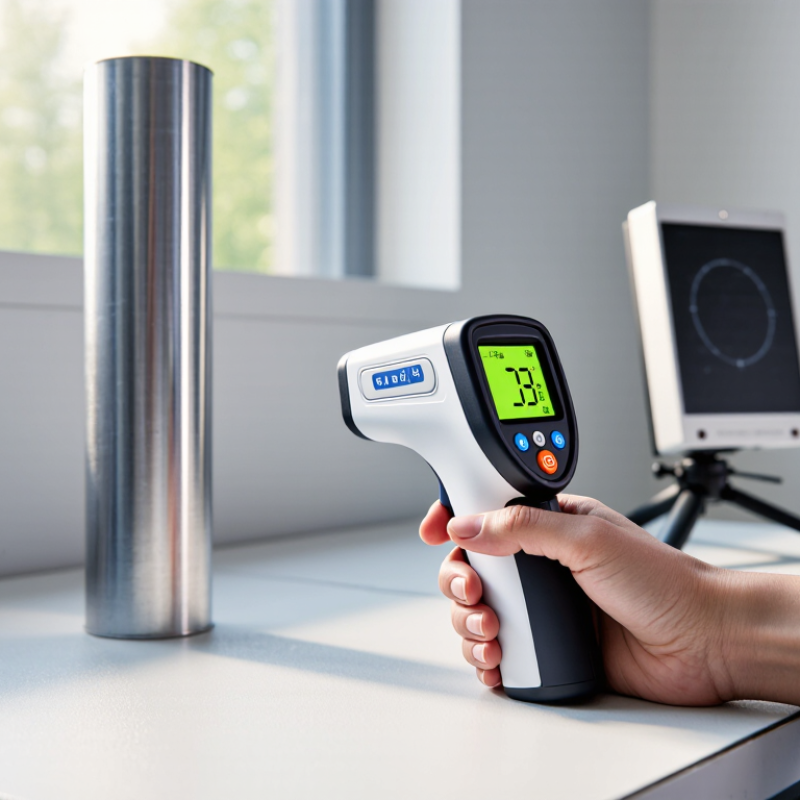
Table of Contents [Hide]
Understanding How Infrared Thermometers Work
How to Choose the Best Infrared Thermometer in 2026?
Understanding How Infrared Thermometers Work
An infrared thermometer detects thermal radiation from an object’s surface. It does not measure temperature through the skin or material. Its sensor usually reads infrared energy around the 8–14 micrometre range. An internal algorithm then converts that energy into a temperature reading. This conversion depends heavily on emissivity, the surface’s ability to emit radiation. Clean human skin is commonly modeled near 0.98 in laboratory temperature studies. ASTM E1933 identifies emissivity as a major source of infrared measurement error. That detail is easy to overlook.
Distance also changes the result. A larger distance-to-spot ratio allows a smaller target to be measured accurately. Shiny metal can reflect nearby heat, including your face or a hot lamp. Steam, dust, and cold air may disturb the reading. The U.S. National Institute of Standards and Technology emphasizes traceable calibration and controlled conditions in temperature metrology. Real rooms are rarely controlled. That is the uncomfortable part.
Tips: Choose an adjustable emissivity setting when measuring materials. Keep the sensor perpendicular to the surface. Measure the same area twice. Let the instrument reach room temperature first. Avoid measuring through glass. For body screening, follow ISO 80601-2-56 and use a device designed for that purpose. A fast display is useful, but speed alone does not prove accuracy. Even careful users can misread a reflective surface.