


- Home
- A-Z Catalogue
- Products
- Valves
- Cetop
- Manual Directional Valves
- Proportional Valves
- Poppet Valves
- High-Speed Linear Servo Valves
- All High-Speed Linear Servo Valves
- Cetop 10 (NG32) Two Stage Type High Speed Linear Servo Valves – LSVHG-10
- Cetop 10 (NG32) Two Stage Type High Speed Linear Servo Valves – LSVHG-10 (With Fail-Safe)
- Cetop 8 (NG25) Two Stage Type High Speed Linear Servo Valves – LSVHG-06
- Cetop 8 (NG25) Two Stage Type High Speed Linear Servo Valves – LSVHG-06 (With Fail-Safe)
- Cetop 7 (NG16) Two Stage Type High Speed Linear Servo Valves – LSVHG-04
- Cetop 7 (NG16) Two Stage Type High Speed Linear Servo Valves – LSVHG-04 (With Fail-Safe)
- Cetop 5 (NG10) Direct Type High Speed Linear Servo Valves – LSVG-03
- Cetop 5 (NG10) OBE Type Direct Operated Linear Servo Valves – LSVG-03-EH
- Cetop 3 (NG6) OBE Type Direct Operated Linear Servo Valves – LSVG-01-EH
- Pumps
- Pressure control
- Flow Control Valves
- Pressure Control Valves
- All Pressure Control Valves
- Brake Valves
- Direct Relief Valve
- Low Noise Solenoid Controlled Relief Valves
- Low Noise Pilot Operated Relief Valves
- Pilot Operated Relief Valves
- Pressure reducing and relieving valves
- Pressure reducing and check valves
- Pressure control valves
- Remote Control Relief Valves
- Solenoid Controlled Relief Valves – BSG
- Solenoid Controlled Relief Valves – BST
- Unloading relief valves
- Check valves
- Environmental
- Valves
- Hydraulic Systems
- Power pack
- About Us
- Contact
- Blog

How to Choose the Best Galvanized Pipe Manufacturer in China?
Choosing the right Galvanized Pipe Manufacturer in China requires more than comparing prices. A supplier may offer impressive photos, fast replies, and attractive certificates. These details help, but they do not prove consistent production quality. In practice, reliable decisions come from checking evidence at several stages. Review steel grades, zinc coating thickness, pipe dimensions, welding quality, and test reports. Ask how these specifications are measured and recorded. Small details matter.
Experience also changes the evaluation process. An experienced buyer usually requests samples before approving a large order. Examine the pipe surface under clear light. Look for uneven galvanizing, exposed steel, rough welds, or damaged threads. Measure the outside diameter and wall thickness with suitable tools. A factory should explain its inspection procedure without avoiding specific questions. It should also provide traceable production records and realistic delivery information. No checklist is flawless. Even careful buyers can miss a problem when communication is rushed.
A dependable manufacturer welcomes factory audits, video inspections, and independent testing. It should discuss packaging, loading methods, storage conditions, and after-sales support clearly. References from similar projects can reveal whether promises match actual performance. Consider the supplier’s production capacity, export experience, and response during technical disagreements. The lowest quotation may become expensive after rejected pipes, delays, or rework. The best choice is not always the largest factory or the cheapest one. It is the partner that consistently supports documented quality, transparent communication, and practical project requirements.#+#+#+#+
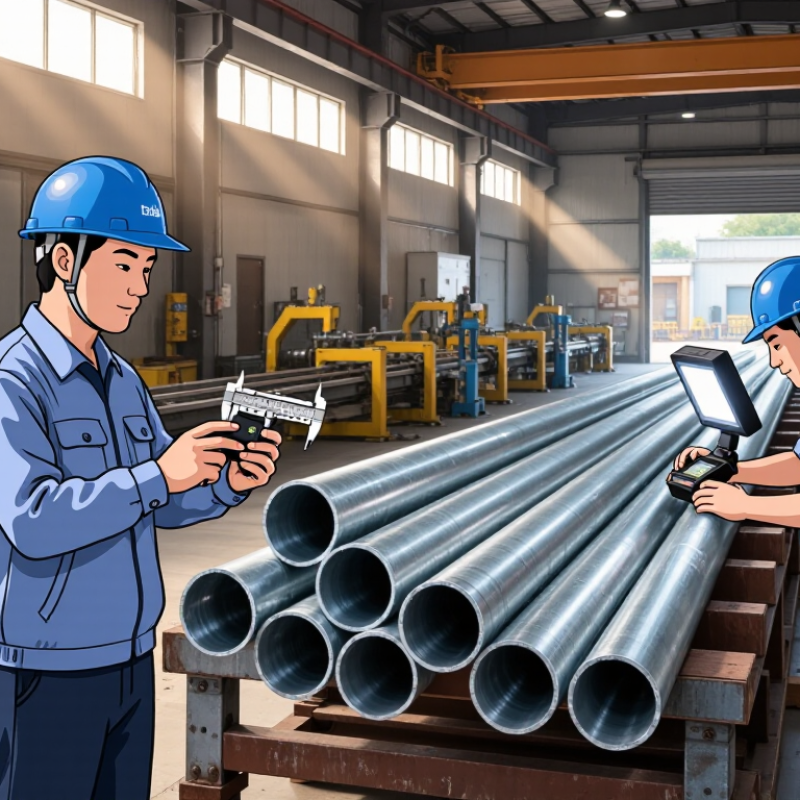
Table of Contents [Hide]
Define Required Pipe Size, Wall Thickness, Steel Grade, and Application
Choosing the best galvanized pipe manufacturer in China starts with a precise specification, not a supplier’s sales promise. Define the required pipe size, outside diameter, nominal bore, and wall thickness. These details affect flow, pressure resistance, weight, and installation space. State the steel grade and applicable standard, such as ASTM, EN, or another recognized specification. Your application matters too. Water distribution, scaffolding, greenhouse structures, and industrial piping require different performance levels.
Ask manufacturers to confirm dimensional tolerances, zinc coating thickness, threading quality, and surface condition. For outdoor use, stronger corrosion protection may be necessary. Request mill certificates, coating test reports, and batch traceability documents. Experienced suppliers should explain how their steel grade suits your working temperature, pressure, and connection method. A small sample can reveal rough threads, uneven galvanizing, or poor pipe straightness. It is easy to overlook these defects during online purchasing.
Tips: Prepare a specification sheet before requesting quotations. Include size, wall thickness, steel grade, length, end finish, quantity, and application. Compare technical replies, not only prices. Ask whether testing is performed in-house or by an independent laboratory. Do not assume a heavier pipe always performs better; excessive weight can increase costs without solving the actual engineering need. My own review habit would include checking several batches, because one attractive sample may not represent consistent production.