


- Home
- A-Z Catalogue
- Products
- Valves
- Cetop
- Manual Directional Valves
- Proportional Valves
- Poppet Valves
- High-Speed Linear Servo Valves
- All High-Speed Linear Servo Valves
- Cetop 10 (NG32) Two Stage Type High Speed Linear Servo Valves – LSVHG-10
- Cetop 10 (NG32) Two Stage Type High Speed Linear Servo Valves – LSVHG-10 (With Fail-Safe)
- Cetop 8 (NG25) Two Stage Type High Speed Linear Servo Valves – LSVHG-06
- Cetop 8 (NG25) Two Stage Type High Speed Linear Servo Valves – LSVHG-06 (With Fail-Safe)
- Cetop 7 (NG16) Two Stage Type High Speed Linear Servo Valves – LSVHG-04
- Cetop 7 (NG16) Two Stage Type High Speed Linear Servo Valves – LSVHG-04 (With Fail-Safe)
- Cetop 5 (NG10) Direct Type High Speed Linear Servo Valves – LSVG-03
- Cetop 5 (NG10) OBE Type Direct Operated Linear Servo Valves – LSVG-03-EH
- Cetop 3 (NG6) OBE Type Direct Operated Linear Servo Valves – LSVG-01-EH
- Pumps
- Pressure control
- Flow Control Valves
- Pressure Control Valves
- All Pressure Control Valves
- Brake Valves
- Direct Relief Valve
- Low Noise Solenoid Controlled Relief Valves
- Low Noise Pilot Operated Relief Valves
- Pilot Operated Relief Valves
- Pressure reducing and relieving valves
- Pressure reducing and check valves
- Pressure control valves
- Remote Control Relief Valves
- Solenoid Controlled Relief Valves – BSG
- Solenoid Controlled Relief Valves – BST
- Unloading relief valves
- Check valves
- Environmental
- Valves
- Hydraulic Systems
- Power pack
- About Us
- Contact
- Blog

How to Choose the Best Disc Diffuser for Your Application
Choosing the right Disc Diffuser is a process decision, not merely a product comparison. Tank depth, airflow, wastewater characteristics, fouling risk, and maintenance access all influence performance. A diffuser that performs well in clean water may struggle in activated sludge.
The U.S. Environmental Protection Agency’s 2023 Clean Watersheds Needs Survey estimated $630.1 billion in future clean-water infrastructure needs. The WHO and UNICEF Joint Monitoring Programme reported that 2.2 billion people lacked safely managed drinking water in 2022. These figures highlight a practical reality: aeration equipment must deliver reliable treatment while controlling energy and maintenance costs.
Dr. Bruce E. Rittmann, a leading wastewater-treatment researcher, offers a useful principle: “The process must be designed around the biology.” That principle applies directly to Disc Diffuser selection. Fine bubbles may improve oxygen transfer, but smaller pores can increase fouling sensitivity. Coarse bubbles may resist clogging, yet they often require more airflow. Nothing is universally best.
A careful selection compares standard oxygen transfer efficiency, oxygen transfer rate, pressure loss, membrane durability, and lifecycle cost. Field experience matters, too. Observe the basin: uneven bubbles, rising pressure, or dead zones can reveal problems that brochures hide. The numbers may look perfect.
Real systems are rarely perfect. Pilot testing, seasonal data, and honest maintenance records can expose weak assumptions before a full installation. Reports provide useful direction, but site-specific evidence should make the final decision.
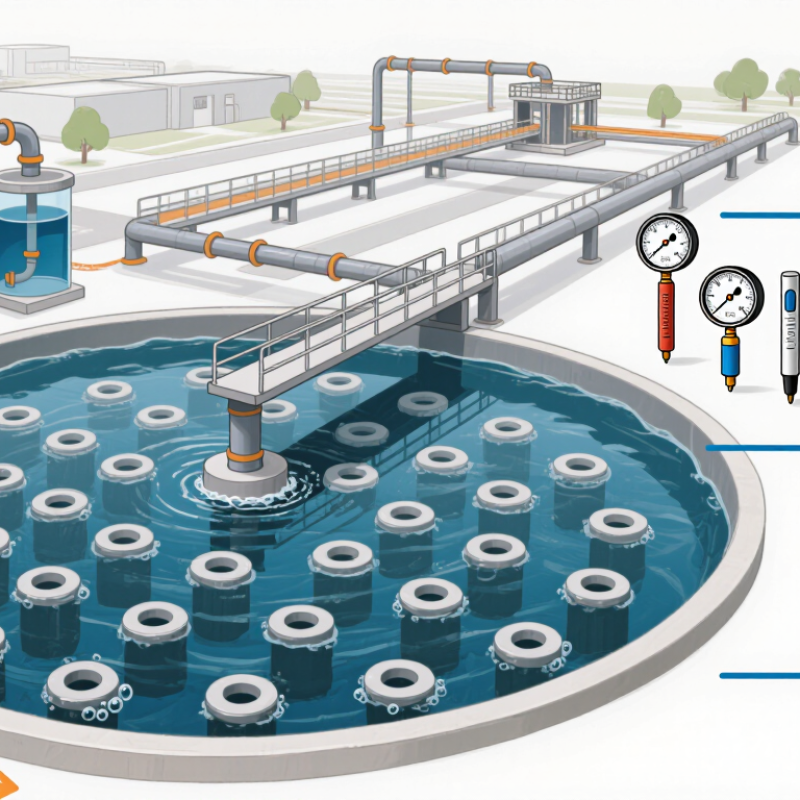
Table of Contents [Hide]
Understanding Disc Diffuser Types and Operating Principles
Choosing the best disc diffuser starts with understanding how different types release air into water. Fine-bubble disc diffusers use small pores to create many tiny bubbles. They provide strong oxygen transfer because the bubbles remain underwater longer. Coarse-bubble discs create larger bubbles and stronger mixing. They are useful where solids may settle or clogging is a concern.
The operating principle is simple. Compressed air enters the diffuser membrane and passes through calibrated openings. Water pressure controls the required airflow and affects bubble size. A deeper tank usually improves oxygen transfer, but it also demands more blower pressure. Membrane material, pore density, and disc diameter influence performance. In field inspections, uneven bubbling often signals fouling, damage, or poor air distribution. Yet, airflow alone does not prove good treatment. Temperature, water quality, and maintenance history matter too.
Tips: Match fine bubbles with oxygen-demanding processes and stable water conditions. Consider coarse bubbles when mixing and clog resistance matter more. Check airflow across several discs, not just one. Keep a pressure record. Small changes can reveal fouling early. No selection is perfect. I have seen efficient diffusers underperform when operators ignored tank depth or cleaning intervals. Test the diffuser under actual site conditions before making a final decision.





