


- Home
- A-Z Catalogue
- Products
- Valves
- Cetop
- Manual Directional Valves
- Proportional Valves
- Poppet Valves
- High-Speed Linear Servo Valves
- All High-Speed Linear Servo Valves
- Cetop 10 (NG32) Two Stage Type High Speed Linear Servo Valves – LSVHG-10
- Cetop 10 (NG32) Two Stage Type High Speed Linear Servo Valves – LSVHG-10 (With Fail-Safe)
- Cetop 8 (NG25) Two Stage Type High Speed Linear Servo Valves – LSVHG-06
- Cetop 8 (NG25) Two Stage Type High Speed Linear Servo Valves – LSVHG-06 (With Fail-Safe)
- Cetop 7 (NG16) Two Stage Type High Speed Linear Servo Valves – LSVHG-04
- Cetop 7 (NG16) Two Stage Type High Speed Linear Servo Valves – LSVHG-04 (With Fail-Safe)
- Cetop 5 (NG10) Direct Type High Speed Linear Servo Valves – LSVG-03
- Cetop 5 (NG10) OBE Type Direct Operated Linear Servo Valves – LSVG-03-EH
- Cetop 3 (NG6) OBE Type Direct Operated Linear Servo Valves – LSVG-01-EH
- Pumps
- Pressure control
- Flow Control Valves
- Pressure Control Valves
- All Pressure Control Valves
- Brake Valves
- Direct Relief Valve
- Low Noise Solenoid Controlled Relief Valves
- Low Noise Pilot Operated Relief Valves
- Pilot Operated Relief Valves
- Pressure reducing and relieving valves
- Pressure reducing and check valves
- Pressure control valves
- Remote Control Relief Valves
- Solenoid Controlled Relief Valves – BSG
- Solenoid Controlled Relief Valves – BST
- Unloading relief valves
- Check valves
- Environmental
- Valves
- Hydraulic Systems
- Power pack
- About Us
- Contact
- Blog

How to Choose Smart Street Lights for Your Project in 2026
In 2026, choosing a Smart Street Light means planning a system, not simply replacing a lamp. A row of bright fixtures may look efficient, yet poor optics can spill light across bedroom windows or leave a crossing dim. Project teams need to balance visibility, energy use, maintenance, and future expansion.
The U.S. Department of Energy’s 2017 report, Adoption of Light-Emitting Diodes in Common Lighting Applications, describes the substantial energy-saving potential of LED street lighting compared with conventional technologies. But projected savings are not guaranteed. They depend on existing equipment, operating hours, dimming schedules, and local conditions. That distinction matters. A control system that looks impressive in a proposal can still add costs if its sensors, software, or network are difficult to maintain.
DOE’s Municipal Solid-State Street Lighting Consortium guidance also offers practical direction for specifying outdoor lighting controls. Use it alongside local lighting requirements and site-level measurements. Record current energy use, inspect pole spacing, and identify areas where glare or uneven coverage already causes concern. Then compare whole-life costs, connectivity options, data ownership, and repair arrangements—not just the fixture price. A pilot installation can reveal problems before hundreds of lights are ordered. It may also expose assumptions your team missed. That is useful, even when the result is inconvenient.
This guide explains how to assess those trade-offs and choose equipment that fits your project’s streets, budget, and maintenance capacity. The right choice is rarely the one with the longest feature list.
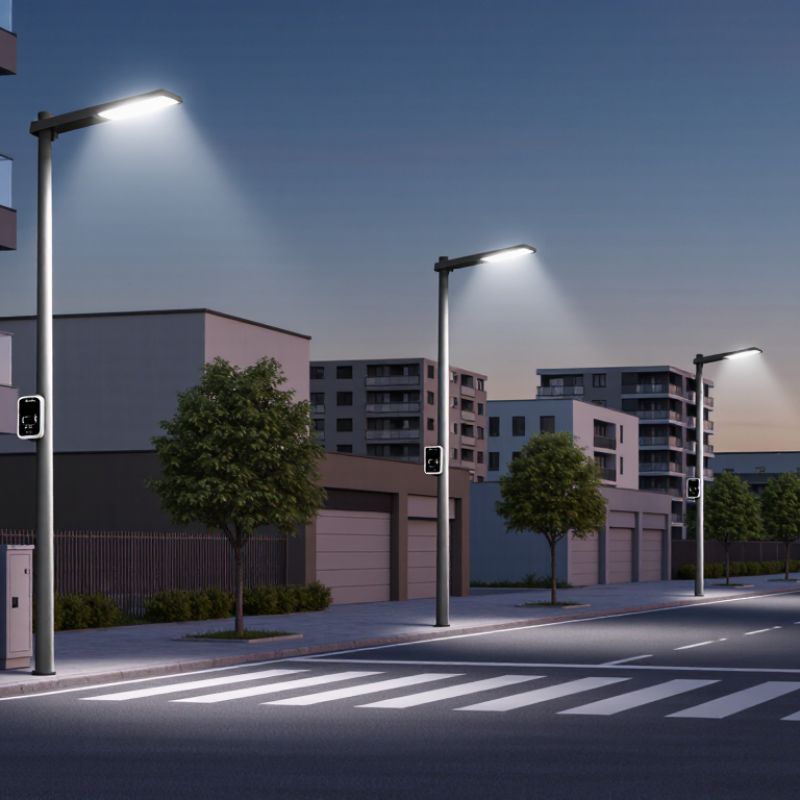
Table of Contents [Hide]
Define Project Goals, Site Conditions, and Lighting Requirements
Before selecting smart street lights, define what the project must improve. Is the priority safer crossings, lower energy use, fewer dark stretches, or faster fault detection? Ask residents and maintenance crews; their accounts often reveal problems a daytime survey misses. Write down measurable targets, such as maintaining consistent visibility at a bus stop or reducing unnecessary overnight output. Keep goals specific. Start with people.
Site conditions change the design. Map road width, pole spacing, tree canopies, building setbacks, and reflective surfaces. Note where wet pavement, fog, or parked trucks alter light distribution. Visit after dark, preferably in more than one season. Measure existing illumination at crossings and along sidewalks, rather than judging brightness by eye alone. Check power access, communications coverage, and pole condition; a weak network can make remote controls unreliable. Measure after dusk.
Then translate these findings into lighting requirements: target light levels, uniformity, glare limits, dimming schedules, and response times for faults. Match controls to real use patterns, such as late buses or quiet residential hours. Specify how performance will be tested and who will review operating data. A plan can look precise on paper and still miss a shadow beneath a mature tree. Leave room to adjust settings after installation, but record each change and its reason. The first survey may be incomplete; verify conditions rather than guess.





