


- Home
- A-Z Catalogue
- Products
- Valves
- Cetop
- Manual Directional Valves
- Proportional Valves
- Poppet Valves
- High-Speed Linear Servo Valves
- All High-Speed Linear Servo Valves
- Cetop 10 (NG32) Two Stage Type High Speed Linear Servo Valves – LSVHG-10
- Cetop 10 (NG32) Two Stage Type High Speed Linear Servo Valves – LSVHG-10 (With Fail-Safe)
- Cetop 8 (NG25) Two Stage Type High Speed Linear Servo Valves – LSVHG-06
- Cetop 8 (NG25) Two Stage Type High Speed Linear Servo Valves – LSVHG-06 (With Fail-Safe)
- Cetop 7 (NG16) Two Stage Type High Speed Linear Servo Valves – LSVHG-04
- Cetop 7 (NG16) Two Stage Type High Speed Linear Servo Valves – LSVHG-04 (With Fail-Safe)
- Cetop 5 (NG10) Direct Type High Speed Linear Servo Valves – LSVG-03
- Cetop 5 (NG10) OBE Type Direct Operated Linear Servo Valves – LSVG-03-EH
- Cetop 3 (NG6) OBE Type Direct Operated Linear Servo Valves – LSVG-01-EH
- Pumps
- Pressure control
- Flow Control Valves
- Pressure Control Valves
- All Pressure Control Valves
- Brake Valves
- Direct Relief Valve
- Low Noise Solenoid Controlled Relief Valves
- Low Noise Pilot Operated Relief Valves
- Pilot Operated Relief Valves
- Pressure reducing and relieving valves
- Pressure reducing and check valves
- Pressure control valves
- Remote Control Relief Valves
- Solenoid Controlled Relief Valves – BSG
- Solenoid Controlled Relief Valves – BST
- Unloading relief valves
- Check valves
- Environmental
- Valves
- Hydraulic Systems
- Power pack
- About Us
- Contact
- Blog

How to Choose the Right Servo Valves for Your Applications?
Choosing the right servo valves for your applications can be a daunting task. With various options and specifications, understanding your needs is crucial. As John Smith, an expert in hydraulic systems, once stated, "The right servo valve can enhance performance significantly." This emphasizes the importance of making informed decisions.
Servo valves control fluid power in hydraulic systems. They regulate flow and pressure, affecting machine performance directly. Selecting the appropriate valve impacts efficiency and precision. Common applications include aerospace, robotics, and automotive sectors. Each application has unique requirements that dictate the choice of servo valves.
Careful assessment of factors like load, speed, and control strategy is paramount. Sometimes, users overlook these details. This can lead to underperformance or even system failures. Understanding your specific needs allows you to identify the perfect servo valve for your solution. The difference between good and excellent operation often lies in this selection process.

Table of Contents
[Hide]
Understanding Servo Valves: Types and Key Features
Servo valves are essential components in fluid power systems. Understanding their types and key features is crucial for selecting the right one for your applications. There are several types of servo valves, including proportional and direct-acting valves, each serving different purposes.
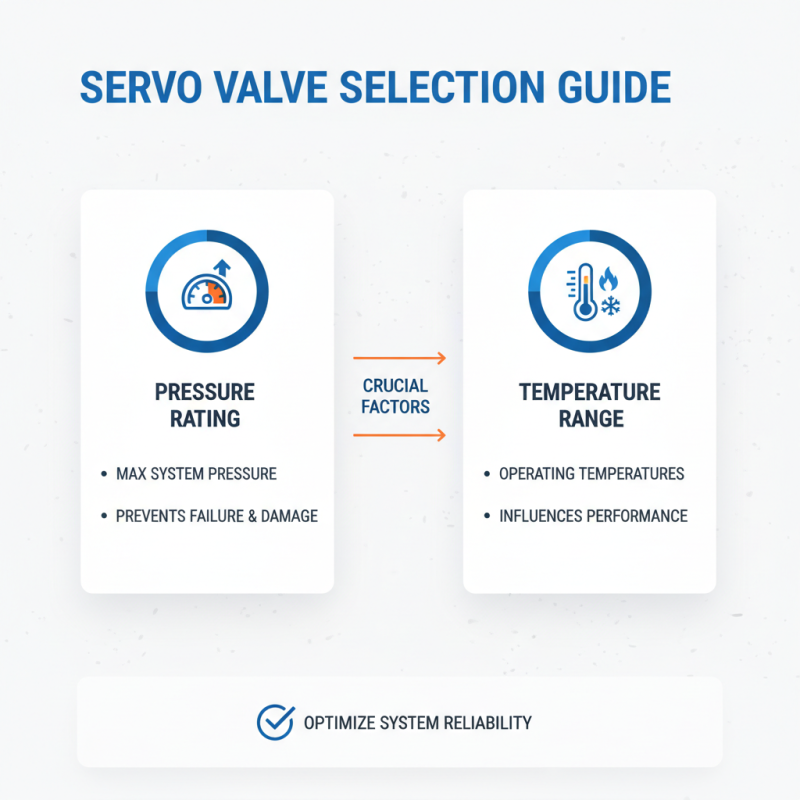
Proportional valves adjust fluid flow based on the input signal. Direct-acting valves operate with high precision and are often used in control applications. It's vital to consider flow rate, pressure range, and response time when selecting a servo valve. A report by the Fluid Power Journal indicated that improperly chosen valves could lead to a 20% efficiency loss in hydraulic systems.
Tip: Always align the valve selection with system specifications. Consider compatibility with the fluid type and temperature, as mismatch can lead to premature wear.
Another key feature is the control method. Some valves use electronic control, while others use mechanical systems. Electronic control offers faster response times. However, it can introduce complexity that may not be necessary for simpler applications. Always evaluate the application's demands carefully.
Tip: Simplicity often leads to reliability. If the application doesn’t require advanced features, consider opting for a basic model.
Related Posts
-
The Future of Automation: How Servo Valves are Revolutionizing Industry Efficiency
-
How to Choose the Right Hydraulic Unit for Your Industrial Needs
-
Understanding the Role of Check Valves in Modern Industrial Systems
-
Top 10 Benefits of Pilot Operated Check Valves in Industrial Applications
-
How to Choose the Right Directional Control Valve for Your Project
-

Exploring the Benefits of Yuken Directional Valves for Enhanced Hydraulic Performance