


- Home
- A-Z Catalogue
- Products
- Valves
- Cetop
- Manual Directional Valves
- Proportional Valves
- Poppet Valves
- High-Speed Linear Servo Valves
- All High-Speed Linear Servo Valves
- Cetop 10 (NG32) Two Stage Type High Speed Linear Servo Valves – LSVHG-10
- Cetop 10 (NG32) Two Stage Type High Speed Linear Servo Valves – LSVHG-10 (With Fail-Safe)
- Cetop 8 (NG25) Two Stage Type High Speed Linear Servo Valves – LSVHG-06
- Cetop 8 (NG25) Two Stage Type High Speed Linear Servo Valves – LSVHG-06 (With Fail-Safe)
- Cetop 7 (NG16) Two Stage Type High Speed Linear Servo Valves – LSVHG-04
- Cetop 7 (NG16) Two Stage Type High Speed Linear Servo Valves – LSVHG-04 (With Fail-Safe)
- Cetop 5 (NG10) Direct Type High Speed Linear Servo Valves – LSVG-03
- Cetop 5 (NG10) OBE Type Direct Operated Linear Servo Valves – LSVG-03-EH
- Cetop 3 (NG6) OBE Type Direct Operated Linear Servo Valves – LSVG-01-EH
- Pumps
- Pressure control
- Flow Control Valves
- Pressure Control Valves
- All Pressure Control Valves
- Brake Valves
- Direct Relief Valve
- Low Noise Solenoid Controlled Relief Valves
- Low Noise Pilot Operated Relief Valves
- Pilot Operated Relief Valves
- Pressure reducing and relieving valves
- Pressure reducing and check valves
- Pressure control valves
- Remote Control Relief Valves
- Solenoid Controlled Relief Valves – BSG
- Solenoid Controlled Relief Valves – BST
- Unloading relief valves
- Check valves
- Environmental
- Valves
- Hydraulic Systems
- Power pack
- About Us
- Contact
- Blog

How to Choose Cooling Evaporators in 2026?
Choosing the right Cooling Evaporators in 2026 requires more than comparing catalog capacity and purchase price. A reliable selection begins with the actual cooling load, room dimensions, product temperature, humidity, and operating schedule. A freezer storing packaged seafood needs different performance from a fresh-produce room maintained near 2°C. Small details matter. Door openings, air movement, and defrost frequency can change results significantly.
Modern evaporators should support energy efficiency, stable temperature control, and practical maintenance. Look for fan motors with efficient operation, corrosion-resistant materials, accessible drain pans, and controls that match the refrigeration system. Refrigerant compatibility is also essential as equipment standards and environmental requirements continue to evolve. Manufacturer performance data should be checked at the expected evaporating temperature, ambient conditions, and airflow rate, not only under ideal laboratory conditions.
Field experience shows that oversized equipment may cycle frequently, while undersized units can run continuously and struggle during peak loads. Neither choice is automatically safer. A careful load calculation remains more dependable than guesswork. Still, calculations can miss real behavior, such as workers leaving doors open or frost building around the coil. That is where commissioning and regular inspection become valuable.
This guide explains how to compare Cooling Evaporators for efficiency, durability, food protection, and long-term operating value. It considers design, installation, controls, cleaning access, and service support. Some recommendations may need adjustment for your facility. That is worth acknowledging. Local climate, available technicians, and future expansion can change the best decision.
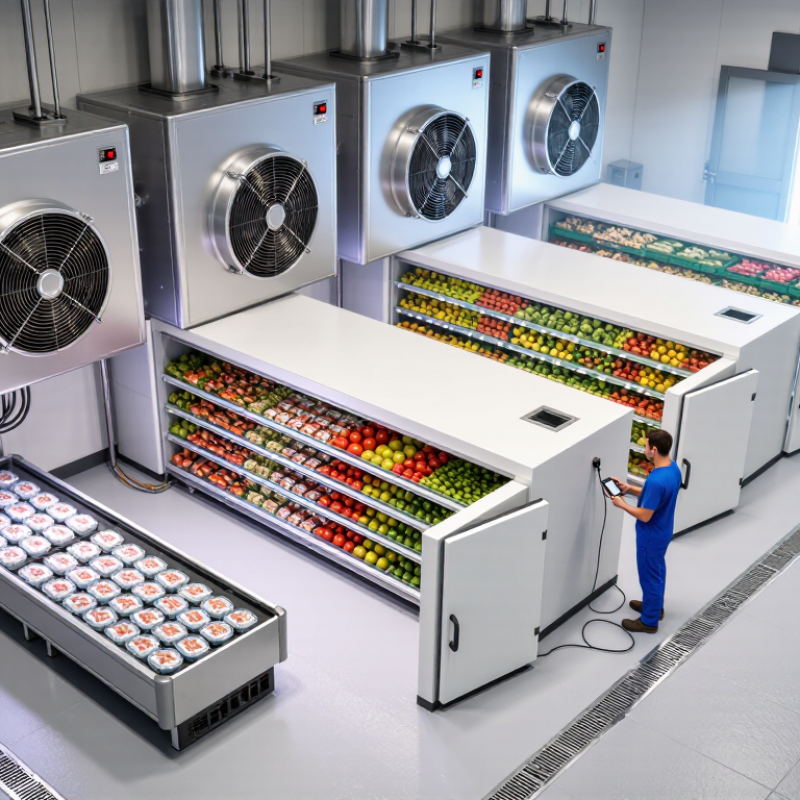
Table of Contents [Hide]
Understanding Cooling Evaporator Types and Their Core Functions
How to Choose Cooling Evaporators in 2026?
Understanding Cooling Evaporator Types and Their Core Functions
A cooling evaporator absorbs heat from air, liquid, or a process surface. Refrigerant enters at low pressure and removes thermal energy as it evaporates. The correct type depends on temperature, moisture, space, and maintenance access.
Direct-expansion evaporators suit compact systems and respond quickly to changing loads. Flooded evaporators keep the heat-transfer surface wetted with refrigerant. They can deliver strong efficiency, but they need careful oil and liquid management. Plate, shell-and-tube, and finned-coil designs serve different fluids and airflow patterns. Finned coils work well in cold rooms, especially when fans move air across exposed surfaces.
Selection should begin with the actual cooling load, not a catalog rating. Measure product temperature, room humidity, operating hours, and expected defrost cycles. A coil that looks oversized may reduce cycling, but it can also create poor humidity control. That detail is often missed.
Material compatibility matters. Stainless steel may suit hygienic liquid applications, while coated surfaces can help resist corrosion in damp environments. Check refrigerant compatibility, pressure ratings, drainage, and cleaning access. A blocked drain can damage performance before the evaporator shows visible wear.
Field conditions rarely match laboratory data. Dust, frost, unstable voltage, and irregular loading change results. Engineers should verify performance after installation and record suction pressure, outlet temperature, and frost patterns. No choice is perfect. A simple measurement is sometimes more reliable than a polished specification sheet.





