


- Home
- A-Z Catalogue
- Products
- Valves
- Cetop
- Manual Directional Valves
- Proportional Valves
- Poppet Valves
- High-Speed Linear Servo Valves
- All High-Speed Linear Servo Valves
- Cetop 10 (NG32) Two Stage Type High Speed Linear Servo Valves – LSVHG-10
- Cetop 10 (NG32) Two Stage Type High Speed Linear Servo Valves – LSVHG-10 (With Fail-Safe)
- Cetop 8 (NG25) Two Stage Type High Speed Linear Servo Valves – LSVHG-06
- Cetop 8 (NG25) Two Stage Type High Speed Linear Servo Valves – LSVHG-06 (With Fail-Safe)
- Cetop 7 (NG16) Two Stage Type High Speed Linear Servo Valves – LSVHG-04
- Cetop 7 (NG16) Two Stage Type High Speed Linear Servo Valves – LSVHG-04 (With Fail-Safe)
- Cetop 5 (NG10) Direct Type High Speed Linear Servo Valves – LSVG-03
- Cetop 5 (NG10) OBE Type Direct Operated Linear Servo Valves – LSVG-03-EH
- Cetop 3 (NG6) OBE Type Direct Operated Linear Servo Valves – LSVG-01-EH
- Pumps
- Pressure control
- Flow Control Valves
- Pressure Control Valves
- All Pressure Control Valves
- Brake Valves
- Direct Relief Valve
- Low Noise Solenoid Controlled Relief Valves
- Low Noise Pilot Operated Relief Valves
- Pilot Operated Relief Valves
- Pressure reducing and relieving valves
- Pressure reducing and check valves
- Pressure control valves
- Remote Control Relief Valves
- Solenoid Controlled Relief Valves – BSG
- Solenoid Controlled Relief Valves – BST
- Unloading relief valves
- Check valves
- Environmental
- Valves
- Hydraulic Systems
- Power pack
- About Us
- Contact
- Blog

How to Choose an ATEX Water Tank for Global Projects?
Choosing an Atex Water Tank for a global project involves more than selecting volume and steel thickness. The tank must fit the site’s explosion-risk assessment, water duty, climate, and maintenance capability. ATEX concerns equipment used in potentially explosive atmospheres. It does not automatically certify every tank installed near hazardous materials.
The need for reliable water infrastructure is substantial. The WHO and UNICEF Joint Monitoring Programme reported in 2023 that 2.2 billion people lacked safely managed drinking water in 2022. Industrial projects face additional pressure. Their tanks may support process water, emergency firefighting, or potable supplies under demanding conditions. A practical design must consider ATEX zone classification, vapor exposure, static control, grounding, temperature range, corrosion, access, and inspection records. European Commission guidance on Directive 2014/34/EU remains a key reference for equipment intended for explosive atmospheres. EN 1127-1 also provides recognized principles for preventing and protecting against explosions.
Details matter. A tank beside a solvent area may require different controls from one serving a remote mine. A dark external coating can raise water temperature. Poorly bonded fittings can create avoidable static risks. A tank marketed as “ATEX-ready” may still lack project-specific evidence. That assumption is often wrong.
This guide explains how to compare materials, certifications, protective systems, and suppliers. It also considers ISO, EN, AWWA, and local fire-water requirements. Experienced engineers should verify every claim against the hazardous-area dossier and operating conditions. Global projects rarely fail because of tank capacity alone. They fail when documentation, installation, or maintenance is overlooked.
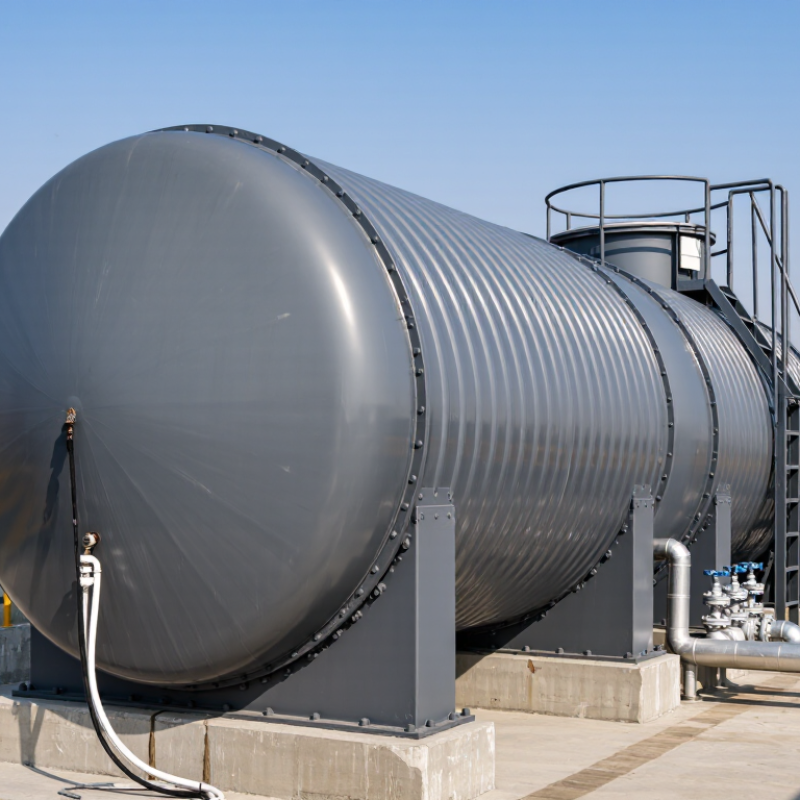
Table of Contents [Hide]
What Is an ATEX Water Tank and Where Is It Required?
An ATEX water tank is not simply a tank painted for hazardous areas. It is a water storage system designed for use near a potentially explosive atmosphere. ATEX refers to European requirements for equipment used where gases, vapours, mists, or combustible dust may ignite. The tank shell may be non-electrical and low risk. However, its level sensor, pump, heater, mixer, cable gland, or control panel can become an ignition source. This distinction matters. A tank does not automatically need ATEX certification because it stores water.
It is typically required when the tank or connected equipment sits inside a classified zone, such as a solvent plant, fuel terminal, gas-processing site, chemical workshop, or dust-producing facility. The zone classification, gas or dust group, temperature class, ambient conditions, and equipment category should guide selection. Project engineers should review the explosion protection document and confirm requirements with the competent site authority. For global projects, local regulations may add conditions beyond ATEX. Treating an ATEX label as universal approval can create expensive gaps.
Tips: Map every component before ordering. Check the sensor, pump, wiring, earthing, and maintenance access. Ask for certificates, technical files, and installation limits. Stainless steel, coatings, and seals must also suit the stored water and environment. In practice, teams sometimes focus on the tank body and overlook a small non-compliant switch. That mistake is easy to make. A second review is worthwhile.





