


- Home
- A-Z Catalogue
- Products
- Valves
- Cetop
- Manual Directional Valves
- Proportional Valves
- Poppet Valves
- High-Speed Linear Servo Valves
- All High-Speed Linear Servo Valves
- Cetop 10 (NG32) Two Stage Type High Speed Linear Servo Valves – LSVHG-10
- Cetop 10 (NG32) Two Stage Type High Speed Linear Servo Valves – LSVHG-10 (With Fail-Safe)
- Cetop 8 (NG25) Two Stage Type High Speed Linear Servo Valves – LSVHG-06
- Cetop 8 (NG25) Two Stage Type High Speed Linear Servo Valves – LSVHG-06 (With Fail-Safe)
- Cetop 7 (NG16) Two Stage Type High Speed Linear Servo Valves – LSVHG-04
- Cetop 7 (NG16) Two Stage Type High Speed Linear Servo Valves – LSVHG-04 (With Fail-Safe)
- Cetop 5 (NG10) Direct Type High Speed Linear Servo Valves – LSVG-03
- Cetop 5 (NG10) OBE Type Direct Operated Linear Servo Valves – LSVG-03-EH
- Cetop 3 (NG6) OBE Type Direct Operated Linear Servo Valves – LSVG-01-EH
- Pumps
- Pressure control
- Flow Control Valves
- Pressure Control Valves
- All Pressure Control Valves
- Brake Valves
- Direct Relief Valve
- Low Noise Solenoid Controlled Relief Valves
- Low Noise Pilot Operated Relief Valves
- Pilot Operated Relief Valves
- Pressure reducing and relieving valves
- Pressure reducing and check valves
- Pressure control valves
- Remote Control Relief Valves
- Solenoid Controlled Relief Valves – BSG
- Solenoid Controlled Relief Valves – BST
- Unloading relief valves
- Check valves
- Environmental
- Valves
- Hydraulic Systems
- Power pack
- About Us
- Contact
- Blog

How to Choose a Hand Manual Coffee Grinder in 2026?
Choosing a Hand Manual Coffee Grinder in 2026 is less about chasing the newest model. It is about matching your brewing habits, hands, and coffee preferences. A grinder that feels perfect for espresso may struggle with a clean pour-over. A lightweight body may travel well, yet feel unstable on a kitchen counter. Small details matter: burr alignment, adjustment steps, handle comfort, bearing smoothness, and the sound of beans breaking apart.
Coffee educator James Hoffmann has said, “The grinder is more important than the machine.” His point remains useful because grind consistency shapes extraction before water touches the coffee. Still, that statement should not become a rigid rule. A carefully designed Hand Manual Coffee Grinder can produce excellent results, but only when its burrs, settings, and user technique work together. My own preference for fewer adjustment clicks may not suit someone brewing Turkish coffee or switching between espresso and French press.
This guide examines how to choose wisely in 2026. It considers stainless steel and coated burrs, stepped and stepless adjustments, grinding speed, capacity, portability, cleaning, and long-term parts support. Your morning routine matters. Ten comfortable turns can feel very different from sixty resistant turns before work. Price also deserves honest reflection. The most expensive grinder is not automatically the best choice, and marketing terms cannot replace brewed evidence. Expect trade-offs. Taste a few coffees, record your settings, and judge the cup rather than the promise on the box.
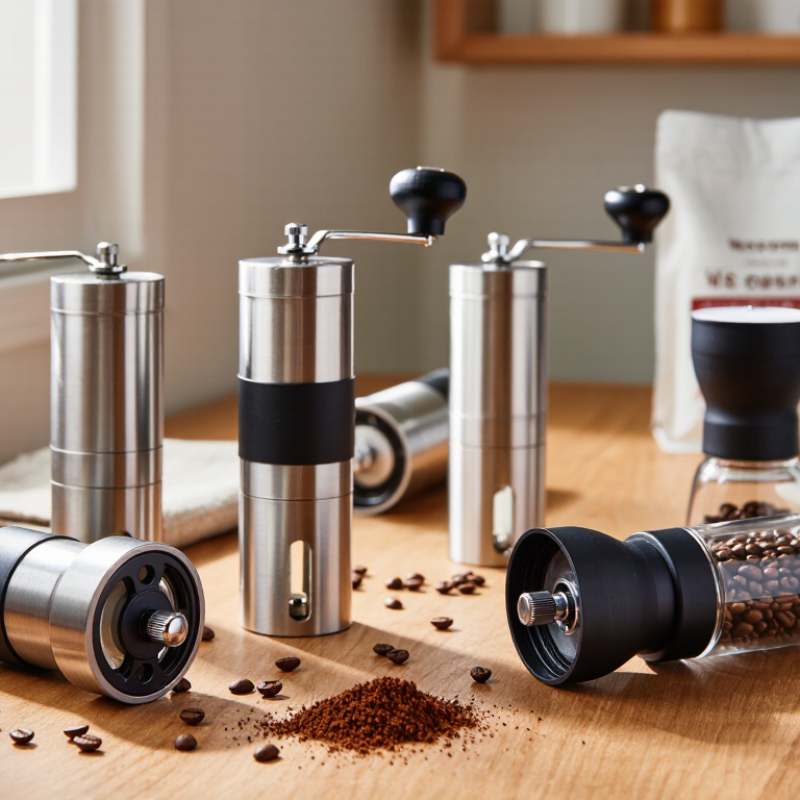
Table of Contents [Hide]
Define Your Brew Scope: SCA’s 55 g/L Ratio and 18–20 g Espresso Doses
Choosing a hand manual coffee grinder starts with your brewing scope, not its appearance. The Specialty Coffee Association’s Golden Cup guidance uses 55 grams of coffee per liter of water, with an accepted range of about 50–60 grams. At home, 18 grams of coffee needs roughly 327 grams of brewing water. That calculation matters when selecting a grinder’s capacity and adjustment range.
For espresso, many home users work with 18–20 gram doses. A grinder should therefore hold enough beans without forcing repeated loading. Fine adjustment is essential because a small change can alter flow, bitterness, and extraction time. The SCA’s brewing research also emphasizes water quality, temperature, and contact time, so grind size cannot fix every weak or harsh cup. I have sometimes tightened the grind when the real problem was stale coffee.
Look for clear, repeatable settings between coarse filter grinding and fine espresso grinding. The Burr Geometry and Grind Size research published by the Coffee Science Foundation shows that particle distribution influences extraction consistency. A stable hand grinder should produce fewer unwanted fines and feel smooth during repeated turns. Yet no grinder performs perfectly. Uneven bean density, tired burrs, and rushed dialing-in still create variation. Choose a model that matches your routine: around 18–20 grams for espresso, or several small doses for 55 g/L filter brewing.





