How to Choose a Hydraulic Piling Rig in 2026?
Choosing a Hydraulic Piling Rig in 2026 is not simply a horsepower comparison. It is a decision about ground conditions, project risk, daily output, and the cost of moving equipment between sites. Oxford Economics’ Global Construction Futures report projected that worldwide construction output could grow by 42% to US$15.5 trillion by 2030. That forecast points to sustained construction demand, but it does not guarantee steady work for every contractor. The right machine must fit the projects you can realistically secure.
Start with the ground, not the brochure. Soil layers, groundwater, pile diameter, and required depth all affect the rig’s method and working capacity. The US Federal Highway Administration’s Drilled Shafts: Construction Procedures and Design Methods (FHWA-NHI-18-024) details how subsurface conditions and construction procedures shape foundation work. Its guidance is a useful technical reference, though each project still needs site-specific engineering review. Ground conditions bite.
Compare torque, crowd force, mast height, and available tooling against actual pile specifications. Then check transport dimensions, setup time, service access, fuel use, and operator support. These details matter on a muddy, confined site, where a machine that looks powerful on paper may lose productive hours. A neat spreadsheet can still mislead. Ask manufacturers for documented performance data, service intervals, and references from similar projects. Verify the assumptions with your own site records and engineering team. This guide explains how to weigh those factors, identify trade-offs, and select a rig that suits both the work and the realities of your fleet.
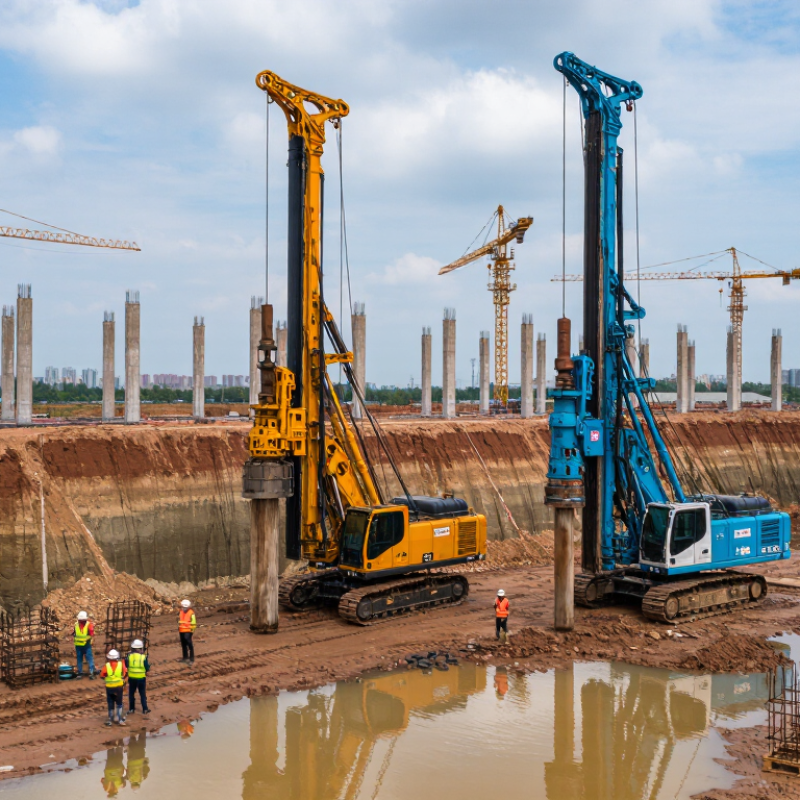
Define Project Requirements and Piling Objectives
Before choosing a hydraulic piling rig, define what the foundation must achieve: design load, pile type, diameter, length, and installation tolerance. Start with the ground, not the machine. Review borehole logs, groundwater levels, obstructions, and nearby structures. FHWA’s Design and Construction of Driven Pile Foundations (2016) emphasizes using site conditions and drivability analysis to guide pile installation planning. A rig that suits soft soil may struggle with dense layers or buried debris.
Translate those findings into measurable job requirements. Record the heaviest pile, required penetration, working-platform limits, access width, lift needs, and daily production target. Note vibration and noise limits near occupied buildings. NIOSH’s Criteria for a Recommended Standard: Occupational Noise Exposure (1998) sets an 85 dBA recommended exposure limit over an eight-hour workday. Treat that as a useful planning reference, not a site-specific approval. The overlooked detail? A tight work zone can matter more than headline rig capacity.
Tips: Bring the geotechnical report, pile schedule, and site layout to equipment discussions. Ask how the rig handles the hardest soil layer and how crews verify depth and alignment. Keep a little allowance for uncertainty; ground conditions rarely match every assumption. That deserves a second look.
Match Rig Type and Capacity to Ground Conditions
How to Choose a Hydraulic Piling Rig in 2026?
Match Rig Type and Capacity to Ground Conditions
Start with borehole logs and CPT or SPT results, not a rig’s headline capacity. Loose sand may need casing or continuous support, while stiff clay can demand strong crowd force. Cobbles and weathered rock call for high torque and tooling that can handle abrupt resistance. Groundwater matters, too. A rig suited to dry soil may struggle when the bore fills with water.
FHWA’s Drilled Shafts manual, NHI-18-024, describes common shaft diameters of roughly 3–12 feet. That range illustrates why “one size fits all” is poor equipment planning. Larger shafts need suitable torque, crowd, mast height, and lifting capacity; these must also match the chosen tool and installation method. FHWA guidance for driven piles likewise emphasizes checking drivability against soil conditions, rather than choosing by pile capacity alone.
Check the full ground profile, not just the first few metres. A weak surface layer can hide dense gravel or rock below. Confirm access width, working-platform bearing capacity, and headroom before mobilizing. Small details count. Compare predicted resistance with the rig’s operating limits, then allow a margin for variable strata. Soil estimates can be wrong; revise the plan if cuttings or penetration rates disagree with the investigation.
Not always. A powerful rig can still be the wrong rig.
Check Site Access, Transport, and Operating Constraints
Before choosing a hydraulic piling rig, check the complete route from delivery gate to working position. Measure narrow turns, overhead clearance, ground slope, and the space needed to unload and assemble the mast. Ask the haulier for the rig’s transport dimensions, axle loads, and turning requirements; do not rely on a brochure’s “compact” label. Small details matter. A low doorway or soft verge can stop delivery before work begins.
Bridge capacity deserves attention. ASCE’s 2021 Infrastructure Report Card estimated that 7.5% of U.S. bridges were structurally deficient; use the relevant authority’s current bridge and load-posting information for your actual route. FHWA’s National Bridge Inventory can help identify structures requiring closer checks. Then measure twice. At the site, compare machine ground pressure with soil conditions, and plan mats where access tracks are weak. Check overhead services, buried utilities, noise limits, vibration-sensitive neighbors, and room for spoil storage. These constraints can change the rig choice more than rated piling capacity.
Transport and operation must work together. A rig that fits through the gate may still need a crane, extra assembly space, or a firm platform to stand safely. Confirm setup sequence, support equipment, and daily movement paths with the site team. Not glamorous. I would still leave room for a missed dimension or a wet access road; plans are rarely perfect. This is a practical screening step, not a substitute for route surveys or project-specific engineering.
Compare Hydraulic Performance, Safety, and Automation
When choosing a hydraulic piling rig in 2026, compare measured output, not brochure peak pressure. Check pump flow, pressure stability, and oil temperature during a representative pile cycle. Ask for duty-cycle records using your pile size and ground conditions. Smooth, consistent force can reduce pauses and protect tooling. Peak figures alone can mislead.
Safety deserves equal weight. The U.S. Bureau of Labor Statistics recorded 1,075 fatal work injuries in construction in 2023; this figure covers the sector, not piling alone. Inspect emergency stops, guarded pinch points, safe access, and interlocks. Test them in the field. A checklist is useful, but it cannot replace observing the rig during setup and operation.
Automation can make performance easier to verify. McKinsey Global Institute’s 2017 Reinventing Construction report estimated construction productivity growth at about 1% annually over two decades, compared with 2.8% for the wider economy. Consider rigs that log pile alignment, cycle data, and hydraulic pressure. Ask how operators handle sensor drift or system failure. That detail matters. A clear screen helps, but the crew still needs practical controls and a manual fallback.
Evaluate Lifecycle Costs, Support, and 2026 Compliance
Choose a hydraulic piling rig by lifecycle cost, not purchase price. Model fuel per shift, scheduled servicing, hydraulic hoses, wear parts, relocation, downtime, and resale value over several years. McKinsey Global Institute’s 2017 report found construction productivity grew about 1% annually over two decades, compared with 2.8% across the total economy. That gap is a reason to examine output per working hour, not just rated power. Request service records and realistic cycle-time estimates for your ground conditions. Small details matter. A spreadsheet still misses some costs; operator feedback can expose awkward access to filters or frequent hose damage.
Treat compliance as a delivery requirement. In the EU, Stage V under Regulation (EU) 2016/1628 sets a particle-number limit of 1×10¹²/kWh for applicable engine categories from 19 to 560 kW. Requirements vary by engine category and market, so verify the engine certificate, emissions label, and after-treatment configuration for the exact rig. Check noise limits, safety documentation, and site-specific rules as well. For EU equipment, confirm which machinery rules apply on its market-placement date; Regulation (EU) 2023/1230 applies from 20 January 2027. Ask for written confirmation before ordering, not after the rig reaches site. A missed document can delay work. Maybe the checklist will feel excessive, but compliance assumptions are expensive to repair later.
How to Choose a Hydraulic Piling Rig in 2026?
Compare the modeled five-year cost of ownership—not just the purchase price.
This illustrative planning model estimates costs in USD thousands for three generic procurement scenarios. Service and support include maintenance and parts; compliance readiness is a planning allowance, not a regulatory fee. Actual costs vary by rig configuration, worksite, utilization, local service coverage, and applicable 2026 emissions and safety requirements. Obtain project-specific quotes and verify local regulations before purchasing.








