


- Home
- A-Z Catalogue
- Products
- Valves
- Cetop
- Manual Directional Valves
- Proportional Valves
- Poppet Valves
- High-Speed Linear Servo Valves
- All High-Speed Linear Servo Valves
- Cetop 10 (NG32) Two Stage Type High Speed Linear Servo Valves – LSVHG-10
- Cetop 10 (NG32) Two Stage Type High Speed Linear Servo Valves – LSVHG-10 (With Fail-Safe)
- Cetop 8 (NG25) Two Stage Type High Speed Linear Servo Valves – LSVHG-06
- Cetop 8 (NG25) Two Stage Type High Speed Linear Servo Valves – LSVHG-06 (With Fail-Safe)
- Cetop 7 (NG16) Two Stage Type High Speed Linear Servo Valves – LSVHG-04
- Cetop 7 (NG16) Two Stage Type High Speed Linear Servo Valves – LSVHG-04 (With Fail-Safe)
- Cetop 5 (NG10) Direct Type High Speed Linear Servo Valves – LSVG-03
- Cetop 5 (NG10) OBE Type Direct Operated Linear Servo Valves – LSVG-03-EH
- Cetop 3 (NG6) OBE Type Direct Operated Linear Servo Valves – LSVG-01-EH
- Pumps
- Pressure control
- Flow Control Valves
- Pressure Control Valves
- All Pressure Control Valves
- Brake Valves
- Direct Relief Valve
- Low Noise Solenoid Controlled Relief Valves
- Low Noise Pilot Operated Relief Valves
- Pilot Operated Relief Valves
- Pressure reducing and relieving valves
- Pressure reducing and check valves
- Pressure control valves
- Remote Control Relief Valves
- Solenoid Controlled Relief Valves – BSG
- Solenoid Controlled Relief Valves – BST
- Unloading relief valves
- Check valves
- Environmental
- Valves
- Hydraulic Systems
- Power pack
- About Us
- Contact
- Blog

Why Choose a Dust Proof Mask for Work?
A Dust Proof Mask can make a dusty workday safer, but the label alone does not guarantee protection. OSHA estimated that about 2.3 million U.S. workers were exposed to respirable crystalline silica in construction and general industry. Fine dust can hang in the air after cutting, grinding, or sweeping, even when the room looks clear. That detail matters.
The right respirator depends on the hazard, exposure level, fit, and task. NIOSH explains that approved respirators are tested against specific performance requirements; a loose seal, damaged strap, or incompatible facial hair can undermine protection. Dr. John Howard, longtime NIOSH Director, has emphasized a practical point: “Respirators must be properly selected, fitted, and used to protect workers.” Treat that as a routine, not a slogan. Check the seal before entering dusty areas, and replace filters according to their instructions.
There is no single mask for every job. A disposable filtering facepiece may suit some conditions, while other tasks require a different respirator and a formal workplace assessment. Product descriptions can be vague. Read the approval markings and manufacturer guidance, and ask a qualified safety professional when dust type or exposure is uncertain. OSHA’s silica estimate is a U.S. figure, not a measure of every workplace worldwide. Still, it shows why dust control deserves attention. A mask is one layer of protection, not a substitute for ventilation, dust suppression, or safer work practices.
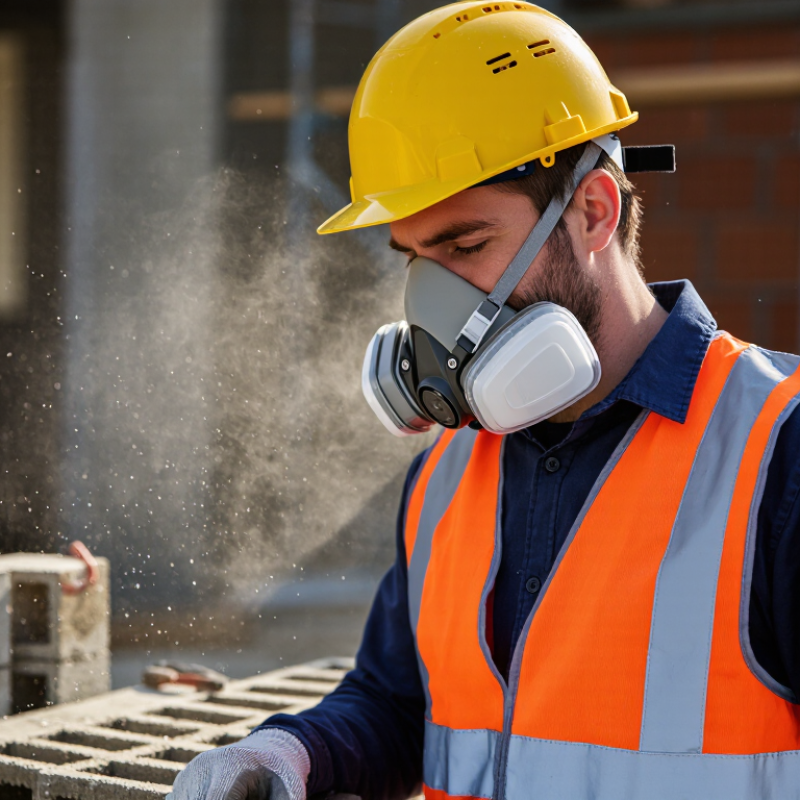
Table of Contents [Hide]
What a Dust-Proof Mask Is and How It Works
A dust-proof mask is a face covering designed to reduce the amount of airborne dust you breathe in. It usually has a filtering layer that captures particles as air passes through it. The mask works best when its edges sit closely against your face, leaving little room for dusty air to slip around the filter. That seal matters. A loose fit can undermine a good filter.
A dust mask is not automatically suitable for every workplace hazard. It may reduce exposure to common particles from sweeping, sanding, or handling dry materials, but it does not necessarily protect against gases or vapors. Check the product’s stated use and the risks of the specific task. At a workbench, a practical fit check means breathing normally and noticing whether air leaks near the nose or cheeks. Facial hair can interfere with the seal. Replace a mask or filter when it becomes damaged, damp, or difficult to breathe through. Comfort matters too. If it keeps shifting during a job, protection may suffer, even if the mask looks sturdy. That detail is easy to overlook.





