


- Home
- A-Z Catalogue
- Products
- Valves
- Cetop
- Manual Directional Valves
- Proportional Valves
- Poppet Valves
- High-Speed Linear Servo Valves
- All High-Speed Linear Servo Valves
- Cetop 10 (NG32) Two Stage Type High Speed Linear Servo Valves – LSVHG-10
- Cetop 10 (NG32) Two Stage Type High Speed Linear Servo Valves – LSVHG-10 (With Fail-Safe)
- Cetop 8 (NG25) Two Stage Type High Speed Linear Servo Valves – LSVHG-06
- Cetop 8 (NG25) Two Stage Type High Speed Linear Servo Valves – LSVHG-06 (With Fail-Safe)
- Cetop 7 (NG16) Two Stage Type High Speed Linear Servo Valves – LSVHG-04
- Cetop 7 (NG16) Two Stage Type High Speed Linear Servo Valves – LSVHG-04 (With Fail-Safe)
- Cetop 5 (NG10) Direct Type High Speed Linear Servo Valves – LSVG-03
- Cetop 5 (NG10) OBE Type Direct Operated Linear Servo Valves – LSVG-03-EH
- Cetop 3 (NG6) OBE Type Direct Operated Linear Servo Valves – LSVG-01-EH
- Pumps
- Pressure control
- Flow Control Valves
- Pressure Control Valves
- All Pressure Control Valves
- Brake Valves
- Direct Relief Valve
- Low Noise Solenoid Controlled Relief Valves
- Low Noise Pilot Operated Relief Valves
- Pilot Operated Relief Valves
- Pressure reducing and relieving valves
- Pressure reducing and check valves
- Pressure control valves
- Remote Control Relief Valves
- Solenoid Controlled Relief Valves – BSG
- Solenoid Controlled Relief Valves – BST
- Unloading relief valves
- Check valves
- Environmental
- Valves
- Hydraulic Systems
- Power pack
- About Us
- Contact
- Blog

China Top Galvanized Steel Pipe for Water Manufacturers?
Choosing a China top manufacturer of Galvanized Steel Pipe For Water requires more than comparing prices. The right supplier must prove coating consistency, dimensional control, and reliable testing. Water systems expose weaknesses quickly. A thin zinc layer can fail around threads, cut ends, or damaged handling points.
Dr. Michael G. Fontana, a respected corrosion engineer, stated, “Corrosion is a natural process.” That simple observation still matters on modern construction sites. Experienced manufacturers inspect zinc coverage, steel chemistry, weld quality, and pressure performance before shipment. They should also explain whether the pipe suits potable water, irrigation, fire protection, or industrial service.
Look closely.
A dependable Chinese factory provides mill certificates, inspection records, and traceable batch numbers. It should identify applicable standards, such as ASTM A53, while confirming local drinking-water requirements. NSF/ANSI/CAN 61 may be relevant for components used with potable water, but acceptance depends on the destination market and project specification.
Factory visits reveal practical details. Watch workers check threaded ends, bundle pipes with protective straps, and separate rejected pieces. Ask how they repair coating damage after cutting. Ask for recent third-party test reports, not only polished brochures. Those documents matter.
No factory is perfect. Even strong suppliers may show occasional coating marks or packaging gaps. What matters is honest disclosure, corrective action, and repeatable control. I would not select a manufacturer from photographs alone. A sample order, independent inspection, and documented water-service application provide stronger evidence. The best supplier combines competitive production with engineering judgment, transparent communication, and dependable after-sales support.
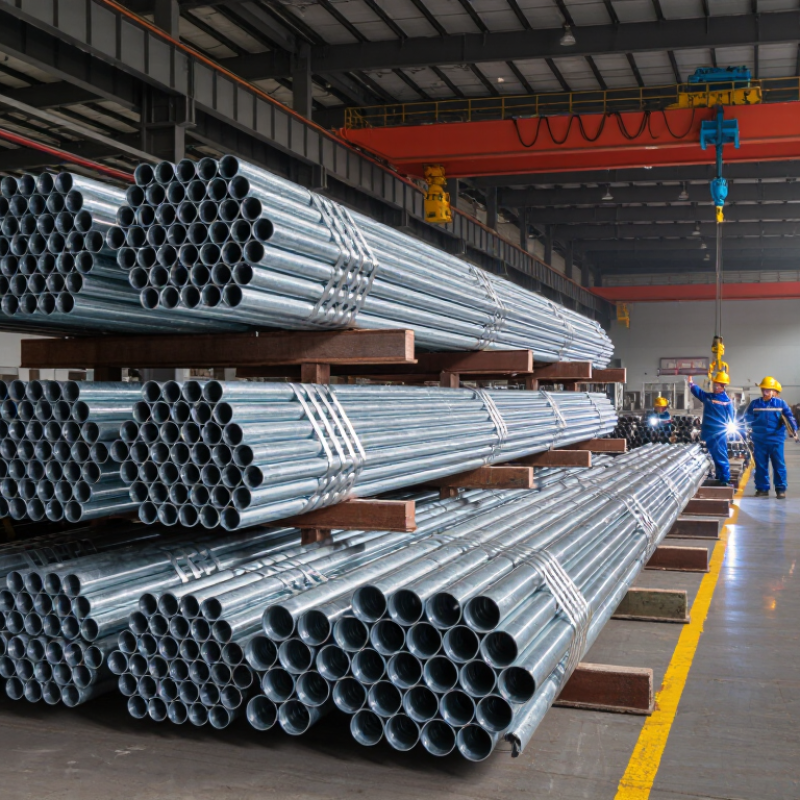
Table of Contents [Hide]
What Are Galvanized Steel Pipes for Water Applications?
Galvanized steel pipes for water applications are carbon steel tubes coated with zinc. The zinc layer protects the steel from moisture and slows surface corrosion. These pipes are strong, rigid, and suitable for many cold-water distribution systems, irrigation lines, and industrial utility networks. Their silver-gray surface also makes damage easier to notice during inspection.
However, galvanized steel is not automatically suitable for every drinking-water project. Water chemistry matters. Acidic or highly mineralized water can gradually attack the zinc coating and create internal scale. Older pipes may reduce flow, even when the exterior looks sound. In practical inspections, I check coating uniformity, wall thickness, threaded areas, and end damage. The fitting method matters too. Poorly sealed threads can leak, while excessive cutting may expose unprotected steel. This part is sometimes overlooked.
Tips: Confirm local drinking-water requirements before ordering. Ask for coating thickness, material test records, and pressure-test data. Flush new lines thoroughly, then inspect the first water for discoloration or particles. Keep pipe ends capped during storage. Do not place galvanized pipe directly against incompatible metals without proper isolation. Small details matter. A better specification should include water temperature, pressure, chemistry, diameter, and expected service life. Even then, field conditions can differ from the original plan, so periodic inspection remains necessary.