


- Home
- A-Z Catalogue
- Products
- Valves
- Cetop
- Manual Directional Valves
- Proportional Valves
- Poppet Valves
- High-Speed Linear Servo Valves
- All High-Speed Linear Servo Valves
- Cetop 10 (NG32) Two Stage Type High Speed Linear Servo Valves – LSVHG-10
- Cetop 10 (NG32) Two Stage Type High Speed Linear Servo Valves – LSVHG-10 (With Fail-Safe)
- Cetop 8 (NG25) Two Stage Type High Speed Linear Servo Valves – LSVHG-06
- Cetop 8 (NG25) Two Stage Type High Speed Linear Servo Valves – LSVHG-06 (With Fail-Safe)
- Cetop 7 (NG16) Two Stage Type High Speed Linear Servo Valves – LSVHG-04
- Cetop 7 (NG16) Two Stage Type High Speed Linear Servo Valves – LSVHG-04 (With Fail-Safe)
- Cetop 5 (NG10) Direct Type High Speed Linear Servo Valves – LSVG-03
- Cetop 5 (NG10) OBE Type Direct Operated Linear Servo Valves – LSVG-03-EH
- Cetop 3 (NG6) OBE Type Direct Operated Linear Servo Valves – LSVG-01-EH
- Pumps
- Pressure control
- Flow Control Valves
- Pressure Control Valves
- All Pressure Control Valves
- Brake Valves
- Direct Relief Valve
- Low Noise Solenoid Controlled Relief Valves
- Low Noise Pilot Operated Relief Valves
- Pilot Operated Relief Valves
- Pressure reducing and relieving valves
- Pressure reducing and check valves
- Pressure control valves
- Remote Control Relief Valves
- Solenoid Controlled Relief Valves – BSG
- Solenoid Controlled Relief Valves – BST
- Unloading relief valves
- Check valves
- Environmental
- Valves
- Hydraulic Systems
- Power pack
- About Us
- Contact
- Blog

China Best Ceramic Laser Reflectors Supplier?
Finding the China Best Ceramic Laser Reflectors Supplier? The answer depends on your laser system, not marketing language. Ceramic Laser Reflectors must match wavelength, beam power, reflector geometry, thermal load, and mounting conditions. A reflector that performs well at 1,064 nanometers may fail under ultraviolet exposure. Small details matter. Surface roughness, coating adhesion, pore structure, and edge quality can change beam stability.
Laser pioneer Theodore Maiman once said, “The laser is a solution looking for a problem.” His words remain useful here. The right reflector should solve a defined engineering problem, rather than simply carry an impressive specification. Experienced suppliers should provide material data, coating options, dimensional tolerances, and test results. Ask about laser-induced damage threshold testing, preferably referencing recognized methods such as ISO 21254. Request sample inspection reports. Check whether values apply to your wavelength and pulse duration.
This guide examines Chinese manufacturers through practical evidence. It considers alumina, beryllia alternatives, zirconia, and other technical ceramics. It also reviews thermal expansion, dielectric behavior, production consistency, and quality control. A polished catalog is not enough. Factory experience matters. So does communication during design changes.
No supplier is perfect. Some companies offer excellent machining but limited coating expertise. Others provide strong coatings but weak documentation. That trade-off deserves attention. Buyers should compare samples, test procedures, lead times, and after-sales support. The strongest choice is the supplier that can explain its limits clearly. Reliability begins there.
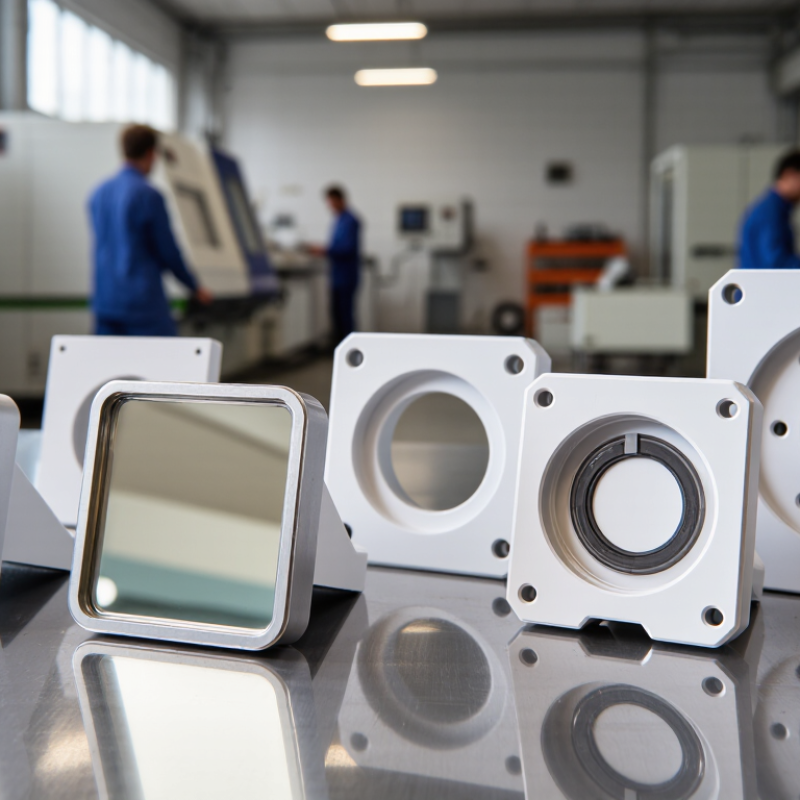
Table of Contents [Hide]
Ceramic Laser Reflectors: Types, Materials, and Key Optical Data
Ceramic laser reflectors are not one universal product. Common types include diffuse reflectors, specular reflectors, and custom-shaped reflector cavities. Alumina offers strong thermal stability and broad availability. Zirconia provides higher toughness and controlled surface quality. Beryllia can conduct heat efficiently, but it requires strict handling controls. Porous white ceramics often scatter light, while dense, polished ceramics support more directional reflection.
Optical data must match the laser wavelength. Typical specifications include reflectance, scattering, absorption, surface roughness, thermal expansion, and maximum operating temperature. In many visible and near-infrared systems, engineered white ceramics can deliver over 90% diffuse reflectance, but the value changes with porosity and measurement geometry. A single reflectance number is not enough. The test wavelength matters. So does the incident angle. Grand View Research’s 2024 laser technology report estimated the global market at about USD 19.8 billion in 2023, with strong growth through 2030. This expansion increases demand for repeatable optical ceramics.
When evaluating a China ceramic laser reflector supplier, request wavelength-specific test data, dimensional tolerances, coating details, and thermal-cycle results. ISO 10110 optical documentation can improve drawing clarity and inspection consistency. Ask whether reflectance was measured using an integrating sphere or a directional setup. These methods can produce different results. I would also check batch variation, because laboratory samples may look better than production parts. That shortcut often fails. A reliable supplier should provide traceable reports, sample approval, and realistic performance limits rather than impressive but incomplete figures.
China Best Ceramic Laser Reflectors Supplier? - Ceramic Laser Reflectors: Types, Materials, and Key Optical Data
| Reflector Type | Typical Ceramic Material | Common Wavelength Range | Typical Reflectance | Reflectance Mode | Typical Surface Finish | Thermal Conductivity | Coefficient of Thermal Expansion | Typical Operating Considerations |
|---|---|---|---|---|---|---|---|---|
| Diffuse cavity reflector | High-purity porous alumina, Al2O3 ≥ 99% | 400–1,100 nm | 90–98% at 532–1,064 nm | Diffuse hemispherical reflection | Matte, porous, or micro-textured surface | 3–15 W/m·K | 6.5–8.5 × 10⁻⁶/K | Widely used for flashlamp and diode-pumped cavities because of its high whiteness, electrical insulation, and good temperature resistance. |
| Dense ceramic reflector | Dense alumina, Al2O3 ≥ 99.5% | 400–1,100 nm | 80–95% at 532–1,064 nm | Diffuse to semi-diffuse reflection | Ground, lapped, or glazed | 20–35 W/m·K | 7.0–8.5 × 10⁻⁶/K | Provides improved mechanical strength and thermal conduction compared with porous alumina; reflectance depends strongly on porosity, color, and surface treatment. |
| White yttria reflector | Yttria, Y2O3 ≥ 99.9% | 400–2,000 nm | 85–96% at 1,064 nm | Diffuse reflection | Fine-grained matte or polished and coated | 8–15 W/m·K | 8–11 × 10−6/K | Useful when low optical absorption and high-temperature chemical stability are required; mechanical shock resistance is lower than that of alumina. |
| High-temperature zirconia reflector | Stabilized zirconia, ZrO2 | 400–2,000 nm | 75–92% at 1,064 nm | Diffuse reflection | Matte, textured, or glazed | 2–3 W/m·K | 9–11 × 10−6/K | Offers high fracture toughness and low thermal conductivity; thermal-gradient design and mounting are important because of its relatively high expansion coefficient. |
| Thermally conductive ceramic reflector | Beryllium oxide, BeO | 400–1,100 nm | 85–96% at 532–1,064 nm | Diffuse reflection | Matte or micro-textured | 200–330 W/m·K | 7.5–8.5 × 10⁻⁶/K | Combines high thermal conductivity with electrical insulation. Beryllium-containing dust is hazardous, so machining and handling require strict industrial controls. |
| Dielectric-coated ceramic mirror | Polished alumina or fused ceramic substrate with multilayer dielectric coating | 355, 532, 633, 808, 915, or 1,064 nm | 99.0–99.9% at the design wavelength | Specular reflection | Polished; typical surface roughness Ra ≤ 10 nm | 20–35 W/m·K for alumina substrate | 7.0–8.5 × 10⁻⁶/K for alumina substrate | Provides high reflectivity and low scatter at a specified angle of incidence. Coating bandwidth, laser-induced damage threshold, and environmental durability must be specified separately. |
| Metal-coated ceramic mirror | Polished alumina substrate with protected aluminum or silver coating | 450–2,000 nm | 90–98%, depending on metal and wavelength | Specular reflection | Polished; protected surface coating | 20–35 W/m·K for alumina substrate | 7.0–8.5 × 10⁻⁶/K for alumina substrate | Offers broad spectral coverage, but coating absorption, oxidation resistance, humidity resistance, and laser damage threshold require application-specific qualification. |
| Glazed ceramic reflector | Alumina or zirconia body with white oxide glaze | 400–1,100 nm | 85–97% at 532–1,064 nm | Diffuse or semi-diffuse reflection | Smooth glazed surface | 2–20 W/m·K, depending on body and glaze | 6.5–11 × 10−6/K | Provides a cleanable, chemically resistant surface. The glaze and ceramic body should have compatible thermal expansion to reduce crazing or delamination. |
Engineering note: The optical values are representative ranges for material and surface classes, not guaranteed product specifications. Reflectance varies with wavelength, angle of incidence, polarization, porosity, grain size, coating design, surface contamination, and measurement geometry. For laser use, confirm total hemispherical or specular reflectance, absorption, scatter, surface roughness, coating durability, and laser-induced damage threshold using the exact operating wavelength and power density.





