


- Home
- A-Z Catalogue
- Products
- Valves
- Cetop
- Manual Directional Valves
- Proportional Valves
- Poppet Valves
- High-Speed Linear Servo Valves
- All High-Speed Linear Servo Valves
- Cetop 10 (NG32) Two Stage Type High Speed Linear Servo Valves – LSVHG-10
- Cetop 10 (NG32) Two Stage Type High Speed Linear Servo Valves – LSVHG-10 (With Fail-Safe)
- Cetop 8 (NG25) Two Stage Type High Speed Linear Servo Valves – LSVHG-06
- Cetop 8 (NG25) Two Stage Type High Speed Linear Servo Valves – LSVHG-06 (With Fail-Safe)
- Cetop 7 (NG16) Two Stage Type High Speed Linear Servo Valves – LSVHG-04
- Cetop 7 (NG16) Two Stage Type High Speed Linear Servo Valves – LSVHG-04 (With Fail-Safe)
- Cetop 5 (NG10) Direct Type High Speed Linear Servo Valves – LSVG-03
- Cetop 5 (NG10) OBE Type Direct Operated Linear Servo Valves – LSVG-03-EH
- Cetop 3 (NG6) OBE Type Direct Operated Linear Servo Valves – LSVG-01-EH
- Pumps
- Pressure control
- Flow Control Valves
- Pressure Control Valves
- All Pressure Control Valves
- Brake Valves
- Direct Relief Valve
- Low Noise Solenoid Controlled Relief Valves
- Low Noise Pilot Operated Relief Valves
- Pilot Operated Relief Valves
- Pressure reducing and relieving valves
- Pressure reducing and check valves
- Pressure control valves
- Remote Control Relief Valves
- Solenoid Controlled Relief Valves – BSG
- Solenoid Controlled Relief Valves – BST
- Unloading relief valves
- Check valves
- Environmental
- Valves
- Hydraulic Systems
- Power pack
- About Us
- Contact
- Blog

China Best Component Terminal Block Manufacturer?
Choosing China’s best Component Terminal Block manufacturer requires more than comparing prices or catalog photos. Terminal blocks sit at the connection point, where a loose clamp or poorly controlled material can interrupt an entire panel. The market’s importance is rising with electrification: the International Energy Agency’s 2023 report, Electricity Grids and Secure Energy Transitions, says annual grid investment must exceed US$600 billion by 2030 to meet global needs. That wider trend puts more attention on dependable connections, although it does not prove that any single supplier is reliable.
Look for evidence you can verify. Ask for current ratings, temperature-rise results, wire-size compatibility, material specifications, and production traceability. IEC 60947-7-1 provides a relevant benchmark for terminal blocks used with copper conductors; confirm the product’s declared compliance and test documentation directly. Small details matter. A sample wired with the intended conductor can reveal clamp access, labeling clarity, and how securely the block holds after repeated handling. For projects exposed to vibration or heat, request test conditions that match the actual installation, rather than accepting a broad “industrial grade” claim. Photos help, but they are not test reports. A supplier may offer fast customization and competitive lead times, yet those advantages matter less if inspection records are incomplete. No manufacturer is perfect. The useful question is whether its engineering team can explain limitations clearly, provide consistent documentation, and respond when a sample fails. This guide examines practical criteria for comparing Chinese manufacturers without treating marketing claims as proof.
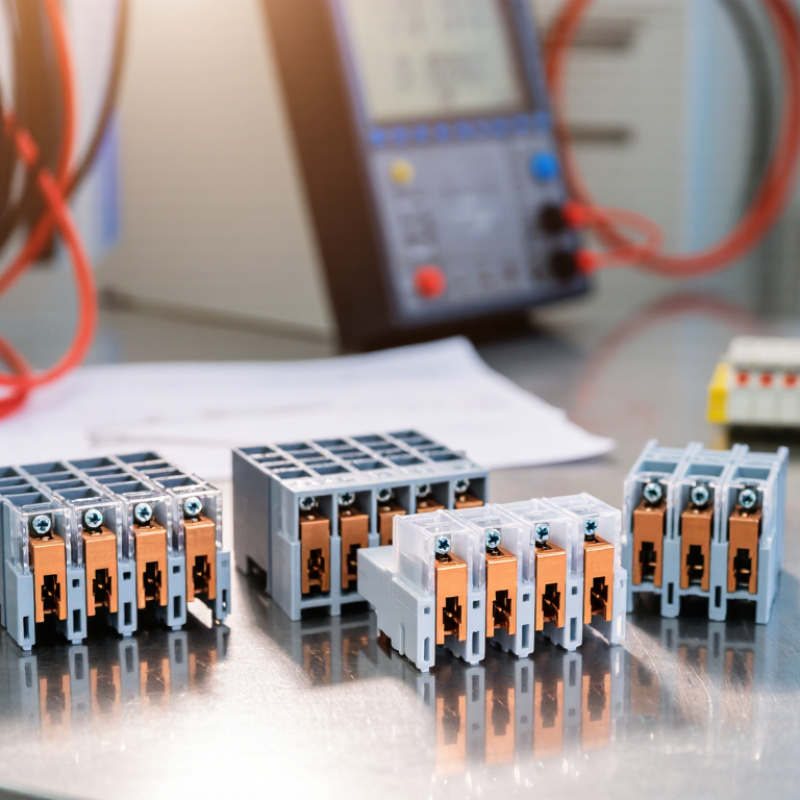
Table of Contents [Hide]
What Is a Terminal Block? IEC 60947-7-1 Covers up to 1,000 V AC and 1,500 V DC
What Is a Terminal Block?
IEC 60947-7-1 Covers up to 1,000 V AC and 1,500 V DC
A terminal block joins electrical conductors at a fixed point, often inside a control cabinet. Its insulated body holds conductive parts, while screws or spring clamps secure the wires. IEC 60947-7-1 addresses certain terminal blocks for copper conductors, with voltage limits up to 1,000 V AC and 1,500 V DC. These are standard limits, not automatic ratings for every product. Check the manufacturer’s datasheet for the specific model.
The voltage figure is only one part of selection. A panel builder should also check conductor size, current rating, temperature limits, and the specified tightening torque. A loose screw can create a hot spot; an oversized wire may not clamp securely. Small details matter. End plates and markers help keep rows organized, but they do not replace correct installation. It is easy to treat compliance as a complete safety answer. It isn’t. Confirm that the terminal block suits the application, the wiring method, and the relevant standard edition. Even careful selection can miss a detail, so review the finished assembly before energizing it.





