


- Home
- A-Z Catalogue
- Products
- Valves
- Cetop
- Manual Directional Valves
- Proportional Valves
- Poppet Valves
- High-Speed Linear Servo Valves
- All High-Speed Linear Servo Valves
- Cetop 10 (NG32) Two Stage Type High Speed Linear Servo Valves – LSVHG-10
- Cetop 10 (NG32) Two Stage Type High Speed Linear Servo Valves – LSVHG-10 (With Fail-Safe)
- Cetop 8 (NG25) Two Stage Type High Speed Linear Servo Valves – LSVHG-06
- Cetop 8 (NG25) Two Stage Type High Speed Linear Servo Valves – LSVHG-06 (With Fail-Safe)
- Cetop 7 (NG16) Two Stage Type High Speed Linear Servo Valves – LSVHG-04
- Cetop 7 (NG16) Two Stage Type High Speed Linear Servo Valves – LSVHG-04 (With Fail-Safe)
- Cetop 5 (NG10) Direct Type High Speed Linear Servo Valves – LSVG-03
- Cetop 5 (NG10) OBE Type Direct Operated Linear Servo Valves – LSVG-03-EH
- Cetop 3 (NG6) OBE Type Direct Operated Linear Servo Valves – LSVG-01-EH
- Pumps
- Pressure control
- Flow Control Valves
- Pressure Control Valves
- All Pressure Control Valves
- Brake Valves
- Direct Relief Valve
- Low Noise Solenoid Controlled Relief Valves
- Low Noise Pilot Operated Relief Valves
- Pilot Operated Relief Valves
- Pressure reducing and relieving valves
- Pressure reducing and check valves
- Pressure control valves
- Remote Control Relief Valves
- Solenoid Controlled Relief Valves – BSG
- Solenoid Controlled Relief Valves – BST
- Unloading relief valves
- Check valves
- Environmental
- Valves
- Hydraulic Systems
- Power pack
- About Us
- Contact
- Blog

How to Check a Fuel Pump Motor Commutator?
A fuel pump can sound healthy and still deliver weak pressure. One overlooked cause is a worn or contaminated Fuel Pump Motor Commutator. Its copper segments and carbon brushes carry current to the armature. When contact becomes uneven, the pump may run intermittently, draw excess current, or fail under load. Small clues matter: darkened copper, deep grooves, loose segments, or brush dust inside the end cap.
This guide explains how to inspect the commutator methodically, using clear visual checks and basic electrical measurements. Disconnect power before opening the motor, and follow the pump manufacturer’s service instructions. A close-up photo can help reveal scoring that is easy to miss under poor lighting. A multimeter can identify some electrical faults, but it cannot confirm every mechanical defect. That distinction is worth remembering.
I can’t responsibly attribute a quotation to a named industry expert without a verifiable source, and no source article was supplied. Rather than inventing authority, this introduction focuses on practical inspection principles. The following outline covers safe disassembly, commutator condition, brush contact, continuity checks, and signs that call for replacement. Not every mark means failure. Yet a rough, burned, or uneven surface deserves careful attention before the pump is returned to service.
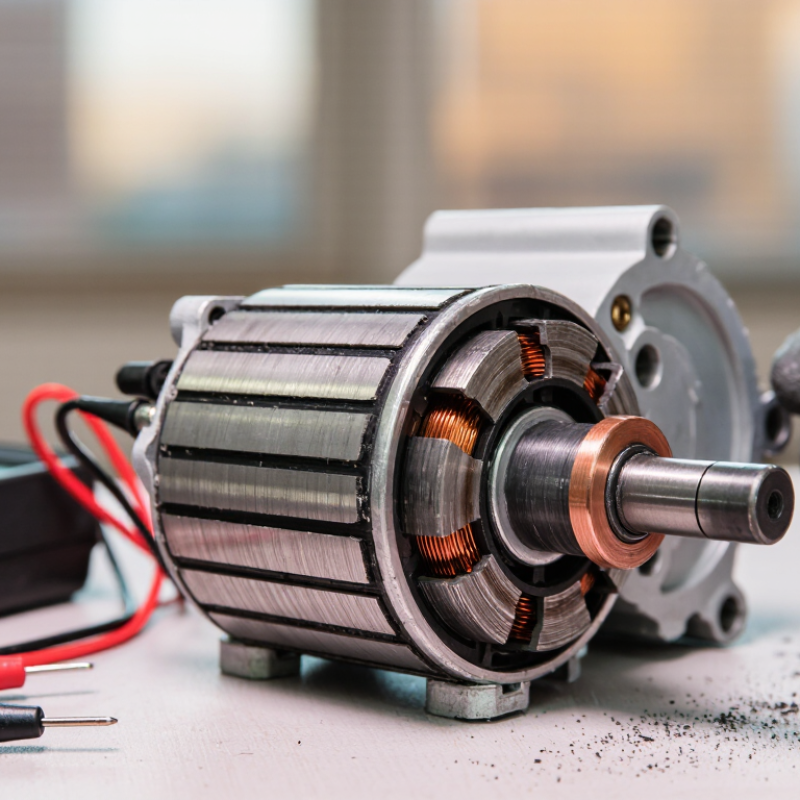
Table of Contents [Hide]
Isolate the Nominal 12 V Pump and Remove It Before Commutator Inspection
Before inspecting a fuel-pump commutator, isolate the vehicle’s electrical supply and remove the pump using the vehicle service procedure. A “12 V” label describes nominal system voltage, not proof that wiring is de-energized. ISO 16750-2:2023 covers electrical-load conditions for 12 V and 24 V road-vehicle systems. That standard gives useful context, but it is not a pump-removal guide. Disconnect the battery’s negative terminal, relieve fuel pressure as directed, and keep the work area well ventilated. Fuel vapour can ignite easily.
Once removed, place the pump on a clean, dry bench. Check its terminals and housing for heat damage, then inspect the commutator for deep grooves, lifted segments, heavy pitting, or uneven dark deposits. A thin, even contact track may be normal; severe scoring can suggest brush wear or contamination. Do not scrape copper aggressively. A visual check can miss intermittent faults, so record what you see and compare it with the vehicle’s service limits. That part is easy to overlook.
Tips: Keep the pump unpowered during inspection. Never energize an open pump near fuel or vapour. If the commutator is badly damaged, stop and seek qualified repair advice.





