


- Home
- A-Z Catalogue
- Products
- Valves
- Cetop
- Manual Directional Valves
- Proportional Valves
- Poppet Valves
- High-Speed Linear Servo Valves
- All High-Speed Linear Servo Valves
- Cetop 10 (NG32) Two Stage Type High Speed Linear Servo Valves – LSVHG-10
- Cetop 10 (NG32) Two Stage Type High Speed Linear Servo Valves – LSVHG-10 (With Fail-Safe)
- Cetop 8 (NG25) Two Stage Type High Speed Linear Servo Valves – LSVHG-06
- Cetop 8 (NG25) Two Stage Type High Speed Linear Servo Valves – LSVHG-06 (With Fail-Safe)
- Cetop 7 (NG16) Two Stage Type High Speed Linear Servo Valves – LSVHG-04
- Cetop 7 (NG16) Two Stage Type High Speed Linear Servo Valves – LSVHG-04 (With Fail-Safe)
- Cetop 5 (NG10) Direct Type High Speed Linear Servo Valves – LSVG-03
- Cetop 5 (NG10) OBE Type Direct Operated Linear Servo Valves – LSVG-03-EH
- Cetop 3 (NG6) OBE Type Direct Operated Linear Servo Valves – LSVG-01-EH
- Pumps
- Pressure control
- Flow Control Valves
- Pressure Control Valves
- All Pressure Control Valves
- Brake Valves
- Direct Relief Valve
- Low Noise Solenoid Controlled Relief Valves
- Low Noise Pilot Operated Relief Valves
- Pilot Operated Relief Valves
- Pressure reducing and relieving valves
- Pressure reducing and check valves
- Pressure control valves
- Remote Control Relief Valves
- Solenoid Controlled Relief Valves – BSG
- Solenoid Controlled Relief Valves – BST
- Unloading relief valves
- Check valves
- Environmental
- Valves
- Hydraulic Systems
- Power pack
- About Us
- Contact
- Blog

Which Renishaw Raman Spectrometer Is Best to Buy in 2026?
Choosing a Renishaw Raman spectrometer in 2026 is less about finding a universal winner than matching an instrument to real samples. A polished crystal, a layered semiconductor, and a pharmaceutical tablet place different demands on optics, mapping, and workflow. There is no universal winner.
Grand View Research’s Raman Spectroscopy Market Size, Share & Trends Analysis Report estimated the global market at USD 1.06 billion in 2023 and projected a 9.2% compound annual growth rate from 2024 to 2030. That growth signals wider adoption, not a guarantee that every laboratory needs the most elaborate configuration. Buyers should compare the Renishaw inVia family and other suitable models against sample type, required spatial resolution, mapping area, fluorescence risk, and operator experience. A tiny inclusion under a microscope is not the same job as screening many samples each day.
This guide focuses on practical trade-offs: research flexibility, automated measurement, software, service, and total cost of ownership. Product specifications and configurations can change, so verify current details with Renishaw and request a demonstration using representative samples. One honest limitation: published specifications cannot predict every sample’s fluorescence or heating behavior. Test your own material, if possible. A careful comparison may feel slower, but it can prevent an expensive mismatch.
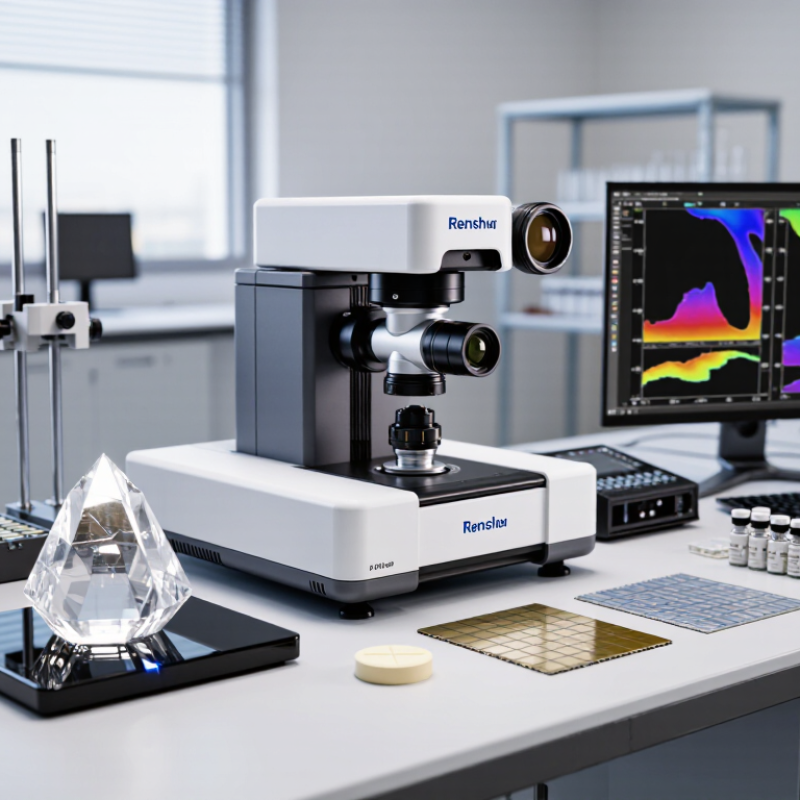
Table of Contents [Hide]
How Renishaw Raman Spectrometers Work
How Raman Spectrometers Work
A Raman spectrometer shines a laser onto a sample and measures the small fraction of light that scatters with a changed energy. That energy difference forms a spectrum, often shown as peaks against Raman shift in cm⁻¹. Each peak reflects molecular vibrations, helping analysts distinguish materials or inspect changes in a sample. It is a useful fingerprint, not a magic answer. Fluorescence, dirty surfaces, and uneven focus can obscure weak peaks.
The measurement path is simple in principle: laser, sample, collection optics, filter, and detector. A notch or edge filter rejects intense laser light so the detector can capture weaker Raman signals. Calibration matters. ASTM E1840 lists polystyrene’s peak near 1001.4 cm⁻¹ as a Raman-shift reference. For intensity response, NIST SRM 2242 is designed for systems using 785 nm excitation. These references help check different parts of instrument performance; neither guarantees a good result on every sample.
Tips: Start with a clean sample and a stable focus. Record the laser wavelength, integration time, and calibration check with each measurement. If a peak looks unexpected, repeat the scan at another spot. Small differences can come from sample texture, not chemistry. Calibration is easy to postpone. That is a mistake.





