


- Home
- A-Z Catalogue
- Products
- Valves
- Cetop
- Manual Directional Valves
- Proportional Valves
- Poppet Valves
- High-Speed Linear Servo Valves
- All High-Speed Linear Servo Valves
- Cetop 10 (NG32) Two Stage Type High Speed Linear Servo Valves – LSVHG-10
- Cetop 10 (NG32) Two Stage Type High Speed Linear Servo Valves – LSVHG-10 (With Fail-Safe)
- Cetop 8 (NG25) Two Stage Type High Speed Linear Servo Valves – LSVHG-06
- Cetop 8 (NG25) Two Stage Type High Speed Linear Servo Valves – LSVHG-06 (With Fail-Safe)
- Cetop 7 (NG16) Two Stage Type High Speed Linear Servo Valves – LSVHG-04
- Cetop 7 (NG16) Two Stage Type High Speed Linear Servo Valves – LSVHG-04 (With Fail-Safe)
- Cetop 5 (NG10) Direct Type High Speed Linear Servo Valves – LSVG-03
- Cetop 5 (NG10) OBE Type Direct Operated Linear Servo Valves – LSVG-03-EH
- Cetop 3 (NG6) OBE Type Direct Operated Linear Servo Valves – LSVG-01-EH
- Pumps
- Pressure control
- Flow Control Valves
- Pressure Control Valves
- All Pressure Control Valves
- Brake Valves
- Direct Relief Valve
- Low Noise Solenoid Controlled Relief Valves
- Low Noise Pilot Operated Relief Valves
- Pilot Operated Relief Valves
- Pressure reducing and relieving valves
- Pressure reducing and check valves
- Pressure control valves
- Remote Control Relief Valves
- Solenoid Controlled Relief Valves – BSG
- Solenoid Controlled Relief Valves – BST
- Unloading relief valves
- Check valves
- Environmental
- Valves
- Hydraulic Systems
- Power pack
- About Us
- Contact
- Blog

Who Are the Best Insulation Parts Suppliers in China?
Insulation Parts are small components with large consequences. A sleeve, spacer, gasket, or molded barrier can affect heat loss, electrical isolation, equipment life, and maintenance needs. Yet “best supplier” has no single definition. The right choice depends on the application, material, operating conditions, and required tolerances.
The scale of the efficiency challenge is clear. UNEP and the Global Alliance for Buildings and Construction reported that buildings and construction accounted for 34% of global energy demand and 37% of energy- and process-related carbon dioxide emissions in 2022. Their 2023 Global Status Report makes energy performance an important consideration for building projects. It does not rank Chinese component manufacturers, however. Supplier comparisons still require product-level evidence.
This guide examines Chinese suppliers through practical criteria: material specifications, manufacturing capability, quality controls, customization, and communication. Look for current test reports, traceable materials, clear dimensional drawings, and samples that match production conditions. Details matter. A polished catalog is not proof of consistent output, and online supplier listings can be incomplete. That is worth remembering. The strongest shortlist is built by checking documents, asking specific technical questions, and confirming that a supplier can meet the intended use. The sections ahead help buyers assess those claims without treating price or marketing language as a substitute for evidence.
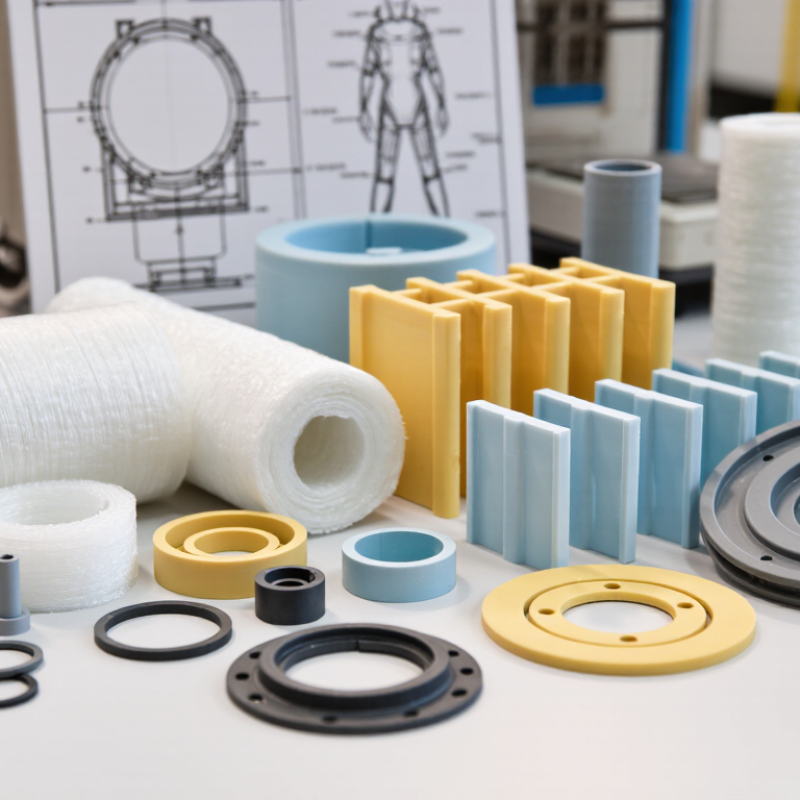
Table of Contents [Hide]
What Insulation Parts Are and Where They Are Used
Insulation parts are nonconductive components that separate energized conductors from other parts of an electrical assembly. They may also support wires, limit heat transfer, or help maintain clearances. Common forms include sheets, tubes, washers, barriers, and molded spacers. Fit matters.
These parts appear in motors, transformers, switchgear, and battery equipment. Inside a motor, a thin insulating sheet can separate windings from the metal housing. In a transformer, formed barriers help keep conductors apart, even when space is tight. Materials such as mica, fiberglass laminate, and engineered plastics suit different temperatures, loads, and moisture conditions. A material name alone is not enough.
Choosing parts calls for checking drawings, tolerances, operating temperature, and exposure to vibration or oil. Ask suppliers for material specifications and relevant test information, then inspect samples for clean edges and consistent thickness. Small details matter. A washer that is slightly too wide may interfere with assembly; one that is too thin may not provide the intended separation. Datasheets are useful, but they cannot describe every real installation. A careful fit check may reveal what the drawing missed.





