


- Home
- A-Z Catalogue
- Products
- Valves
- Cetop
- Manual Directional Valves
- Proportional Valves
- Poppet Valves
- High-Speed Linear Servo Valves
- All High-Speed Linear Servo Valves
- Cetop 10 (NG32) Two Stage Type High Speed Linear Servo Valves – LSVHG-10
- Cetop 10 (NG32) Two Stage Type High Speed Linear Servo Valves – LSVHG-10 (With Fail-Safe)
- Cetop 8 (NG25) Two Stage Type High Speed Linear Servo Valves – LSVHG-06
- Cetop 8 (NG25) Two Stage Type High Speed Linear Servo Valves – LSVHG-06 (With Fail-Safe)
- Cetop 7 (NG16) Two Stage Type High Speed Linear Servo Valves – LSVHG-04
- Cetop 7 (NG16) Two Stage Type High Speed Linear Servo Valves – LSVHG-04 (With Fail-Safe)
- Cetop 5 (NG10) Direct Type High Speed Linear Servo Valves – LSVG-03
- Cetop 5 (NG10) OBE Type Direct Operated Linear Servo Valves – LSVG-03-EH
- Cetop 3 (NG6) OBE Type Direct Operated Linear Servo Valves – LSVG-01-EH
- Pumps
- Pressure control
- Flow Control Valves
- Pressure Control Valves
- All Pressure Control Valves
- Brake Valves
- Direct Relief Valve
- Low Noise Solenoid Controlled Relief Valves
- Low Noise Pilot Operated Relief Valves
- Pilot Operated Relief Valves
- Pressure reducing and relieving valves
- Pressure reducing and check valves
- Pressure control valves
- Remote Control Relief Valves
- Solenoid Controlled Relief Valves – BSG
- Solenoid Controlled Relief Valves – BST
- Unloading relief valves
- Check valves
- Environmental
- Valves
- Hydraulic Systems
- Power pack
- About Us
- Contact
- Blog

China Best Corrugated Steel Pipe Manufacturers?
China’s steelmaking scale makes it a significant place to search for Corrugated Steel Pipe suppliers. World Steel Association data report that China produced 1,005.1 million tonnes of crude steel in 2024, out of 1,882.6 million tonnes worldwide. That is useful context, not proof of pipe quality. Steel output alone cannot identify the best manufacturer.
A credible comparison should examine more than price and catalogue photographs. Buyers can request mill certificates, coating specifications, dimensional tolerances, and documented inspection procedures. They should also verify whether a factory produces the required pipe profiles, diameters, and fittings in-house. Small details matter: a coating-thickness record or a clearly marked pipe section can reveal how carefully quality is controlled. Ask for recent project references, too.
Design requirements deserve equal attention. The Federal Highway Administration’s Hydraulic Design of Highway Culverts (HDS-5) provides technical guidance for culvert design, including hydraulic considerations. It does not rank Chinese manufacturers, and no single supplier suits every project. That distinction is easy to miss. This guide therefore treats “best” as a practical match between engineering needs, manufacturing evidence, delivery capability, and after-sales support—not a universal label. Some information may remain difficult to verify from public listings, so direct checks are necessary.
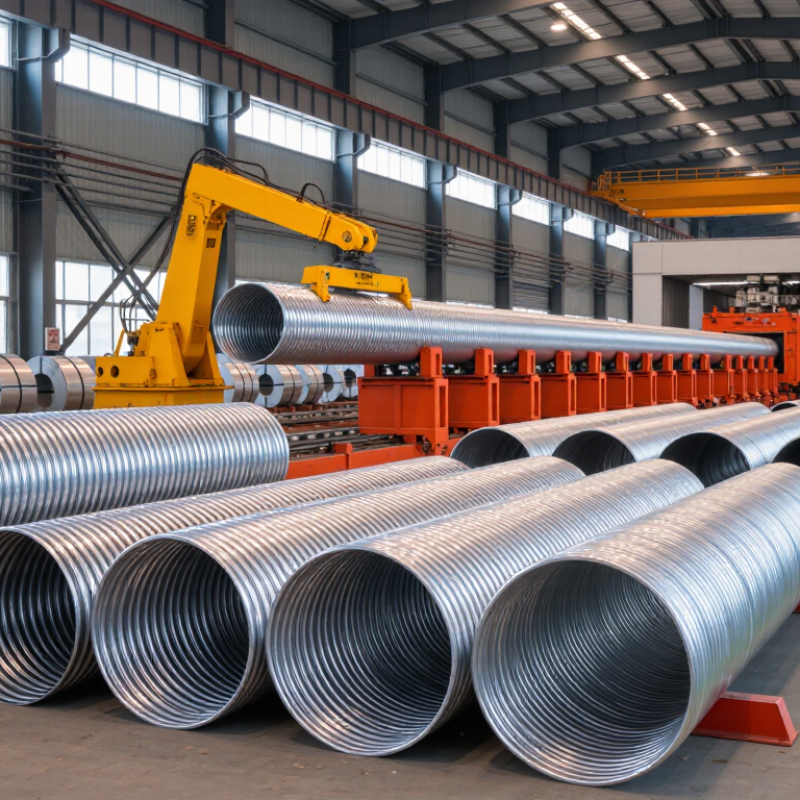
Table of Contents [Hide]
What Defines Corrugated Steel Pipe and Its Core Infrastructure Uses?
Corrugated steel pipe is formed from steel sheet shaped into repeated ridges and valleys. These corrugations add stiffness, helping the pipe resist soil pressure while remaining relatively light to transport and install. It is not simply a smooth metal tube with a rough surface. The profile and steel thickness both affect its structural behavior.
Its core infrastructure uses include road culverts, stormwater drainage, and cross-drains beneath railways or access routes. A culvert may carry runoff under a road embankment, where blocked flow can cause standing water or erosion at the outlet. Corrugated steel pipe is also used to protect utility lines in some projects. The right application depends on flow, soil conditions, burial depth, and expected loads.
Details matter. Engineers and installers consider pipe diameter, corrugation shape, protective coating, joint design, and the quality of bedding and backfill. Poor compaction can create uneven support around the pipe. A product can look robust and still be a poor match for a corrosive site or heavy traffic. That part deserves careful review. Soil chemistry, abrasion from sediment, and maintenance access may influence service life, so project specifications should be checked against actual site conditions rather than assumptions.





