- Home
- A-Z Catalogue
- Products
- Valves
- Cetop
- Manual Directional Valves
- Proportional Valves
- Poppet Valves
- High-Speed Linear Servo Valves
- All High-Speed Linear Servo Valves
- Cetop 10 (NG32) Two Stage Type High Speed Linear Servo Valves – LSVHG-10
- Cetop 10 (NG32) Two Stage Type High Speed Linear Servo Valves – LSVHG-10 (With Fail-Safe)
- Cetop 8 (NG25) Two Stage Type High Speed Linear Servo Valves – LSVHG-06
- Cetop 8 (NG25) Two Stage Type High Speed Linear Servo Valves – LSVHG-06 (With Fail-Safe)
- Cetop 7 (NG16) Two Stage Type High Speed Linear Servo Valves – LSVHG-04
- Cetop 7 (NG16) Two Stage Type High Speed Linear Servo Valves – LSVHG-04 (With Fail-Safe)
- Cetop 5 (NG10) Direct Type High Speed Linear Servo Valves – LSVG-03
- Cetop 5 (NG10) OBE Type Direct Operated Linear Servo Valves – LSVG-03-EH
- Cetop 3 (NG6) OBE Type Direct Operated Linear Servo Valves – LSVG-01-EH
- Pumps
- Pressure control
- Flow Control Valves
- Pressure Control Valves
- All Pressure Control Valves
- Brake Valves
- Direct Relief Valve
- Low Noise Solenoid Controlled Relief Valves
- Low Noise Pilot Operated Relief Valves
- Pilot Operated Relief Valves
- Pressure reducing and relieving valves
- Pressure reducing and check valves
- Pressure control valves
- Remote Control Relief Valves
- Solenoid Controlled Relief Valves – BSG
- Solenoid Controlled Relief Valves – BST
- Unloading relief valves
- Check valves
- Environmental
- Valves
- Hydraulic Systems
- Power pack
- About Us
- Contact
- Blog

10 Best Cemented Carbide Inserts for CNC Machining
Choosing the right insert can decide whether a CNC job runs smoothly or leaves a rough edge and a worn tool. This guide to the 10 Best Cemented Carbide Inserts for CNC Machining compares options by grade, coating, geometry, and intended workpiece material. The aim is practical: help machinists narrow their choices, not promise one insert will suit every setup.
Cemented-carbide researcher H. O. Andrén’s work offers a useful reminder: “Microstructure shapes performance.” This is a paraphrase, not a verified verbatim quotation. Carbide composition and binder content affect hardness, toughness, and wear behavior. In the shop, those differences show up in familiar ways: a chipped corner, a shiny flank, or a finish that drifts after repeated passes. Small details matter.
The selections consider turning, milling, and general-purpose applications, alongside factors such as heat, interrupted cuts, and chip control. A coating that performs well in steel may not be the best choice for aluminum or stainless steel. Machine rigidity and coolant also change the result. No ranking can replace a controlled trial on the actual machine. That caveat matters. Use the list as a starting point, then check the insert maker’s cutting data and test cautiously. The best choice is often the one that stays predictable in your conditions—not the one with the boldest catalog claim.
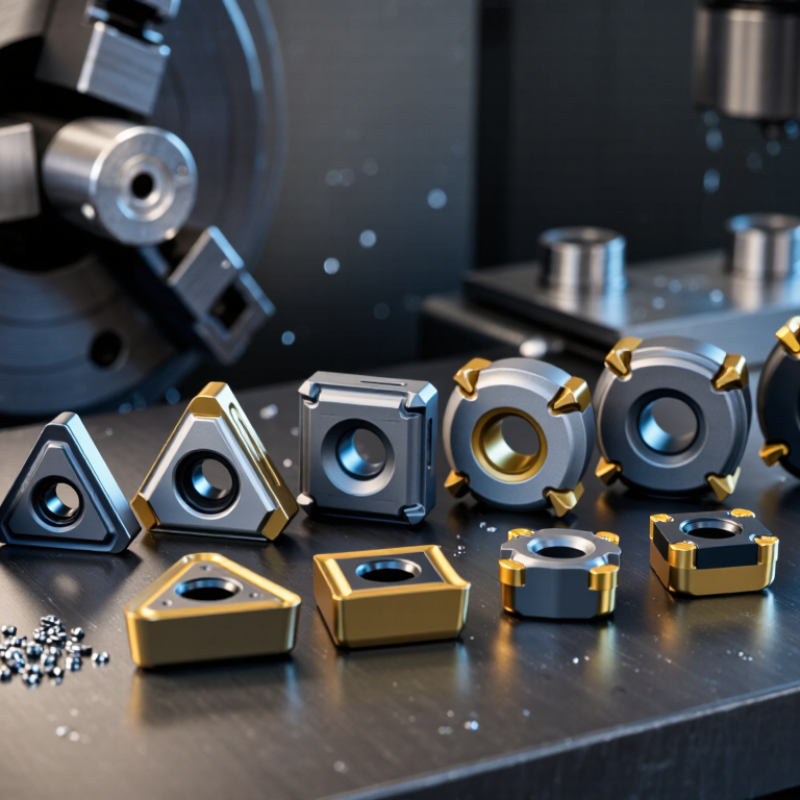
Table of Contents [Hide]
What Cemented Carbide Inserts Are and How They Work
Cemented carbide inserts are replaceable cutting tips used in CNC turning, milling, and drilling. They are usually made from hard tungsten carbide particles held together by a metal binder. The carbide resists abrasion, while the binder helps the insert withstand cutting forces. Neither quality makes an insert indestructible.
As the spindle turns, the cutting edge shears material from the workpiece. The insert’s shape directs chips away and influences heat, surface finish, and cutting pressure. A chipbreaker groove can curl long chips into shorter pieces. The holder keeps the insert seated at a precise angle. No insert is universally best. Interrupted cuts can chip an edge that performs well on a steady pass.
Tips: Match the insert grade and geometry to the workpiece and operation. Check the manufacturer’s cutting-speed and feed recommendations, then adjust cautiously. Watch for chatter, built-up material, and uneven edge wear. Chip color can offer clues, but it is not a reliable diagnosis by itself. Change one setting at a time; otherwise, the cause of a better or worse result may stay unclear.