


- Home
- A-Z Catalogue
- Products
- Valves
- Cetop
- Manual Directional Valves
- Proportional Valves
- Poppet Valves
- High-Speed Linear Servo Valves
- All High-Speed Linear Servo Valves
- Cetop 10 (NG32) Two Stage Type High Speed Linear Servo Valves – LSVHG-10
- Cetop 10 (NG32) Two Stage Type High Speed Linear Servo Valves – LSVHG-10 (With Fail-Safe)
- Cetop 8 (NG25) Two Stage Type High Speed Linear Servo Valves – LSVHG-06
- Cetop 8 (NG25) Two Stage Type High Speed Linear Servo Valves – LSVHG-06 (With Fail-Safe)
- Cetop 7 (NG16) Two Stage Type High Speed Linear Servo Valves – LSVHG-04
- Cetop 7 (NG16) Two Stage Type High Speed Linear Servo Valves – LSVHG-04 (With Fail-Safe)
- Cetop 5 (NG10) Direct Type High Speed Linear Servo Valves – LSVG-03
- Cetop 5 (NG10) OBE Type Direct Operated Linear Servo Valves – LSVG-03-EH
- Cetop 3 (NG6) OBE Type Direct Operated Linear Servo Valves – LSVG-01-EH
- Pumps
- Pressure control
- Flow Control Valves
- Pressure Control Valves
- All Pressure Control Valves
- Brake Valves
- Direct Relief Valve
- Low Noise Solenoid Controlled Relief Valves
- Low Noise Pilot Operated Relief Valves
- Pilot Operated Relief Valves
- Pressure reducing and relieving valves
- Pressure reducing and check valves
- Pressure control valves
- Remote Control Relief Valves
- Solenoid Controlled Relief Valves – BSG
- Solenoid Controlled Relief Valves – BST
- Unloading relief valves
- Check valves
- Environmental
- Valves
- Hydraulic Systems
- Power pack
- About Us
- Contact
- Blog

Top 10 Best Car Battery Jumpers to Buy in 2026?
Choosing one of the Top 10 Best Car Battery Jumpers to Buy in 2026 is about more than chasing the biggest number on a box. A dependable Car Battery Jumper should suit your vehicle, work reliably in cold weather, and feel straightforward when you are stressed beside a quiet engine. That moment matters.
Automotive product expert Richard Reina has long emphasized matching products to real vehicle needs. His advice, paraphrased for this guide, is simple: “Choose for the vehicle, not the headline number.” That is a useful standard. Peak-amp claims can be difficult to compare, so check the manufacturer’s vehicle-size guidance, battery compatibility, clamp design, and built-in protections. Reverse-polarity alerts, short-circuit protection, and clear instructions can make a real difference. A bright screen helps at night. A solid case helps when the unit slides around a trunk.
This guide compares ten options through practical details, including starting capability, portability, charging features, and ease of use. It also considers trade-offs: a compact model may be easier to store, while a larger unit may offer more capacity. No device is perfect. Even a highly rated jumper needs a charged battery, sound clamps, and careful use according to its manual. Read the fine print. The right pick is the one you can operate confidently and maintain properly—not necessarily the one with the loudest advertising.
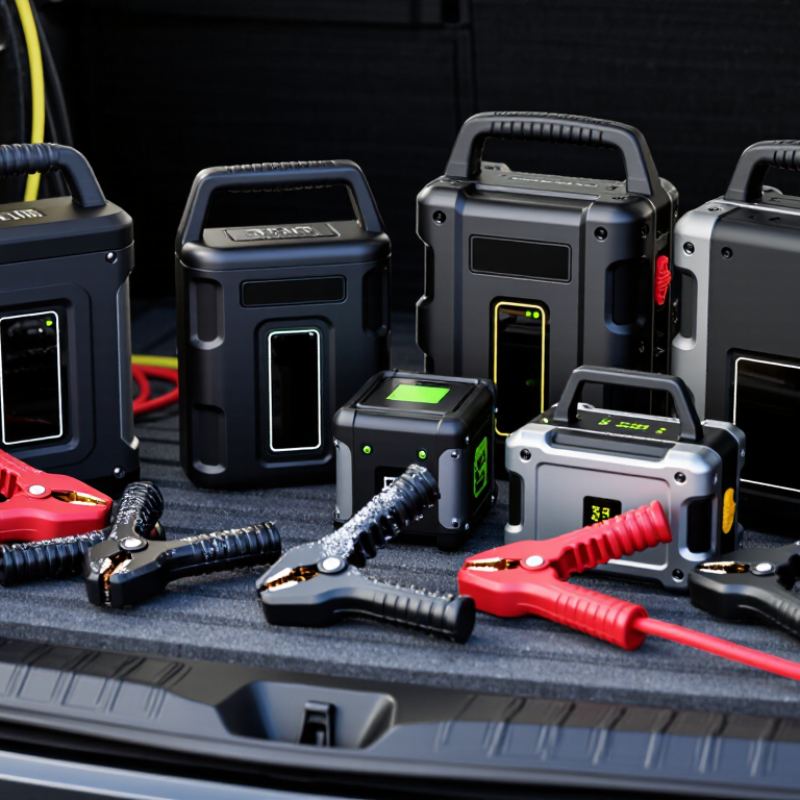
Table of Contents [Hide]
What a Car Battery Jumper Is and How It Works
A car battery jumper, often called a jump starter, is a portable power source used to help start a vehicle with a weak or discharged battery. It sends a brief, high current through jumper cables to the vehicle’s electrical system. That current gives the starter motor enough power to turn the engine. It does not necessarily recharge the car battery. That distinction matters.
A portable unit usually has its own rechargeable battery and insulated clamps. With the vehicle switched off, connect the clamps to the terminals as directed in the unit’s manual. Red usually goes to positive, while black connects to the specified negative or ground point. Check the vehicle and jumper instructions; connection details can vary. Keep the clamps apart, and never ignore a reversed-polarity warning. Start the vehicle only when the connections are secure, then remove the clamps in the recommended order. Simple, but worth slowing down for.
If the engine starts, the vehicle’s charging system may restore some battery charge during driving, but that is not a reliable repair. A battery that repeatedly fails may be worn, or the charging system may need inspection. I used to think a successful start meant the problem was solved. It may only mean the engine got one more chance.





