


- Home
- A-Z Catalogue
- Products
- Valves
- Cetop
- Manual Directional Valves
- Proportional Valves
- Poppet Valves
- High-Speed Linear Servo Valves
- All High-Speed Linear Servo Valves
- Cetop 10 (NG32) Two Stage Type High Speed Linear Servo Valves – LSVHG-10
- Cetop 10 (NG32) Two Stage Type High Speed Linear Servo Valves – LSVHG-10 (With Fail-Safe)
- Cetop 8 (NG25) Two Stage Type High Speed Linear Servo Valves – LSVHG-06
- Cetop 8 (NG25) Two Stage Type High Speed Linear Servo Valves – LSVHG-06 (With Fail-Safe)
- Cetop 7 (NG16) Two Stage Type High Speed Linear Servo Valves – LSVHG-04
- Cetop 7 (NG16) Two Stage Type High Speed Linear Servo Valves – LSVHG-04 (With Fail-Safe)
- Cetop 5 (NG10) Direct Type High Speed Linear Servo Valves – LSVG-03
- Cetop 5 (NG10) OBE Type Direct Operated Linear Servo Valves – LSVG-03-EH
- Cetop 3 (NG6) OBE Type Direct Operated Linear Servo Valves – LSVG-01-EH
- Pumps
- Pressure control
- Flow Control Valves
- Pressure Control Valves
- All Pressure Control Valves
- Brake Valves
- Direct Relief Valve
- Low Noise Solenoid Controlled Relief Valves
- Low Noise Pilot Operated Relief Valves
- Pilot Operated Relief Valves
- Pressure reducing and relieving valves
- Pressure reducing and check valves
- Pressure control valves
- Remote Control Relief Valves
- Solenoid Controlled Relief Valves – BSG
- Solenoid Controlled Relief Valves – BST
- Unloading relief valves
- Check valves
- Environmental
- Valves
- Hydraulic Systems
- Power pack
- About Us
- Contact
- Blog

China Best Cantilever Rack Manufacturers and Suppliers
China has a broad market for cantilever storage, from small workshops to high-bay distribution centers. Choosing a supplier takes more than comparing prices. Buyers need to assess load capacity, arm spacing, column strength, finish quality, and the intended goods. A bundle of long steel tubes behaves differently from timber boards or lightweight trim. Details matter.
Warehouse-storage consultant Alex Morgan puts it this way: “A Cantilever Rack is only as dependable as its load plan, connections, and installation.” This is a useful principle, not a substitute for a project-specific engineering review. Ask manufacturers for clear load ratings, drawings, material specifications, and guidance on anchoring. Check whether the quoted capacity applies to each arm or the full upright. That distinction can be easy to miss.
This overview examines China-based manufacturers and suppliers through practical criteria: product range, customization, quality controls, communication, lead times, and after-sales support. It also considers questions buyers can ask before requesting a quotation, such as how the rack will handle uneven loads or future expansion. A polished catalog is not proof of consistent production. Nor is the lowest quote automatically poor value. Supplier claims should be checked against documents and project needs. Some information may remain hard to verify remotely; that deserves honest attention. The goal is a safer, more useful shortlist—not a rushed endorsement.
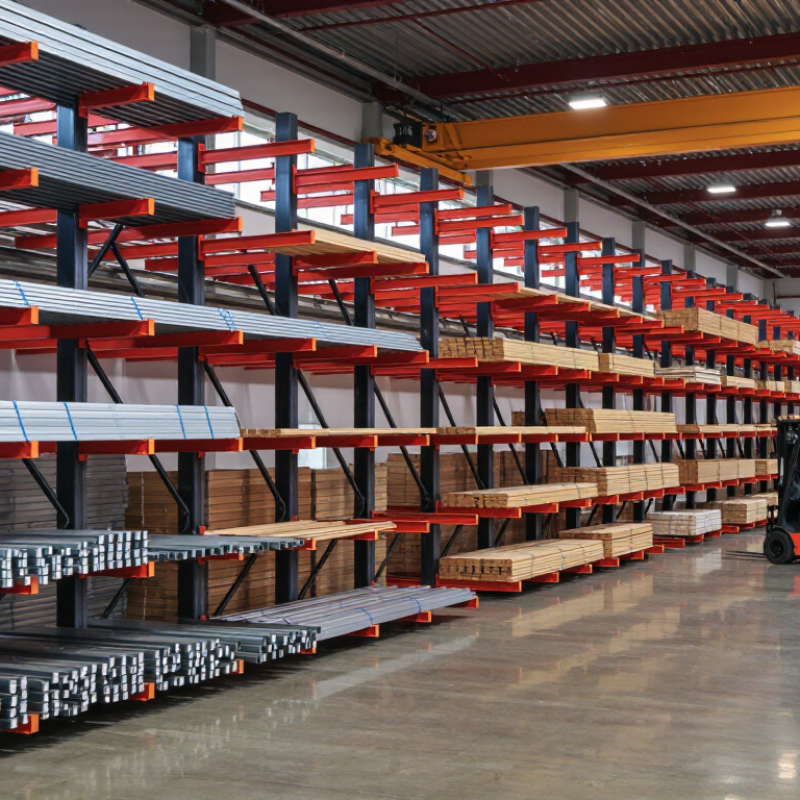
Table of Contents [Hide]
China Cantilever Rack Manufacturers: 4 Core Components and System Types
A cantilever rack is built around four parts: uprights, base plates, arms, and bracing. The uprights carry vertical loads, while base plates spread forces across the floor. Arms project outward to support long goods such as timber, pipe, or metal sections. Bracing connects the frames and helps limit sway. Small details matter.
Arm length and spacing should match the stored product, not just the available aisle space. Measure the load’s weight, length, and contact points before selecting a system. Uneven bundles can place more force on one arm than expected. Capacity figures also depend on configuration, so confirm the complete rack layout with a qualified supplier.
System types commonly include single-sided and double-sided racks. Single-sided units fit against walls; double-sided units serve loads from both sides and suit central aisles. Light-, medium-, and heavy-duty versions address different load ranges, but labels alone are not enough. Compare rated capacity, arm adjustment, floor conditions, and handling equipment. A drawing may look clear. On site, access and product overhang can change the plan.





