- Home
- A-Z Catalogue
- Products
- Valves
- Cetop
- Manual Directional Valves
- Proportional Valves
- Poppet Valves
- High-Speed Linear Servo Valves
- All High-Speed Linear Servo Valves
- Cetop 10 (NG32) Two Stage Type High Speed Linear Servo Valves – LSVHG-10
- Cetop 10 (NG32) Two Stage Type High Speed Linear Servo Valves – LSVHG-10 (With Fail-Safe)
- Cetop 8 (NG25) Two Stage Type High Speed Linear Servo Valves – LSVHG-06
- Cetop 8 (NG25) Two Stage Type High Speed Linear Servo Valves – LSVHG-06 (With Fail-Safe)
- Cetop 7 (NG16) Two Stage Type High Speed Linear Servo Valves – LSVHG-04
- Cetop 7 (NG16) Two Stage Type High Speed Linear Servo Valves – LSVHG-04 (With Fail-Safe)
- Cetop 5 (NG10) Direct Type High Speed Linear Servo Valves – LSVG-03
- Cetop 5 (NG10) OBE Type Direct Operated Linear Servo Valves – LSVG-03-EH
- Cetop 3 (NG6) OBE Type Direct Operated Linear Servo Valves – LSVG-01-EH
- Pumps
- Pressure control
- Flow Control Valves
- Pressure Control Valves
- All Pressure Control Valves
- Brake Valves
- Direct Relief Valve
- Low Noise Solenoid Controlled Relief Valves
- Low Noise Pilot Operated Relief Valves
- Pilot Operated Relief Valves
- Pressure reducing and relieving valves
- Pressure reducing and check valves
- Pressure control valves
- Remote Control Relief Valves
- Solenoid Controlled Relief Valves – BSG
- Solenoid Controlled Relief Valves – BST
- Unloading relief valves
- Check valves
- Environmental
- Valves
- Hydraulic Systems
- Power pack
- About Us
- Contact
- Blog

7 Best Alloy Wheel Curing Ovens for Global Buyers
Selecting an Alloy Wheel Curing Oven involves more than comparing price or chamber size. Buyers need to match the oven’s usable dimensions and batch capacity to their wheel range and daily production schedule. A chamber that fits a large rim may still heat unevenly when loaded poorly. Details matter.
This guide reviews seven options for global buyers, focusing on practical factors such as temperature control, airflow, loading access, energy use, and after-sales support. Consistent curing depends on the coating’s specified time and temperature, so clear controls and reliable monitoring are important. Ask suppliers for technical data, installation requirements, and service arrangements before comparing quotations. Local power supplies and safety requirements also differ.
A bigger oven is not always better. Smaller workshops may value a compact footprint and straightforward operation, while higher-volume facilities may need larger batches and repeatable process settings. Price alone can hide costs, including installation, maintenance, and production downtime. Not every specification tells the whole story.
The recommendations are intended as a starting point, not a universal ranking. Buyers should confirm that each model suits their wheel dimensions, coating process, and site conditions. Even a well-built oven can disappoint if its capacity or controls do not fit the actual workflow. That is worth reconsidering before purchase.
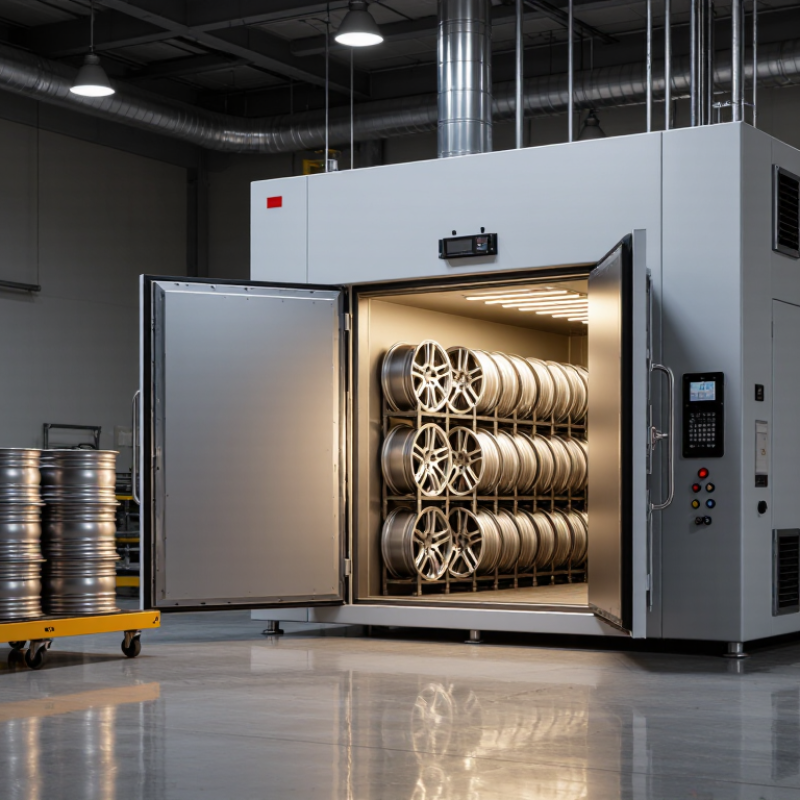
Table of Contents [Hide]
What an Alloy Wheel Curing Oven Does
An alloy wheel curing oven does more than dry paint. It supplies controlled heat so the powder coating melts, flows, and crosslinks into a durable film. The oven must bring the wheel itself to the specified part-metal temperature. A hot-air reading alone cannot confirm that the coating has cured. Correct time and temperature help the finish withstand chips, corrosion, and routine handling.
Cure schedules vary by coating chemistry, wheel mass, and oven airflow, so follow the coating supplier’s technical data sheet. One common oversight is assuming every part of a wheel heats evenly. Spokes, hubs, and inner barrels can reach temperature at different rates. The International Energy Agency’s Tracking Industry 2023 report estimates that industry accounts for about 37% of global final energy consumption. This is broad industrial context, not a wheel-oven benchmark, but it makes heat loss and efficient loading worth checking.
Tip: Use a calibrated contact thermocouple on a representative wheel, and log the actual part temperature and dwell time. Check more than one location when validating a load. It takes extra effort. But an oven display can look perfect while a heavy hub is still catching up.