


- Home
- A-Z Catalogue
- Products
- Valves
- Cetop
- Manual Directional Valves
- Proportional Valves
- Poppet Valves
- High-Speed Linear Servo Valves
- All High-Speed Linear Servo Valves
- Cetop 10 (NG32) Two Stage Type High Speed Linear Servo Valves – LSVHG-10
- Cetop 10 (NG32) Two Stage Type High Speed Linear Servo Valves – LSVHG-10 (With Fail-Safe)
- Cetop 8 (NG25) Two Stage Type High Speed Linear Servo Valves – LSVHG-06
- Cetop 8 (NG25) Two Stage Type High Speed Linear Servo Valves – LSVHG-06 (With Fail-Safe)
- Cetop 7 (NG16) Two Stage Type High Speed Linear Servo Valves – LSVHG-04
- Cetop 7 (NG16) Two Stage Type High Speed Linear Servo Valves – LSVHG-04 (With Fail-Safe)
- Cetop 5 (NG10) Direct Type High Speed Linear Servo Valves – LSVG-03
- Cetop 5 (NG10) OBE Type Direct Operated Linear Servo Valves – LSVG-03-EH
- Cetop 3 (NG6) OBE Type Direct Operated Linear Servo Valves – LSVG-01-EH
- Pumps
- Pressure control
- Flow Control Valves
- Pressure Control Valves
- All Pressure Control Valves
- Brake Valves
- Direct Relief Valve
- Low Noise Solenoid Controlled Relief Valves
- Low Noise Pilot Operated Relief Valves
- Pilot Operated Relief Valves
- Pressure reducing and relieving valves
- Pressure reducing and check valves
- Pressure control valves
- Remote Control Relief Valves
- Solenoid Controlled Relief Valves – BSG
- Solenoid Controlled Relief Valves – BST
- Unloading relief valves
- Check valves
- Environmental
- Valves
- Hydraulic Systems
- Power pack
- About Us
- Contact
- Blog

What Is an Automatic Feeding Gluing Machine?
An Automatic Feeding Gluing Machine combines sheet feeding, folding, adhesive application, and delivery in one controlled workflow. It is widely used for folding cartons, paper boxes, envelopes, and lightweight corrugated packaging. Sheets enter through a guided feeder, pass under glue nozzles, and emerge folded with consistent pressure. The process looks simple. It is not.
Industry reports explain why this equipment matters. Smithers’ The Future of Folding Cartons to 2028 identifies rising demand for efficient, recyclable, and digitally managed carton production. PMMI’s State of the Industry reports also highlight automation, labor shortages, and productivity as major packaging priorities. These trends support investment in an Automatic Feeding Gluing Machine, especially where manual feeding creates uneven spacing, adhesive waste, or slower output. However, speed alone does not guarantee value. Poor calibration can still produce open seams and damaged edges.
Jorge Izquierdo, vice president of market development at PMMI, has said, “Automation improves productivity, quality, and safety.” That principle applies directly here. A reliable machine should maintain feeding accuracy, glue placement, folding pressure, and inspection records across long production runs. Operators still matter. They adjust cartons, monitor adhesive viscosity, and respond to material changes. The machine supports judgment; it does not replace it. In practice, even advanced equipment may struggle with warped sheets, dusty surfaces, or unstable paper stock. That limitation deserves attention. This article examines machine structure, working principles, benefits, maintenance needs, and purchasing considerations through practical packaging evidence.
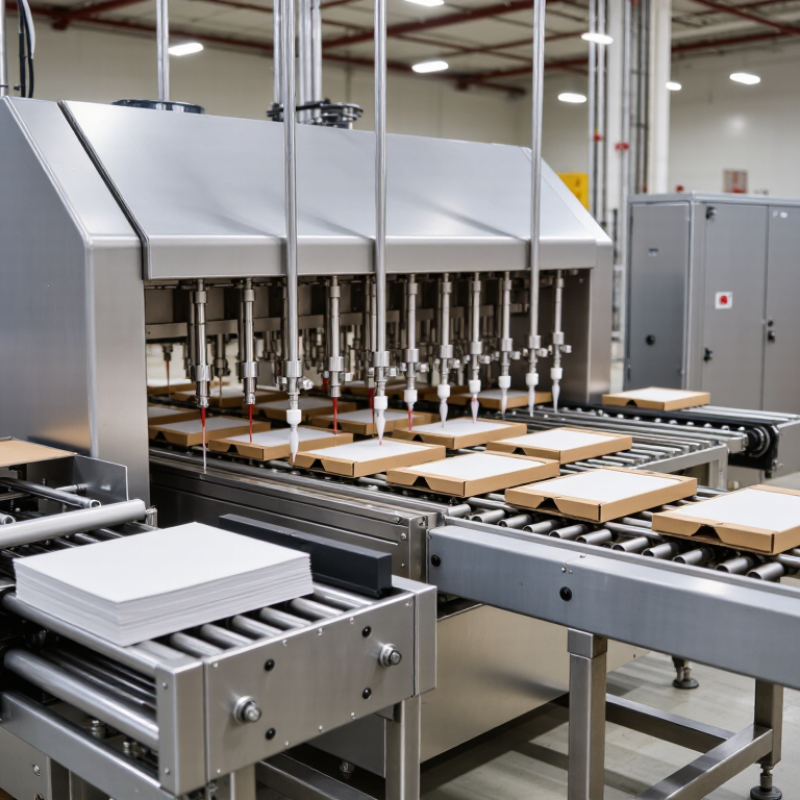
Table of Contents [Hide]
Definition and Scope: Automatic Feeding Gluing Machines in 150–300 m/min Lines
What Is an Automatic Feeding Gluing Machine?
An automatic feeding gluing machine forms flat carton blanks into finished boxes without manual sheet placement. It feeds, aligns, folds, glues, and delivers cartons in one continuous process. In 150–300 m/min lines, the machine must maintain timing within fractions of a second. One skewed blank can disturb the entire stream. That distinction matters.
According to FEFCO’s 2023 industry statistics, European corrugated plants produced roughly 48 billion square metres of board. Such volume explains the demand for stable automation. At 150 m/min, a line can theoretically move 9,000 metres of material each hour. At 300 m/min, that figure doubles. Speed is not output. Actual production depends on carton size, board quality, glue setting, changeover time, and rejected pieces.
A reliable system uses servo-driven feeders, vacuum belts, photoelectric sensors, and adjustable compression sections. These components help control overlap, folding accuracy, and adhesive placement. Industry reports from Smithers also place the global corrugated packaging market above US$200 billion during the current forecast period, increasing pressure on converters to improve throughput without sacrificing quality. Yet a high-speed specification can mislead. Small cartons may run quickly, while large or complex designs require slower settings. In practical testing, operators should record usable cartons per hour, not only the advertised line speed. That measurement is less impressive, but more honest.