


- Home
- A-Z Catalogue
- Products
- Valves
- Cetop
- Manual Directional Valves
- Proportional Valves
- Poppet Valves
- High-Speed Linear Servo Valves
- All High-Speed Linear Servo Valves
- Cetop 10 (NG32) Two Stage Type High Speed Linear Servo Valves – LSVHG-10
- Cetop 10 (NG32) Two Stage Type High Speed Linear Servo Valves – LSVHG-10 (With Fail-Safe)
- Cetop 8 (NG25) Two Stage Type High Speed Linear Servo Valves – LSVHG-06
- Cetop 8 (NG25) Two Stage Type High Speed Linear Servo Valves – LSVHG-06 (With Fail-Safe)
- Cetop 7 (NG16) Two Stage Type High Speed Linear Servo Valves – LSVHG-04
- Cetop 7 (NG16) Two Stage Type High Speed Linear Servo Valves – LSVHG-04 (With Fail-Safe)
- Cetop 5 (NG10) Direct Type High Speed Linear Servo Valves – LSVG-03
- Cetop 5 (NG10) OBE Type Direct Operated Linear Servo Valves – LSVG-03-EH
- Cetop 3 (NG6) OBE Type Direct Operated Linear Servo Valves – LSVG-01-EH
- Pumps
- Pressure control
- Flow Control Valves
- Pressure Control Valves
- All Pressure Control Valves
- Brake Valves
- Direct Relief Valve
- Low Noise Solenoid Controlled Relief Valves
- Low Noise Pilot Operated Relief Valves
- Pilot Operated Relief Valves
- Pressure reducing and relieving valves
- Pressure reducing and check valves
- Pressure control valves
- Remote Control Relief Valves
- Solenoid Controlled Relief Valves – BSG
- Solenoid Controlled Relief Valves – BST
- Unloading relief valves
- Check valves
- Environmental
- Valves
- Hydraulic Systems
- Power pack
- About Us
- Contact
- Blog

7 Pin Trailer Socket Buying Tips for Global Buyers?
Buying a 7 Pin Trailer Socket for international trailer production is not a simple plug-and-play decision. Regional wiring layouts can differ, even when the socket looks identical. A reliable purchase begins with the correct pin configuration, vehicle compatibility, and clear technical documentation.
RV electrical safety educator Mike Sokol puts it plainly: “A bad ground can make a good circuit look broken.” That warning matters in real use. A loose ground may cause dim lights, intermittent brakes, or confusing test results. Buyers should examine terminal quality, copper contact thickness, sealing performance, and strain relief. Small details matter.
Think beyond the catalog photo.
The seven key checks include wiring standards, housing material, contact protection, current capacity, weather resistance, installation fit, and supplier support. A socket made from impact-resistant nylon may survive vibration better than brittle plastic. Tin-plated terminals can help resist oxidation near coastal roads. However, no coating replaces proper sealing and careful installation.
Global buyers also need samples before placing large orders. Test the 7 Pin Trailer Socket with the intended tow vehicle, trailer harness, lamps, and brake controller. Check fit after repeated connection cycles. Ask for pin diagrams, test reports, production tolerances, and packaging details. Frankly, many product pages remain too vague. That should make buyers pause, not guess.
A lower unit price can become expensive after field failures, returns, and delayed shipments. The best choice balances electrical performance, environmental durability, documentation, and dependable communication. Yet even experienced buyers can overlook one detail: the socket must match the complete towing system, not just the vehicle connector.
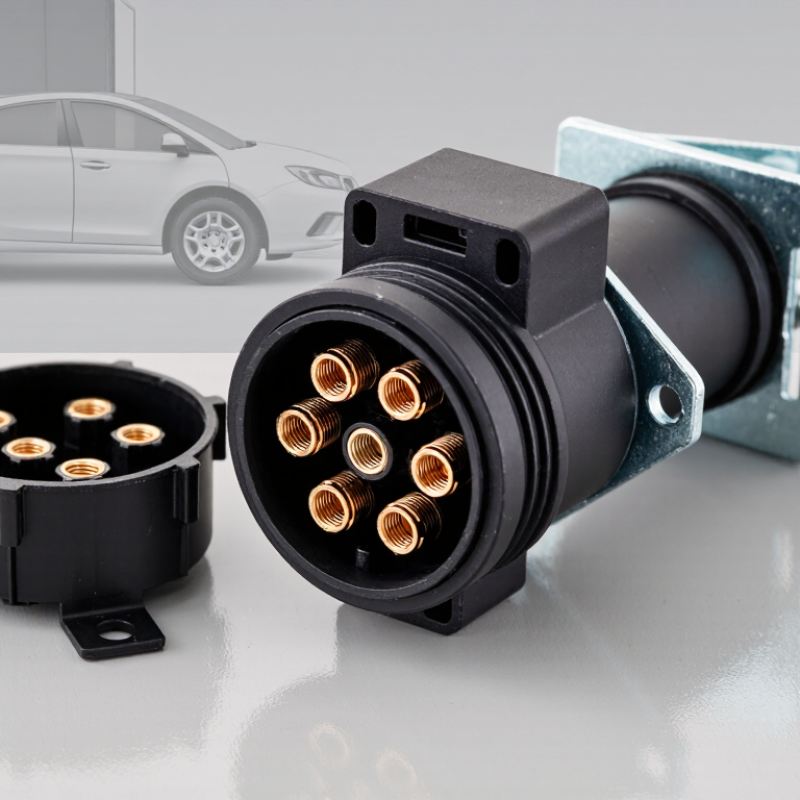
Table of Contents [Hide]
Identify Your Trailer’s Towing Needs and Regional Standards
7 Pin Trailer Socket Buying Tips for Global Buyers
Identify your trailer’s towing needs before choosing a 7 pin trailer socket. A socket may fit physically but still fail electrically. Check whether your trailer uses tail lamps, indicators, brake lamps, reverse lights, or a dedicated charging line. Confirm the vehicle’s voltage, towing module, and wiring capacity. Do not assume every seven-pin layout is identical.
Regional standards can change pin assignments, contact shapes, cable colors, and testing requirements. A socket designed for one market may connect poorly with a trailer from another region. Compare the vehicle manual, trailer plug diagram, and local certification information. This simple check prevents crossed signals and unexpected lighting faults. Measure carefully.
In practical inspections, I look for sealed contacts, firm locking, strain relief, and protection from road spray. Salt, mud, and repeated twisting can damage exposed terminals quickly. Choose materials suited to the climate and towing frequency. Heavy agricultural use needs stronger protection than occasional highway towing. Leave room for inspection. Even a well-built socket can fail when wiring is loose, overloaded, or poorly grounded. Some buyers focus only on pin count, and that is an easy mistake. Check compatibility before price.





