


- Home
- A-Z Catalogue
- Products
- Valves
- Cetop
- Manual Directional Valves
- Proportional Valves
- Poppet Valves
- High-Speed Linear Servo Valves
- All High-Speed Linear Servo Valves
- Cetop 10 (NG32) Two Stage Type High Speed Linear Servo Valves – LSVHG-10
- Cetop 10 (NG32) Two Stage Type High Speed Linear Servo Valves – LSVHG-10 (With Fail-Safe)
- Cetop 8 (NG25) Two Stage Type High Speed Linear Servo Valves – LSVHG-06
- Cetop 8 (NG25) Two Stage Type High Speed Linear Servo Valves – LSVHG-06 (With Fail-Safe)
- Cetop 7 (NG16) Two Stage Type High Speed Linear Servo Valves – LSVHG-04
- Cetop 7 (NG16) Two Stage Type High Speed Linear Servo Valves – LSVHG-04 (With Fail-Safe)
- Cetop 5 (NG10) Direct Type High Speed Linear Servo Valves – LSVG-03
- Cetop 5 (NG10) OBE Type Direct Operated Linear Servo Valves – LSVG-03-EH
- Cetop 3 (NG6) OBE Type Direct Operated Linear Servo Valves – LSVG-01-EH
- Pumps
- Pressure control
- Flow Control Valves
- Pressure Control Valves
- All Pressure Control Valves
- Brake Valves
- Direct Relief Valve
- Low Noise Solenoid Controlled Relief Valves
- Low Noise Pilot Operated Relief Valves
- Pilot Operated Relief Valves
- Pressure reducing and relieving valves
- Pressure reducing and check valves
- Pressure control valves
- Remote Control Relief Valves
- Solenoid Controlled Relief Valves – BSG
- Solenoid Controlled Relief Valves – BST
- Unloading relief valves
- Check valves
- Environmental
- Valves
- Hydraulic Systems
- Power pack
- About Us
- Contact
- Blog

2026 Top Turbo Intercooler Types for Global Buyers
Choosing a Turbo Intercooler is not simply a matter of finding the largest core. Global buyers must match cooling performance, pressure drop, packaging, and service needs to the engine and its intended use. Air-to-air designs are often valued for their straightforward layout. Air-to-water systems can suit tighter engine bays, but add pumps, plumbing, and other components. Bar-and-plate and tube-and-fin cores bring different trade-offs in durability, weight, and airflow. Details matter.
A useful editorial paraphrase of the system-level approach in turbocharging author Jeff Hartman’s work is: “Choose an intercooler for the complete charge-air system, not for core size alone.” This is a paraphrase, not a verbatim quotation. It captures a practical point: a core that looks impressive on a product page may not perform well when ducting, airflow, and installation space are ignored. That is easy to miss.
This guide to 2026’s top Turbo Intercooler types compares common designs through the needs of global buyers. It considers vehicle fitment, climate, maintenance, materials, and supplier support. Buyers should also verify dimensions, connection sizes, and pressure-drop data before ordering. Product claims deserve scrutiny. Not every catalog gives comparable test conditions, and published figures may not reflect a finished installation. A little caution helps. There is no universal winner; the right choice depends on the system, the application, and the evidence available.
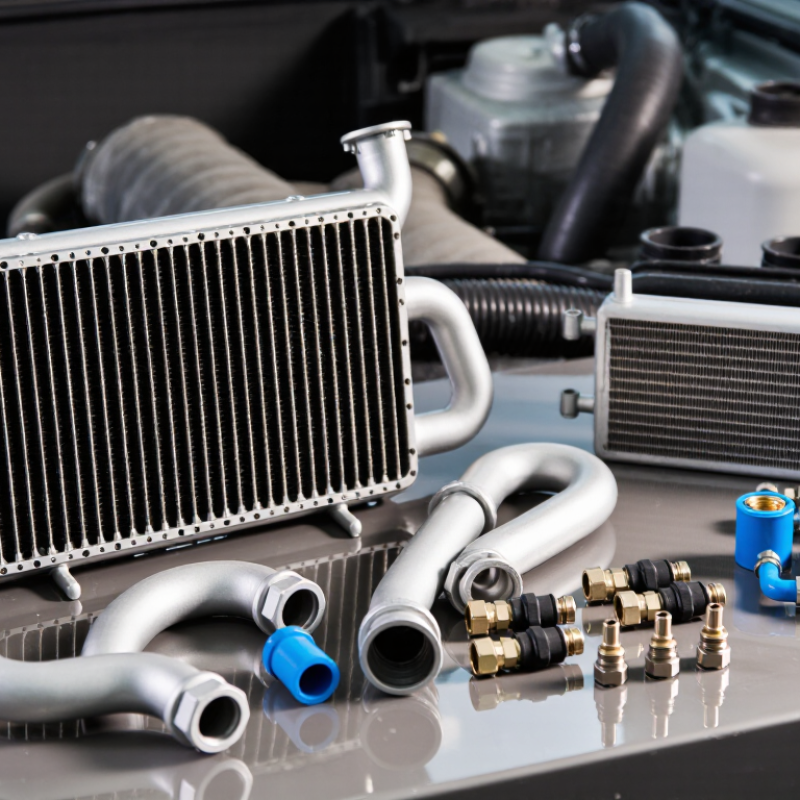
Table of Contents [Hide]
What a Turbo Intercooler Does in a Turbocharged Engine
A turbocharger compresses intake air, raising its temperature before it reaches the engine. Hot air is less dense, so each cylinder may receive less oxygen than expected. The intercooler transfers heat from this compressed air to ambient air or coolant. Cooler, denser charge supports more consistent combustion and helps limit knock risk under load. The effect is tangible: after a hard climb, a front-mounted air-to-air core may feel warm, while its outlet pipe should carry noticeably cooler air.
The U.S. Department of Energy’s Fundamentals Handbook, Thermodynamics, Heat Transfer, and Fluid Flow, explains the ideal-gas relationship between temperature and density. At unchanged pressure, cooling air from 100°C to 50°C gives an estimated density increase of about 15%, calculated using absolute temperatures. That is a theoretical comparison, not a guaranteed engine power gain; pressure losses, humidity, airflow, and engine controls all matter. Small details matter. Core size alone does not tell the whole story: a large unit can add lag or restrict airflow if poorly matched. Real-world intake temperatures should be checked after sustained load, not only during a brief workshop test. Even then, one reading can mislead.





