


- Home
- A-Z Catalogue
- Products
- Valves
- Cetop
- Manual Directional Valves
- Proportional Valves
- Poppet Valves
- High-Speed Linear Servo Valves
- All High-Speed Linear Servo Valves
- Cetop 10 (NG32) Two Stage Type High Speed Linear Servo Valves – LSVHG-10
- Cetop 10 (NG32) Two Stage Type High Speed Linear Servo Valves – LSVHG-10 (With Fail-Safe)
- Cetop 8 (NG25) Two Stage Type High Speed Linear Servo Valves – LSVHG-06
- Cetop 8 (NG25) Two Stage Type High Speed Linear Servo Valves – LSVHG-06 (With Fail-Safe)
- Cetop 7 (NG16) Two Stage Type High Speed Linear Servo Valves – LSVHG-04
- Cetop 7 (NG16) Two Stage Type High Speed Linear Servo Valves – LSVHG-04 (With Fail-Safe)
- Cetop 5 (NG10) Direct Type High Speed Linear Servo Valves – LSVG-03
- Cetop 5 (NG10) OBE Type Direct Operated Linear Servo Valves – LSVG-03-EH
- Cetop 3 (NG6) OBE Type Direct Operated Linear Servo Valves – LSVG-01-EH
- Pumps
- Pressure control
- Flow Control Valves
- Pressure Control Valves
- All Pressure Control Valves
- Brake Valves
- Direct Relief Valve
- Low Noise Solenoid Controlled Relief Valves
- Low Noise Pilot Operated Relief Valves
- Pilot Operated Relief Valves
- Pressure reducing and relieving valves
- Pressure reducing and check valves
- Pressure control valves
- Remote Control Relief Valves
- Solenoid Controlled Relief Valves – BSG
- Solenoid Controlled Relief Valves – BST
- Unloading relief valves
- Check valves
- Environmental
- Valves
- Hydraulic Systems
- Power pack
- About Us
- Contact
- Blog

2026 Top Lithium Ion Battery Pack Types for Buyers
Choosing a Lithium Ion Battery Pack is not just a matter of comparing voltage or price. Buyers need to understand how pack design affects installation, service life, and everyday performance. Cylindrical, prismatic, and pouch cells each offer different trade-offs in shape, cooling, and packaging. The best fit depends on the device, available space, expected load, and operating conditions. Small details matter. A pack that fits neatly in a drawing may be harder to cool or replace in the field.
This guide introduces common battery pack types and the practical questions buyers can ask suppliers. It considers capacity, rated voltage, battery management systems, thermal control, enclosure design, and documentation. These details help buyers compare offers beyond the headline specifications. Ask how performance is measured, what protections are built in, and whether test data matches your intended use. A clear datasheet is useful, but it cannot answer every question about real-world conditions. That is worth remembering. No format is best for every application, and published figures may vary with temperature, discharge rate, and pack configuration. Careful comparison can narrow the options, but buyers should verify specifications with the manufacturer before making a decision.
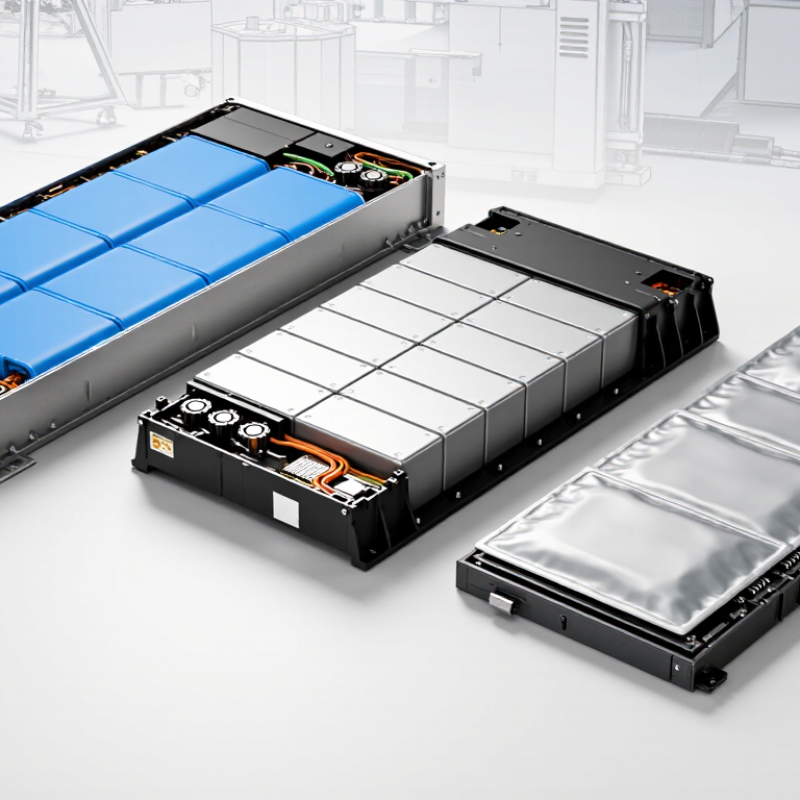
Table of Contents [Hide]
Understanding Lithium-Ion Battery Pack Basics
Understanding Lithium-Ion Battery Pack Basics
A lithium-ion battery pack is more than a row of cells. Cells connect in series to raise voltage and in parallel to increase capacity. A battery management system monitors temperature, voltage, and current, helping prevent damaging operating conditions. It cannot compensate for poor pack design. Buyers should compare usable energy in kilowatt-hours, continuous power in kilowatts, operating temperature, and expected cycle life. These figures describe different things.
Chemistry affects weight, cost, and performance. Lithium iron phosphate packs often prioritize long service life and thermal stability, while nickel-rich chemistries commonly offer higher energy density. Neither label alone predicts real-world suitability. Check the manufacturer’s test conditions and warranty assumptions.
The International Energy Agency reported that electric-vehicle battery demand reached about 750 gigawatt-hours in 2023, showing how rapidly pack technology is scaling.
BloombergNEF reported an average lithium-ion pack price of $139 per kilowatt-hour in 2023, 14% lower than in 2022.
Still, price per kilowatt-hour can obscure differences in usable capacity, cooling, and serviceability. A compact pack may fit neatly beneath a floor, yet its performance can shift in cold weather.
Details matter.





