


- Home
- A-Z Catalogue
- Products
- Valves
- Cetop
- Manual Directional Valves
- Proportional Valves
- Poppet Valves
- High-Speed Linear Servo Valves
- All High-Speed Linear Servo Valves
- Cetop 10 (NG32) Two Stage Type High Speed Linear Servo Valves – LSVHG-10
- Cetop 10 (NG32) Two Stage Type High Speed Linear Servo Valves – LSVHG-10 (With Fail-Safe)
- Cetop 8 (NG25) Two Stage Type High Speed Linear Servo Valves – LSVHG-06
- Cetop 8 (NG25) Two Stage Type High Speed Linear Servo Valves – LSVHG-06 (With Fail-Safe)
- Cetop 7 (NG16) Two Stage Type High Speed Linear Servo Valves – LSVHG-04
- Cetop 7 (NG16) Two Stage Type High Speed Linear Servo Valves – LSVHG-04 (With Fail-Safe)
- Cetop 5 (NG10) Direct Type High Speed Linear Servo Valves – LSVG-03
- Cetop 5 (NG10) OBE Type Direct Operated Linear Servo Valves – LSVG-03-EH
- Cetop 3 (NG6) OBE Type Direct Operated Linear Servo Valves – LSVG-01-EH
- Pumps
- Pressure control
- Flow Control Valves
- Pressure Control Valves
- All Pressure Control Valves
- Brake Valves
- Direct Relief Valve
- Low Noise Solenoid Controlled Relief Valves
- Low Noise Pilot Operated Relief Valves
- Pilot Operated Relief Valves
- Pressure reducing and relieving valves
- Pressure reducing and check valves
- Pressure control valves
- Remote Control Relief Valves
- Solenoid Controlled Relief Valves – BSG
- Solenoid Controlled Relief Valves – BST
- Unloading relief valves
- Check valves
- Environmental
- Valves
- Hydraulic Systems
- Power pack
- About Us
- Contact
- Blog

2026 Top Grab Hook Types for Global Buyers?
Choosing the right Grab Hook in 2026 requires more than comparing prices or browsing attractive product photos. Global buyers need reliable information about design, material quality, working load limits, surface treatment, and traceable manufacturing. A hook may look strong, yet its performance depends on steel grade, heat treatment, welding quality, and correct chain compatibility. Small details matter.
This guide examines the leading Grab Hook types considered by buyers across construction, transport, agriculture, marine support, and industrial lifting markets. It focuses on practical selection points, including clevis and eye configurations, alloy options, corrosion resistance, load marking, inspection access, and supplier documentation. Regional standards and purchasing requirements can differ, so buyers should confirm testing records, dimensional drawings, certificates, and declared working load limits before placing an order. Not every option fits.
The discussion also reflects real purchasing challenges. Samples may perform well but fail to represent consistent batch quality. A low quote can hide weaker traceability or limited after-sales support. Even experienced buyers sometimes overlook hook throat dimensions or chain grade matching. That deserves attention. Reliable suppliers should explain limitations clearly, provide product identification, and support inspection procedures without making unrealistic safety claims. This overview is not a substitute for qualified engineering review or site-specific risk assessment. It offers a practical starting point for comparing Grab Hook types with greater confidence, clearer questions, and more responsible global sourcing decisions.
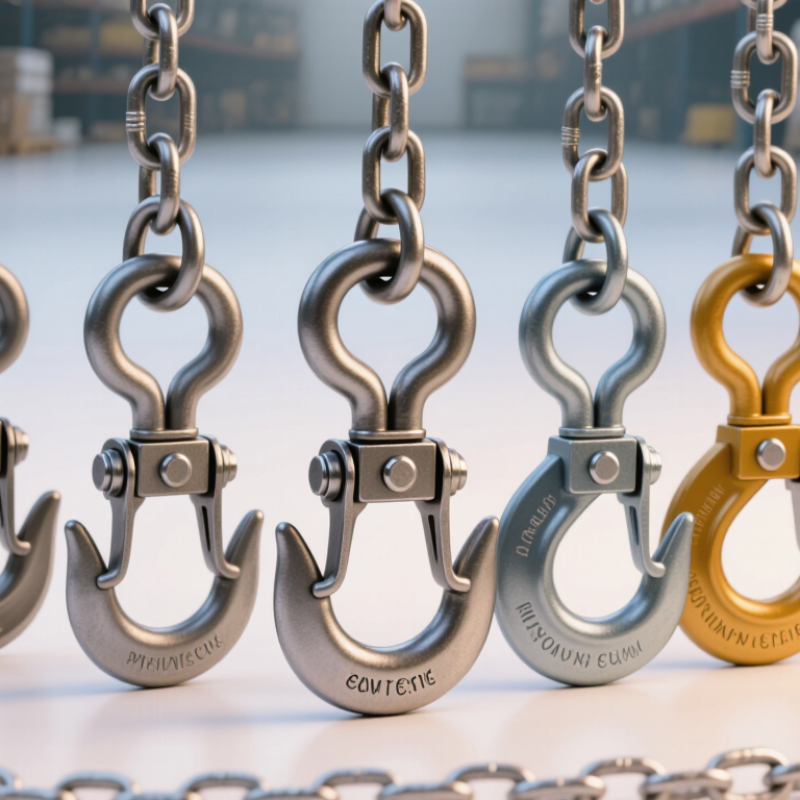
Table of Contents [Hide]
Grade 80, 100, and 120 Grab Hooks: Strength Classes and WLL Data
2026 Top Grab Hook Types for Global Buyers
Grade 80 grab hooks remain a practical choice for general lifting and chain shortening. Grade 100 offers higher strength in a similar chain diameter. Grade 120 can provide greater capacity, but only when the complete assembly supports it. Higher grade does not automatically mean higher WLL.
WLL means Working Load Limit under specified conditions. It depends on hook size, chain diameter, loading direction, connection method, and safety factor.
For example, a Grade 80 hook may have a WLL of 2.0 tonnes at one size, while a larger Grade 100 hook may reach 3.15 tonnes. Grade 120 data can exceed this range, but figures must come from the product marking and technical certificate. Never compare grades without comparing dimensions.
A reliable buying check starts with the stamped grade, size, WLL, traceability code, and inspection status.
The hook should seat fully on the chain link, without side loading or tip loading. Watch the opening.
In practical lifting inspections, deformation, cracks, heavy wear, and damaged latches are immediate concerns. I still treat catalogue tables cautiously. They often omit sling angles or unusual connections.
Ask for proof-load records and applicable test standards before selecting a hook. The safest decision uses the lowest-rated component in the entire lifting assembly.