


- Home
- A-Z Catalogue
- Products
- Valves
- Cetop
- Manual Directional Valves
- Proportional Valves
- Poppet Valves
- High-Speed Linear Servo Valves
- All High-Speed Linear Servo Valves
- Cetop 10 (NG32) Two Stage Type High Speed Linear Servo Valves – LSVHG-10
- Cetop 10 (NG32) Two Stage Type High Speed Linear Servo Valves – LSVHG-10 (With Fail-Safe)
- Cetop 8 (NG25) Two Stage Type High Speed Linear Servo Valves – LSVHG-06
- Cetop 8 (NG25) Two Stage Type High Speed Linear Servo Valves – LSVHG-06 (With Fail-Safe)
- Cetop 7 (NG16) Two Stage Type High Speed Linear Servo Valves – LSVHG-04
- Cetop 7 (NG16) Two Stage Type High Speed Linear Servo Valves – LSVHG-04 (With Fail-Safe)
- Cetop 5 (NG10) Direct Type High Speed Linear Servo Valves – LSVG-03
- Cetop 5 (NG10) OBE Type Direct Operated Linear Servo Valves – LSVG-03-EH
- Cetop 3 (NG6) OBE Type Direct Operated Linear Servo Valves – LSVG-01-EH
- Pumps
- Pressure control
- Flow Control Valves
- Pressure Control Valves
- All Pressure Control Valves
- Brake Valves
- Direct Relief Valve
- Low Noise Solenoid Controlled Relief Valves
- Low Noise Pilot Operated Relief Valves
- Pilot Operated Relief Valves
- Pressure reducing and relieving valves
- Pressure reducing and check valves
- Pressure control valves
- Remote Control Relief Valves
- Solenoid Controlled Relief Valves – BSG
- Solenoid Controlled Relief Valves – BST
- Unloading relief valves
- Check valves
- Environmental
- Valves
- Hydraulic Systems
- Power pack
- About Us
- Contact
- Blog

2026 Top Types of Floor Grating for Global Buyers?
Choosing the right Floor Grating in 2026 requires more than comparing prices per square metre. Global buyers must match load capacity, corrosion exposure, drainage needs, installation methods, and local safety requirements. A grating that performs well in a dry warehouse may fail quickly beside a coastal cooling tower.
Industry data supports this careful approach. The World Steel Association’s Short Range Outlook continues to track global steel demand and construction activity, both of which influence grating availability and pricing. Meanwhile, the International Energy Agency’s Buildings report highlights the sector’s continuing focus on efficiency, durability, and lower lifecycle impacts. These trends are pushing buyers toward galvanized steel, stainless steel, aluminum, and molded FRP solutions. Each material has a different balance of strength, weight, maintenance, and service life.
The leading types include welded bar grating, press-locked grating, swage-locked grating, aluminum grating, stainless steel grating, and FRP molded grating. Welded panels suit heavy industrial platforms. Press-locked designs offer clean visual lines and flexible spacing. FRP performs strongly in wet, chemical, or electrically sensitive areas, but its long-term behavior needs careful specification.
Small details matter.
Opening size affects footwear safety, drainage, and tool loss. Surface treatment also matters. ISO 14122 guidance can support safer access design, but it does not replace project-specific engineering review. Some product comparisons remain too generic. That is a weakness worth recognizing.
This guide evaluates the top Floor Grating types through practical selection criteria, relevant standards, and global procurement realities.
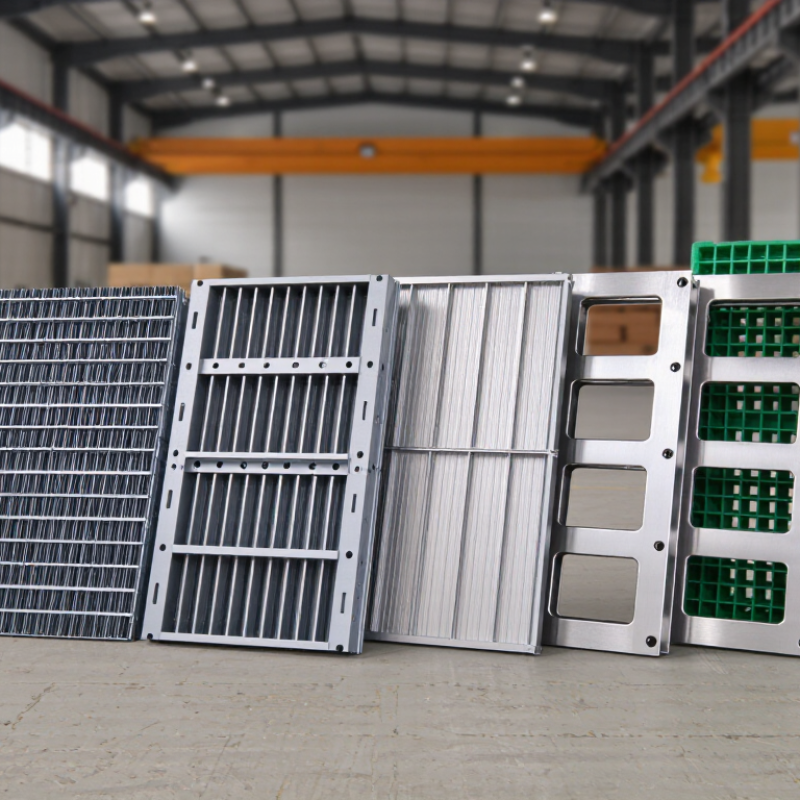
Table of Contents [Hide]
What Is Floor Grating and Why Does Its Type Matter?
Floor grating is a load-bearing surface made from connected metal, fiberglass, or composite sections. It supports workers, equipment, and maintenance traffic above open spaces. Its openings allow water, oil, air, and light to pass through. This design can improve drainage and reduce standing water near machinery. However, floor grating is not simply a replacement for solid flooring. Its strength depends on span, load, bearing bars, support spacing, and installation quality.
Type matters because working conditions differ widely. Steel bar grating offers high strength for platforms, walkways, and industrial floors. Aluminum reduces weight and may suit areas needing easier handling. Fiberglass grating resists moisture and many chemicals, but its stiffness and fire performance require careful verification. Serrated surfaces can improve traction in wet areas. Perforated panels provide smaller openings, although they may drain more slowly.
In real projects, buyers should check load tables, surface treatment, opening size, slip resistance, and applicable local standards. A warehouse walkway may need a different design from a coastal service platform. I have seen specifications focus on price while overlooking support spacing. That mistake can create vibration, deflection, or unsafe edges. Ask for material certificates, test records, dimensional tolerances, and installation guidance. Do not assume one type fits every market. Weather, footwear, cleaning methods, and maintenance habits can change the practical choice.
2026 Top Types of Floor Grating for Global Buyers? - What Is Floor Grating and Why Does Its Type Matter?
| Grating Type | How It Is Made | Common Materials | Main Performance Characteristics | Typical Applications | Corrosion Resistance | Key Buying Considerations |
|---|---|---|---|---|---|---|
| Welded Bar Grating | Bearing bars are welded to cross bars, usually at each intersection. | Carbon steel, galvanized steel, stainless steel, aluminum | High rigidity, strong load-carrying capacity, good airflow and drainage, suitable for frequent foot traffic. | Industrial platforms, walkways, stair treads, drainage covers, plant floors | Good when galvanized, painted, or manufactured from stainless steel; untreated carbon steel needs protection. | Bearing-bar size, span, panel orientation, surface finish, weld quality, and required load rating |
| Press-Locked Grating | Cross bars are mechanically pressed into pre-punched bearing bars or vice versa. | Steel, stainless steel, aluminum | Clean, uniform appearance with closely spaced bars; offers good lateral stability and a broad range of openings. | Architectural floors, platforms, ramps, ventilation areas, pedestrian walkways | Depends on the base metal and coating; stainless steel is suitable for many hygienic or corrosive environments. | Opening size, slip resistance, bar alignment, edge treatment, and compatibility with access requirements |
| Riveted Grating | Cross bars are connected to bearing bars with rivets, creating a flexible and durable panel. | Carbon steel, galvanized steel, aluminum | Good vibration tolerance, comfortable walking surface, and strong resistance to repeated pedestrian traffic. | Bridges, industrial walkways, loading areas, transit facilities, maintenance platforms | Requires coating or corrosion-resistant material for outdoor, marine, or chemically exposed locations. | Rivet condition, vibration levels, load direction, drainage needs, and inspection access |
| Swage-Locked Grating | Cross bars are formed or hydraulically locked into bearing bars, commonly producing a smooth visual profile. | Aluminum, stainless steel, steel | Light to moderate structural service, neat appearance, and useful open-area performance. | Commercial buildings, pedestrian bridges, platforms, ventilation screens | Aluminum and stainless steel provide strong resistance in many outdoor environments; material selection remains essential. | Structural span, thermal expansion, galvanic corrosion risk, opening dimensions, and finish |
| Expanded Metal Grating | A metal sheet is slit and stretched to form a continuous mesh with no separate welded joints. | Carbon steel, galvanized steel, aluminum, stainless steel | Continuous construction, good ventilation, useful anti-slip texture, and relatively low material waste during production. | Light-duty walkways, guards, platforms, machine enclosures, ventilation floors | Varies with metal and coating; galvanized or stainless versions are preferred in damp conditions. | Mesh geometry, strand thickness, load span, sharp edges, walking comfort, and drainage performance |
| Molded FRP Grating | Continuous fiberglass reinforcement is molded in a resin matrix to form an integral grid panel. | Fiberglass-reinforced polymer with polyester, vinyl ester, or phenolic resin | Non-conductive, lightweight, corrosion-resistant, and available with molded-in anti-slip surfaces. | Chemical plants, wastewater facilities, marine areas, electrical zones, water-treatment platforms | Generally high, but resin selection must match chemicals, temperature, ultraviolet exposure, and service conditions. | Resin type, fire performance, ultraviolet stability, deflection, load rating, and electrical insulation requirements |
| Aluminum Grating | Manufactured using welded, press-locked, swage-locked, or other metal-grating methods with aluminum sections. | Aluminum alloys | Low density, easy handling, natural oxide protection, and good resistance to many atmospheric environments. | Roofs, marine platforms, pedestrian bridges, access walkways, lightweight structures | Good atmospheric corrosion resistance; performance can be affected by strong alkalis and contact with dissimilar metals. | Load-to-weight ratio, alloy, deflection limits, galvanic isolation, surface treatment, and fire requirements |
| Stainless Steel Grating | Produced by welded, press-locked, or other grating processes using stainless steel bars and cross members. | Austenitic or other specified stainless-steel grades | High hygiene potential, durable surface, strong corrosion resistance, and suitability for demanding service environments. | Food-processing areas, pharmaceutical facilities, laboratories, marine environments, chemical plants | High when the grade is correctly matched to chlorides, acids, moisture, cleaning agents, and temperature. | Steel grade, chloride exposure, weld finishing, cleaning regime, surface roughness, and lifecycle cost |
Selection note: Floor grating type affects load capacity, span, slip resistance, drainage, corrosion performance, electrical conductivity, maintenance, and total lifecycle cost. Final selection should be based on verified structural calculations, project specifications, local safety requirements, environmental exposure, and the applicable national or international design standard.





