


- Home
- A-Z Catalogue
- Products
- Valves
- Cetop
- Manual Directional Valves
- Proportional Valves
- Poppet Valves
- High-Speed Linear Servo Valves
- All High-Speed Linear Servo Valves
- Cetop 10 (NG32) Two Stage Type High Speed Linear Servo Valves – LSVHG-10
- Cetop 10 (NG32) Two Stage Type High Speed Linear Servo Valves – LSVHG-10 (With Fail-Safe)
- Cetop 8 (NG25) Two Stage Type High Speed Linear Servo Valves – LSVHG-06
- Cetop 8 (NG25) Two Stage Type High Speed Linear Servo Valves – LSVHG-06 (With Fail-Safe)
- Cetop 7 (NG16) Two Stage Type High Speed Linear Servo Valves – LSVHG-04
- Cetop 7 (NG16) Two Stage Type High Speed Linear Servo Valves – LSVHG-04 (With Fail-Safe)
- Cetop 5 (NG10) Direct Type High Speed Linear Servo Valves – LSVG-03
- Cetop 5 (NG10) OBE Type Direct Operated Linear Servo Valves – LSVG-03-EH
- Cetop 3 (NG6) OBE Type Direct Operated Linear Servo Valves – LSVG-01-EH
- Pumps
- Pressure control
- Flow Control Valves
- Pressure Control Valves
- All Pressure Control Valves
- Brake Valves
- Direct Relief Valve
- Low Noise Solenoid Controlled Relief Valves
- Low Noise Pilot Operated Relief Valves
- Pilot Operated Relief Valves
- Pressure reducing and relieving valves
- Pressure reducing and check valves
- Pressure control valves
- Remote Control Relief Valves
- Solenoid Controlled Relief Valves – BSG
- Solenoid Controlled Relief Valves – BST
- Unloading relief valves
- Check valves
- Environmental
- Valves
- Hydraulic Systems
- Power pack
- About Us
- Contact
- Blog

2026 Top TRV Radiator Suppliers for Global Buyers
In 2026, global heating buyers need more than attractive catalogs and low quotations. A reliable Trv Radiator supplier should demonstrate consistent production, accurate temperature control, and dependable after-sales support. Thermostatic radiator valves influence comfort, energy use, and system stability. Small faults can create large installation problems.
This guide examines leading suppliers through practical purchasing criteria. These include material quality, valve compatibility, factory capacity, testing procedures, certifications, and delivery performance. Buyers should check whether brass bodies resist corrosion and whether sensing heads respond smoothly to room temperature changes. Thread standards matter too. An M30 x 1.5 connection may not suit every heating system. Ask for drawings, samples, test reports, and clear warranty terms before placing large orders.
Details often reveal the real supplier quality. Inspect thread finishing, packaging protection, labeling, and carton strength. A damaged control head can delay an entire project. Request evidence of quality management and confirm certification validity for the destination market. Do not rely only on polished websites or impressive showroom photographs. Experience suggests that communication during sampling often predicts future cooperation. Yet no supplier evaluation is perfect. Lead times can shift, test documents may require clarification, and product performance can vary between batches. Buyers should leave room for verification.
The following supplier overview supports careful comparison. It is not a substitute for technical review or local compliance checks. Good decisions require evidence, patience, and honest questions. That is the practical starting point.
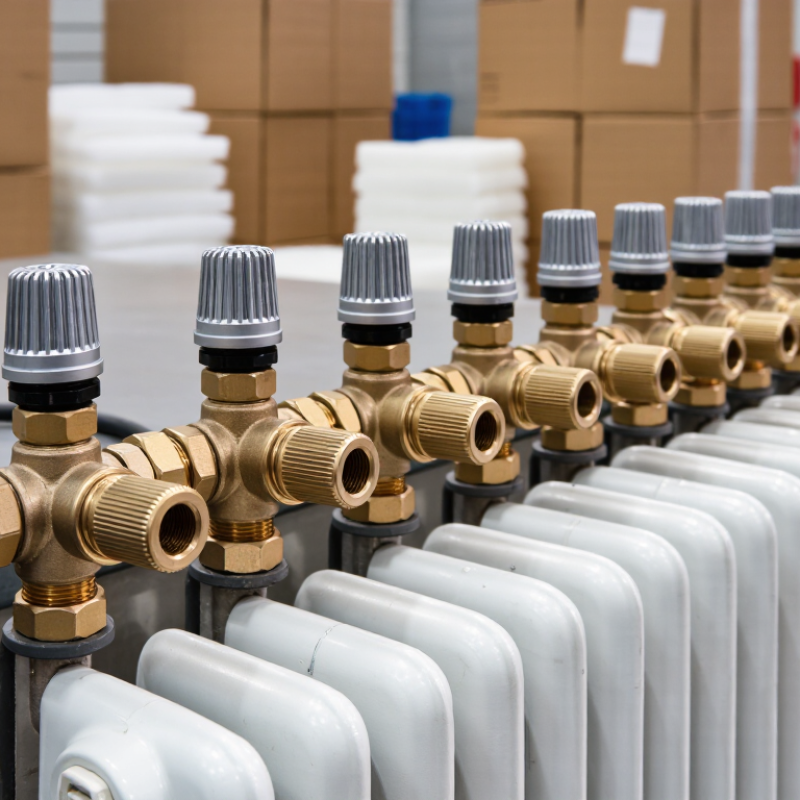
Table of Contents [Hide]
What TRV Radiators Are and How They Work
2026 Top TRV Radiator Suppliers for Global Buyers
What TRV Radiators Are and How They Work
A thermostatic radiator valve, or TRV, controls water flow through a radiator. It does not heat the room directly. Instead, its sensor measures nearby air temperature and adjusts a small internal pin. When the room reaches the selected setting, the valve restricts hot-water flow. When the room cools, it opens again.
The mechanism is simple, but installation quality matters. A wax capsule, liquid sensor, or electronic probe moves the pin. Correct positioning helps the sensor read room air, not radiator heat. EN 215 provides performance requirements for thermostatic radiator valves. Buyers should request test evidence and declared temperature control ranges.
Energy performance makes TRVs relevant to global heating projects. The International Energy Agency reports that buildings use about 30% of global final energy. Eurostat reported that space heating represented roughly 63% of household energy use in the European Union in 2022. A TRV cannot solve poor insulation or an unbalanced system. That assumption needs challenging.
Tips: Keep curtains away from the valve. Do not cover it with furniture. Use lower settings in bedrooms and unused rooms. Check system balancing before judging valve performance. In field inspections, valves often appear faulty when air pockets or incorrect pump settings cause uneven heating. That detail is easy to miss.





