


- Home
- A-Z Catalogue
- Products
- Valves
- Cetop
- Manual Directional Valves
- Proportional Valves
- Poppet Valves
- High-Speed Linear Servo Valves
- All High-Speed Linear Servo Valves
- Cetop 10 (NG32) Two Stage Type High Speed Linear Servo Valves – LSVHG-10
- Cetop 10 (NG32) Two Stage Type High Speed Linear Servo Valves – LSVHG-10 (With Fail-Safe)
- Cetop 8 (NG25) Two Stage Type High Speed Linear Servo Valves – LSVHG-06
- Cetop 8 (NG25) Two Stage Type High Speed Linear Servo Valves – LSVHG-06 (With Fail-Safe)
- Cetop 7 (NG16) Two Stage Type High Speed Linear Servo Valves – LSVHG-04
- Cetop 7 (NG16) Two Stage Type High Speed Linear Servo Valves – LSVHG-04 (With Fail-Safe)
- Cetop 5 (NG10) Direct Type High Speed Linear Servo Valves – LSVG-03
- Cetop 5 (NG10) OBE Type Direct Operated Linear Servo Valves – LSVG-03-EH
- Cetop 3 (NG6) OBE Type Direct Operated Linear Servo Valves – LSVG-01-EH
- Pumps
- Pressure control
- Flow Control Valves
- Pressure Control Valves
- All Pressure Control Valves
- Brake Valves
- Direct Relief Valve
- Low Noise Solenoid Controlled Relief Valves
- Low Noise Pilot Operated Relief Valves
- Pilot Operated Relief Valves
- Pressure reducing and relieving valves
- Pressure reducing and check valves
- Pressure control valves
- Remote Control Relief Valves
- Solenoid Controlled Relief Valves – BSG
- Solenoid Controlled Relief Valves – BST
- Unloading relief valves
- Check valves
- Environmental
- Valves
- Hydraulic Systems
- Power pack
- About Us
- Contact
- Blog

2026 How to Choose the Right Pipe Elbow?
Choosing the right Pipe Elbow is a design decision, not a catalogue exercise. The fitting must match pressure, temperature, fluid chemistry, wall thickness, and installation space. A 90-degree elbow may look ordinary, yet its radius can influence turbulence, pressure loss, vibration, and fatigue. Small details matter.
Fortune Business Insights reported that the global pipe fittings market was valued at approximately USD 13 billion in 2023. Its forecast also indicates continued growth through 2032. Grand View Research similarly identifies construction, energy, and industrial processing as important demand sectors. These figures show market momentum, but they do not replace engineering judgment. A report cannot see your corroded condensate line or restricted maintenance aisle.
Mohinder L. Nayyar, a respected piping engineer and author of Piping Handbook, states, “Piping design is a compromise between safety, reliability, and economics.” That principle remains useful when comparing welded, threaded, socket-weld, and flanged elbows. Material selection should follow the service environment, not purchasing habits. Carbon steel, stainless steel, alloy steel, and plastic each behave differently under heat, chemicals, and cyclic loading.
The best choice may not be the cheapest component. It may reduce welding time, inspection concerns, and future shutdowns. Still, this approach is not flawless. Product data can be incomplete, and field conditions can differ from drawings. A reliable selection process therefore combines standards, manufacturer certificates, hydraulic calculations, and experienced site review. This guide explains how to make that decision with greater confidence in 2026.
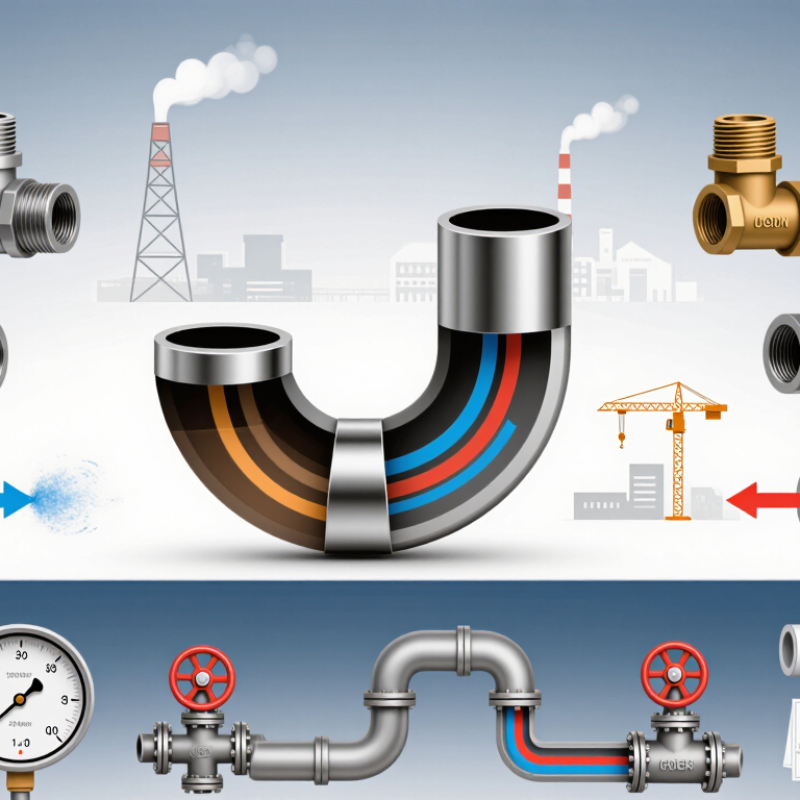
Table of Contents [Hide]
Pipe Elbow Basics: Types, Functions, and Common Applications
2026 How to Choose the Right Pipe Elbow?
Pipe elbows change the direction of fluid flow without adding a separate joint. The common 90-degree elbow turns a line around a corner, while a 45-degree elbow creates a gentler change. A 180-degree return elbow reverses flow direction in compact systems. Long-radius elbows reduce turbulence and pressure loss. Short-radius elbows save space but may create stronger flow resistance. These differences matter in pump lines, steam systems, cooling water networks, and process piping.
Connection style also affects installation and maintenance. Butt-weld elbows suit permanent, high-pressure piping. Socket-weld and threaded elbows can fit smaller systems or service lines. Material selection must match the fluid, temperature, pressure, and corrosion risk. Carbon steel may suit general utility water, while stainless alloys often perform better with aggressive or hygienic media. Always verify wall thickness, dimensions, and pressure ratings against the project code and approved technical data. Small dimensional errors can cause difficult alignment during installation.
A practical selection starts with the pipe size and required bend angle. Then check the center-to-end dimension, schedule, radius, and joining method. Field inspections often find elbows installed backward in flow-sensitive assemblies. A quick visual check is useful, but it is not enough. Review weld quality, internal cleanliness, and support spacing before commissioning. I would also question a low-cost elbow with unclear material records. It may fit perfectly, yet fail early under heat, vibration, or corrosive service. A better choice balances performance, inspection evidence, installation access, and the actual operating conditions.
2026 How to Choose the Right Pipe Elbow? - Pipe Elbow Basics: Types, Functions, and Common Applications
| Elbow Type | Typical Angle | Main Function | Flow and Pressure Characteristics | Common Applications | Key Selection Considerations |
|---|---|---|---|---|---|
| 90° Long-Radius Elbow | 90° | Changes the flow direction by a right angle. | Lower pressure loss and less turbulence than a short-radius elbow because of its gradual curve. | Water supply, process piping, HVAC systems, oil and gas lines, and general industrial piping. | Use when space allows a larger bend radius and reduced energy loss is important. |
| 90° Short-Radius Elbow | 90° | Provides a compact right-angle turn. | Higher pressure loss and turbulence than a long-radius elbow due to the tighter bend. | Compact machinery layouts, skid systems, utility lines, and areas with limited installation space. | Choose only when footprint is more important than minimizing friction loss; check flow velocity and erosion risk. |
| 45° Elbow | 45° | Makes a moderate directional change or divides a larger turn into two gentler turns. | Usually causes less pressure loss than a 90° elbow of the same radius and size. | Drainage, water treatment, pump discharge piping, and process systems requiring smoother routing. | Good choice for reducing turbulence while maintaining a relatively compact layout. |
| 22.5° Elbow | 22.5° | Creates a small directional adjustment. | Typically produces a relatively low pressure drop compared with sharper elbows. | Fine alignment of pipelines, drainage systems, structural offsets, and routing around obstacles. | Use when a gradual change is preferred and a 45° or 90° turn would be excessive. |
| Reducing Elbow | Usually 90° or 45° | Changes direction while transitioning between different pipe diameters. | May increase turbulence and pressure loss compared with a standard elbow; the reducer profile affects performance. | Pump connections, process equipment nozzles, compressed-air systems, and piping size transitions. | Confirm the large and small end sizes, flow direction, wall thickness, and compatibility with connected equipment. |
| Mitered Elbow | Commonly 30°, 45°, or 90° | Forms a bend by joining cut pipe sections rather than using a continuous curved fitting. | Can create more turbulence and stress concentration, especially at sharp angles or high flow velocities. | Large-diameter, low-pressure air ducts, water lines, and fabricated industrial piping. | Evaluate pressure rating, reinforcement, weld quality, flow characteristics, and applicable design codes. |
| Threaded Elbow | Usually 90° or 45° | Connects threaded pipe or components without welding. | Suitable for many low- and medium-pressure services; internal threads can increase resistance and require sealing. | Small-diameter water, air, fuel, instrumentation, and maintenance piping. | Verify thread type, pressure class, sealing method, service temperature, and compatibility with the pipe material. |
| Socket-Weld Elbow | Usually 90° or 45° | Joins small-bore pipe by inserting the pipe into a socket and welding around the joint. | Provides a compact, strong connection when correctly installed; internal geometry may affect flow. | Small-diameter chemical, steam, hydraulic, and high-pressure utility piping. | Check socket dimensions, weld procedure, thermal expansion, corrosion allowance, and inspection requirements. |
| Butt-Weld Elbow | Usually 90°, 45°, or 22.5° | Creates a welded connection with a continuous internal bore. | Supports efficient flow and high-integrity service when the elbow radius and weld profile are properly selected. | Petrochemical plants, power generation, water treatment, food processing, and high-pressure process lines. | Match outside diameter, wall thickness, material grade, bend radius, weld procedures, and inspection standards. |
| Flanged Elbow | Usually 90° or 45° | Provides a bolted connection for easier installation, removal, or equipment access. | Performance depends on the elbow geometry and flange alignment; the joint requires correct gasket compression. | Pump and valve connections, water treatment plants, cooling systems, and maintenance-sensitive piping. | Confirm flange facing, nominal pressure class, bolt pattern, gasket type, alignment, and available installation space. |
Key Factors for Choosing a Pipe Elbow
- Pipe size and wall thickness: Match the elbow dimensions and thickness to the connected pipe.
- Pressure and temperature: Select a fitting with adequate design ratings for the operating and testing conditions.
- Material compatibility: Consider corrosion, erosion, chemical exposure, temperature, and galvanic effects.
- Bend radius: Use a long-radius elbow to reduce pressure loss when space and layout permit.
- Connection method: Choose butt-weld, socket-weld, threaded, or flanged ends according to service and maintenance needs.
- Applicable standards: Confirm the required dimensional, material, fabrication, and inspection standards for the project.