


- Home
- A-Z Catalogue
- Products
- Valves
- Cetop
- Manual Directional Valves
- Proportional Valves
- Poppet Valves
- High-Speed Linear Servo Valves
- All High-Speed Linear Servo Valves
- Cetop 10 (NG32) Two Stage Type High Speed Linear Servo Valves – LSVHG-10
- Cetop 10 (NG32) Two Stage Type High Speed Linear Servo Valves – LSVHG-10 (With Fail-Safe)
- Cetop 8 (NG25) Two Stage Type High Speed Linear Servo Valves – LSVHG-06
- Cetop 8 (NG25) Two Stage Type High Speed Linear Servo Valves – LSVHG-06 (With Fail-Safe)
- Cetop 7 (NG16) Two Stage Type High Speed Linear Servo Valves – LSVHG-04
- Cetop 7 (NG16) Two Stage Type High Speed Linear Servo Valves – LSVHG-04 (With Fail-Safe)
- Cetop 5 (NG10) Direct Type High Speed Linear Servo Valves – LSVG-03
- Cetop 5 (NG10) OBE Type Direct Operated Linear Servo Valves – LSVG-03-EH
- Cetop 3 (NG6) OBE Type Direct Operated Linear Servo Valves – LSVG-01-EH
- Pumps
- Pressure control
- Flow Control Valves
- Pressure Control Valves
- All Pressure Control Valves
- Brake Valves
- Direct Relief Valve
- Low Noise Solenoid Controlled Relief Valves
- Low Noise Pilot Operated Relief Valves
- Pilot Operated Relief Valves
- Pressure reducing and relieving valves
- Pressure reducing and check valves
- Pressure control valves
- Remote Control Relief Valves
- Solenoid Controlled Relief Valves – BSG
- Solenoid Controlled Relief Valves – BST
- Unloading relief valves
- Check valves
- Environmental
- Valves
- Hydraulic Systems
- Power pack
- About Us
- Contact
- Blog

2026 Best Embedded PC for Industrial Automation?
Choosing the 2026 best Embedded Pc for industrial automation requires more than comparing processor speeds. Factory floors demand dependable performance, stable communication, and predictable operation under pressure.
An experienced engineering review should examine temperature ranges, vibration resistance, fanless cooling, and long-term component availability. The system may control a robotic arm, collect sensor data, or connect several PLC networks. Each task creates different requirements.
Real installations reveal what brochures often miss. A compact computer beside a conveyor may face dust, electrical noise, and restricted airflow. Dual Ethernet ports, isolated I/O, and support for protocols such as EtherCAT or Modbus TCP can simplify deployment. Secure boot, TPM support, and manageable remote updates also deserve close attention.
Performance matters, but only within the application.
A powerful CPU cannot fix poor thermal design. Likewise, excessive memory may add cost without improving machine output. During testing, engineers should measure startup time, sustained workloads, storage reliability, and recovery after power interruption. These results are more useful than a single benchmark score.
There is no universal winner. A food-processing line may prioritize sealed construction, while machine vision may require GPU acceleration. Some manufacturers also need five or more years of supply stability. That promise should be verified, not assumed.
This guide compares leading options through practical industrial criteria, documented specifications, and field-oriented reasoning. The conclusions may change as software demands evolve. That uncertainty matters. A careful buyer should validate every shortlisted Embedded Pc with real sensors, cables, workloads, and environmental conditions before approving production use.
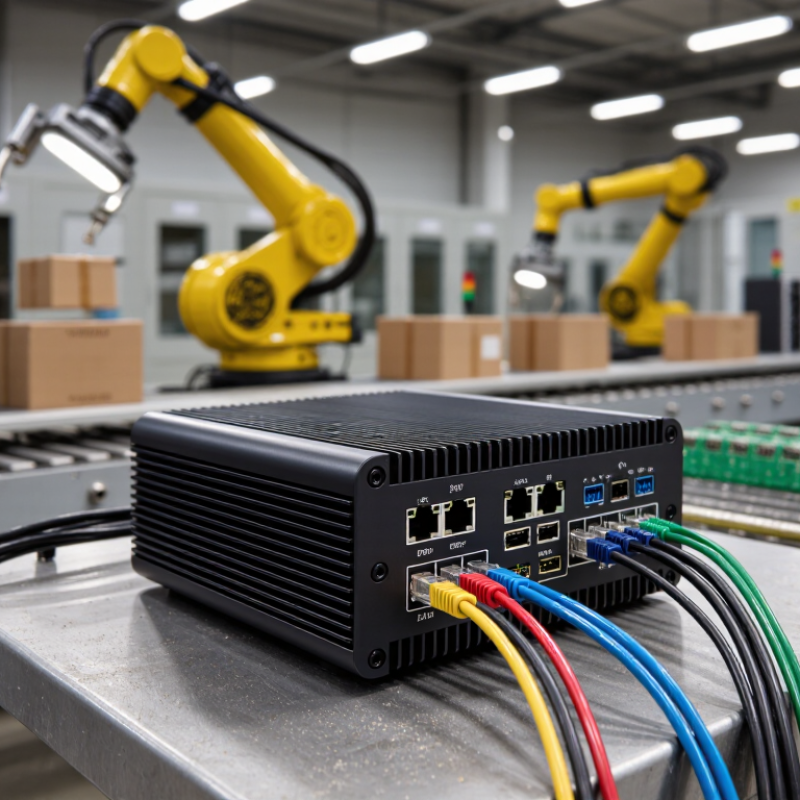
Table of Contents [Hide]
What Is an Embedded PC in Industrial Automation?
2026 Best Embedded PC for Industrial Automation?
What Is an Embedded PC in Industrial Automation?
An embedded PC is a compact computer built to control, monitor, and analyze industrial equipment. Unlike a standard office computer, it operates near machines and sensors. It may manage conveyor belts, robotic cells, inspection cameras, or temperature systems. These computers often use industrial processors, solid-state storage, and fanless cooling. Fewer moving parts can reduce dust-related failures.
In daily automation work, the embedded PC receives data from sensors and controllers. It then runs software, displays machine status, or sends commands through industrial communication protocols. Low-latency processing matters when a motor must stop within milliseconds. A durable enclosure also helps protect electronics from vibration, heat, and electrical noise. DIN-rail mounting can simplify cabinet installation.
Choosing one requires more than checking processor speed. Engineers should examine operating temperature, memory capacity, storage endurance, and expansion options. Serial ports, Ethernet interfaces, and digital I/O may be essential. Security features also deserve attention, including controlled access and secure system updates. In field deployments, I have seen overheating cause more trouble than slow processing. That lesson is easy to overlook. A larger heatsink may help, but it cannot fix poor cabinet ventilation. Long-term reliability depends on testing the complete system, not only the computer. Real production conditions can reveal weaknesses that laboratory tests miss.