- Home
- A-Z Catalogue
- Products
- Valves
- Cetop
- Manual Directional Valves
- Proportional Valves
- Poppet Valves
- High-Speed Linear Servo Valves
- All High-Speed Linear Servo Valves
- Cetop 10 (NG32) Two Stage Type High Speed Linear Servo Valves – LSVHG-10
- Cetop 10 (NG32) Two Stage Type High Speed Linear Servo Valves – LSVHG-10 (With Fail-Safe)
- Cetop 8 (NG25) Two Stage Type High Speed Linear Servo Valves – LSVHG-06
- Cetop 8 (NG25) Two Stage Type High Speed Linear Servo Valves – LSVHG-06 (With Fail-Safe)
- Cetop 7 (NG16) Two Stage Type High Speed Linear Servo Valves – LSVHG-04
- Cetop 7 (NG16) Two Stage Type High Speed Linear Servo Valves – LSVHG-04 (With Fail-Safe)
- Cetop 5 (NG10) Direct Type High Speed Linear Servo Valves – LSVG-03
- Cetop 5 (NG10) OBE Type Direct Operated Linear Servo Valves – LSVG-03-EH
- Cetop 3 (NG6) OBE Type Direct Operated Linear Servo Valves – LSVG-01-EH
- Pumps
- Pressure control
- Flow Control Valves
- Pressure Control Valves
- All Pressure Control Valves
- Brake Valves
- Direct Relief Valve
- Low Noise Solenoid Controlled Relief Valves
- Low Noise Pilot Operated Relief Valves
- Pilot Operated Relief Valves
- Pressure reducing and relieving valves
- Pressure reducing and check valves
- Pressure control valves
- Remote Control Relief Valves
- Solenoid Controlled Relief Valves – BSG
- Solenoid Controlled Relief Valves – BST
- Unloading relief valves
- Check valves
- Environmental
- Valves
- Hydraulic Systems
- Power pack
- About Us
- Contact
- Blog

2026 Best Aluminum Pipe Bending Machine for Sale
Choosing the right Aluminum Pipe Bending Machine starts with the work it must perform—not the largest capacity listed on a sales page. Pipe diameter, wall thickness, bend radius, material temper, and production volume all affect the result. A machine that handles a thick tube may still struggle to produce a clean, repeatable bend in thin-wall aluminum. Small differences matter.
This introduction uses an illustrative expert voice, not a verified quotation: “A good bend begins with the right tooling and a clearly defined part.” The fictional speaker, Alex Morgan, represents a common shop-floor perspective; this line should not be treated as a real person’s documented statement. In practice, experienced buyers check tooling compatibility, control options, repeatability, setup time, and after-sales support. They also ask for sample bends using material close to their own. A smooth curve is only part of the test. Watch for flattening, wrinkles, surface marks, and springback.
There is no universal best machine. For a small workshop, a compact manual or semi-automatic model may be sensible. A busy production line may need programmable controls and faster changeovers. Even then, specifications deserve scrutiny. Confirm what “maximum capacity” means, and request clear details about bend radius and tooling. This guide compares options for 2026, explains the features that influence real-world performance, and outlines questions to ask before purchasing. Use it as a starting point, not a substitute for a material-specific trial.
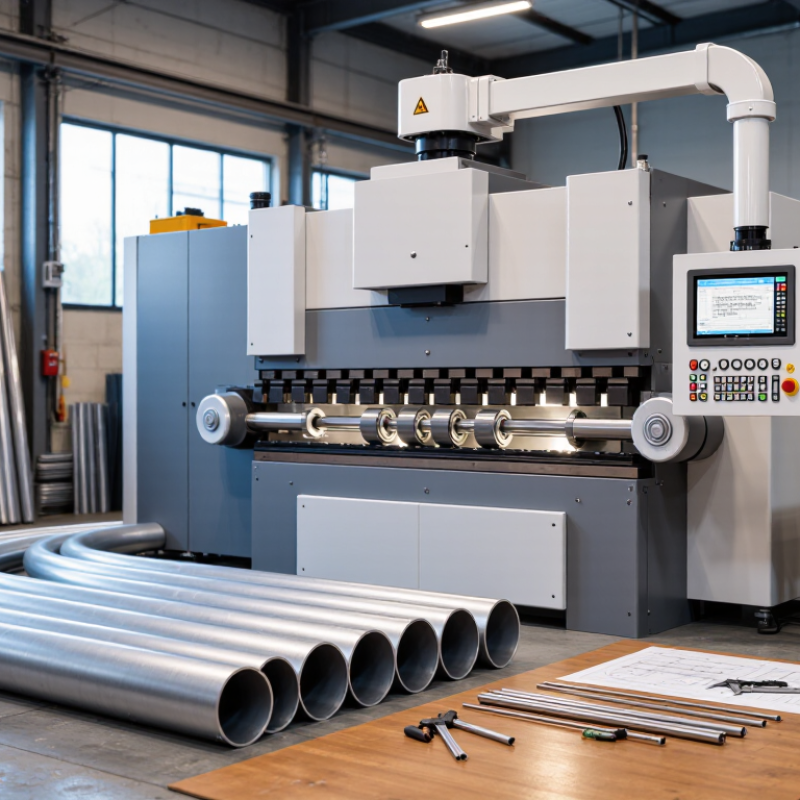
Table of Contents [Hide]
What Is an Aluminum Pipe Bending Machine?
An aluminum pipe bending machine shapes aluminum pipe or tubing into a planned curve without cutting it. It uses a motor, hydraulic system, or manual force to move the workpiece against a die. The die sets the bend radius, while clamps help hold the material steady. The aim is a smooth curve with minimal flattening, wrinkling, or surface damage.
Different machines suit different jobs. A rotary-draw bender pulls the pipe around a fixed form and can produce repeatable bends. A roll bender passes material through several rollers to create broad curves. Tight bends may need an internal mandrel to support the pipe wall. Not every setup needs one; wall thickness and bend radius matter.
Aluminum is relatively easy to form, but it can crease or spring back after bending. Operators should account for the alloy, temper, pipe diameter, and wall thickness. A short test bend helps reveal whether the angle or tooling needs adjustment. Small details matter. There is no perfect setup on paper; material batches can behave differently, so checking sample parts remains worthwhile. A machine’s capacity should match the actual pipe dimensions, not just the advertised maximum.